Copyright: Public domain
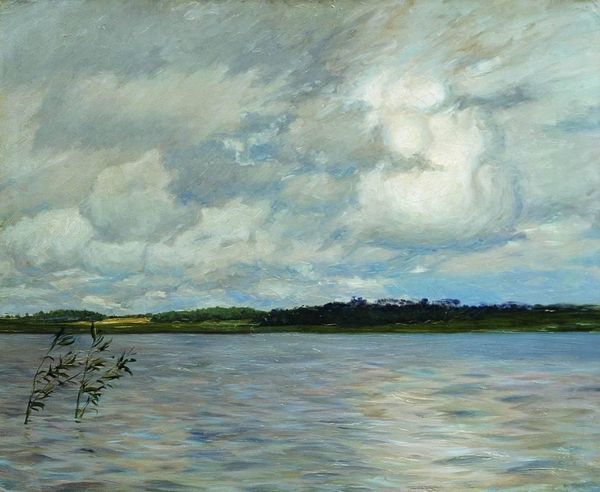
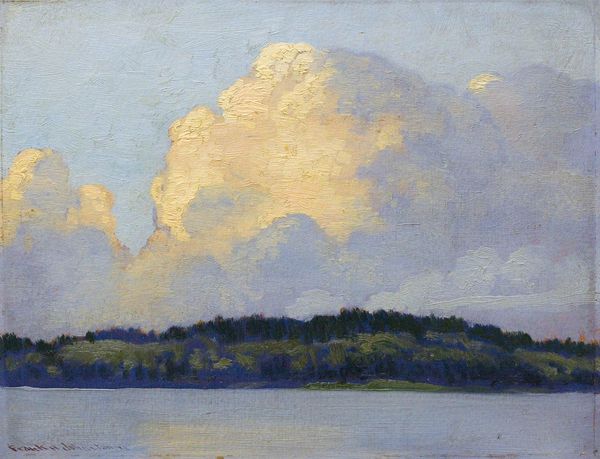
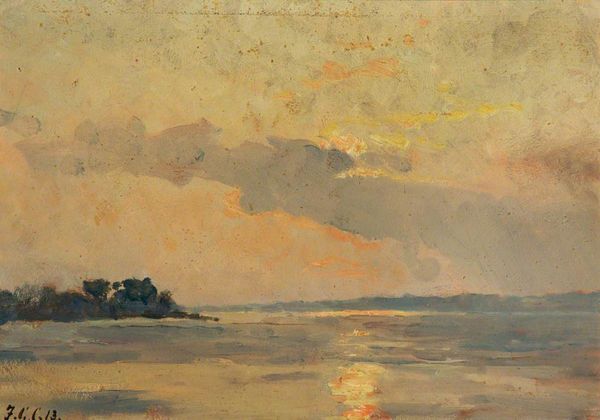
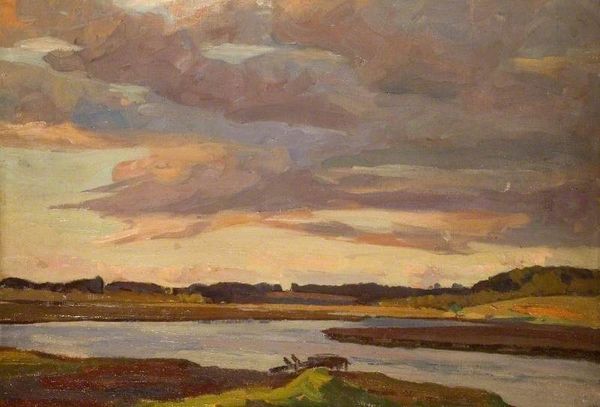
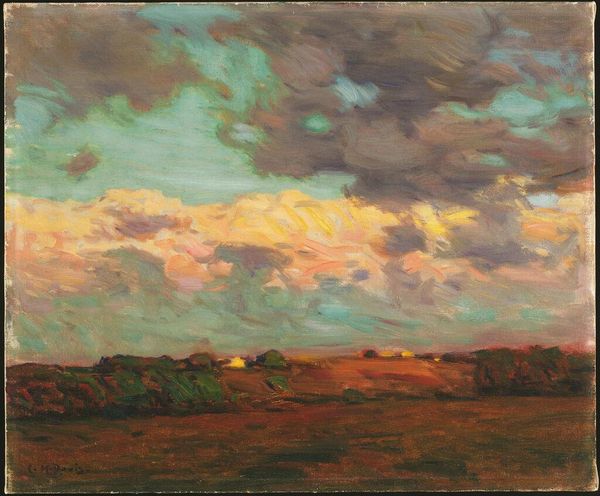
Curator: Alright, let’s spend a few minutes with Frank Johnston's "Serenity Lake of the Woods," painted in 1922. It's an oil on canvas. Quite lovely, isn’t it? Editor: It does draw you in. There's an incredible wash of light…like a hazy summer afternoon simmering over the water. The sky feels so vast, it almost threatens to overwhelm everything else. It's certainly not what I expected, serenity wise— there's an industrial hint on the horizon—which muddies it somewhat for me. Curator: That industrial presence does add a compelling tension, doesn’t it? A reminder of the encroachment of the modern world. Johnston was part of the Group of Seven, after all. Their landscapes are rarely just about pure, untouched nature. He captures light like a fever dream, all those swirling, broken brushstrokes giving movement and an ethereal glow. The atmospheric perspective flattens the forms. Do you see how it almost abstracts the islands into decorative shapes? Editor: I see what you mean, absolutely. But the colour palette feels a little limited. Yellows, greys and muted blues? Is there something about that? Almost an essay in tonal range, if you will? It reminds me of Whistler's nocturnes—there's that same focus on harmony, but somehow less emotive than it could be? Is he aiming for accuracy or an idea about natural serenity here? Curator: Interesting. For Johnston, light becomes form, and colour becomes mood. Maybe what reads as limited to you is actually the constraint allowing him to express something so subtle and sublime. As you observe, you’ll notice it's not just representational, it's about that feeling of being utterly still and connected to the vastness of nature. Think of the impressionists in their plein air style; capturing transient effects outdoors. In contrast Johnston has a deeper interest in how light behaves and effects. His handling feels both faithful and interpretive here—not easy in an en plain air. I feel an undercurrent that captures my interest. Editor: So it's less the actual landscape, and more how the light distorts it and reveals a specific kind of stillness? I do admire how those soft, blended edges create a kind of dreamlike haze—that helps generate some romantic qualities in contrast to the landscape. Maybe what I initially saw as a muted palette is a pathway into that very unique expression—to reflect and perhaps to invite me to observe his observations. I think that this needs more observation from my side, that's for sure! Curator: Exactly! There's an awful lot in those ‘quiet’ passages to explore further. Thank you for your insights; now lets walk to the next picture.
Comments
No comments
Be the first to comment and join the conversation on the ultimate creative platform.
 Collect
 React
React Comment
More like this