

n.d.
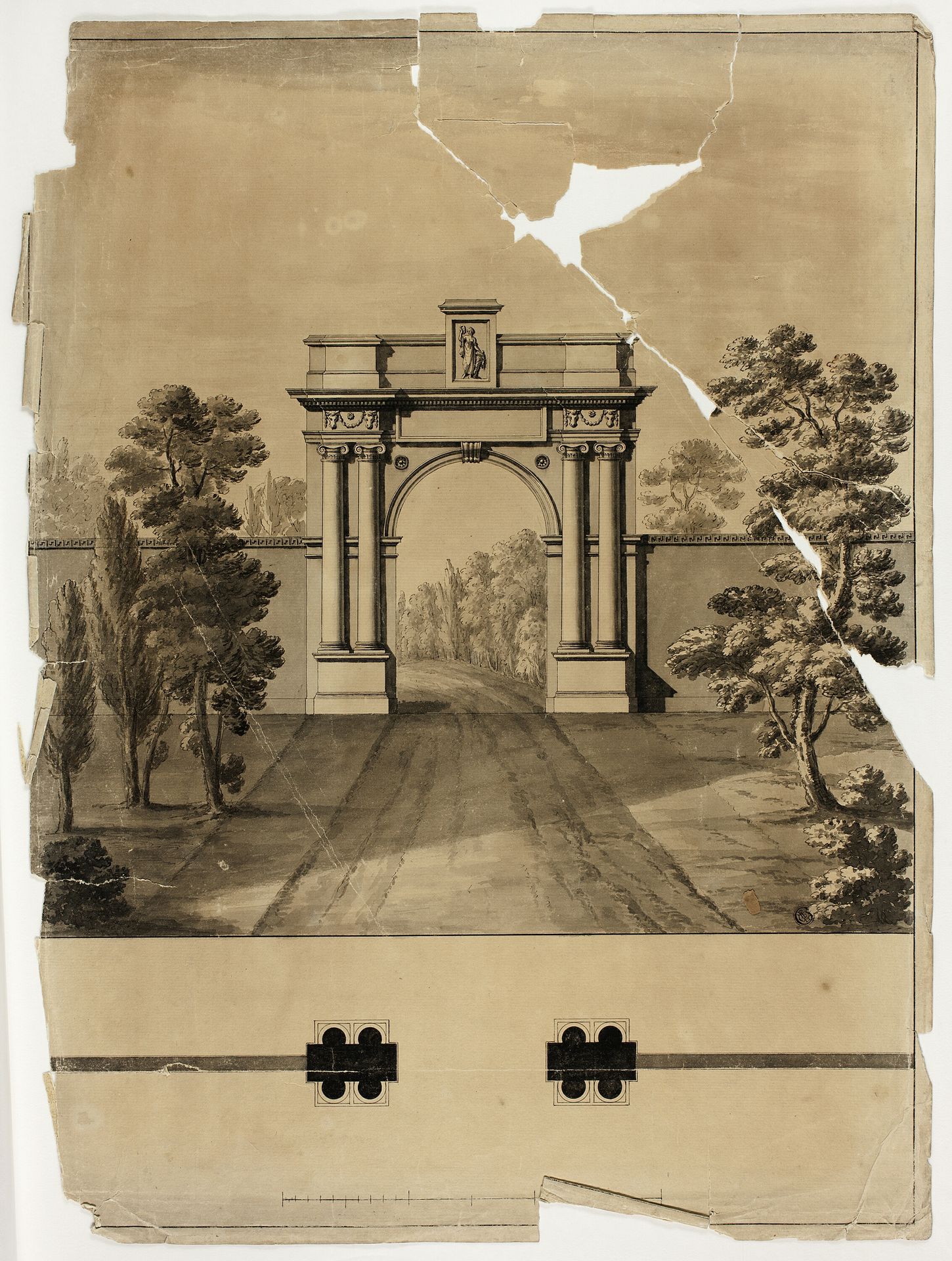
Monumental Entrance to Cemetery


Listen to curator's interpretation
Curatorial notes
Editor: This is James Malton's "Monumental Entrance to Cemetery," a drawing made with ink, pen, and paper, though the exact date is unknown. It evokes such a sense of stillness. The perfect symmetry and stark lines are almost unsettling. What do you see in this piece, especially considering its historical context? Curator: The grand Neoclassical architecture invites us to consider power, representation, and even class structures. Architecture, particularly in cemetery design, historically reinforced social hierarchies. Note how the monumentality dwarfs any human figure, seemingly suggesting both the individual's insignificance in the face of death and, perhaps, the enduring legacy of those interred. The very style itself evokes ancient empires and the patriarchy. What social narratives were being reinforced through this imagery, and whom did it exclude or silence? Editor: That's a perspective I hadn't fully considered. The idea that even in death, social hierarchies are maintained… it's quite sobering. So, the design itself becomes a symbol of power dynamics? Curator: Precisely. Think about the language of Neoclassicism itself – its emphasis on order, reason, and idealization. This wasn’t just an aesthetic choice; it reflected specific socio-political values, often those of the ruling class. The image presents an ordered and rational transition. Who gets to have this "order" imposed on their afterlife? Whose narrative is privileged, and whose is erased in this visualization of death? What about gender? What female figure do you see portrayed here, or represented? Editor: I hadn't noticed that. I mean, death is obviously universal, yet the visual language here speaks more to certain societal demographics and ideologies. The focus is so directed, but exclusionary at the same time. It's designed in a way that obscures. Curator: Yes. Now, consider how later, more 'democratic' or 'egalitarian' movements in cemetery design directly challenged this kind of imposing monumentality. This artwork is one example out of countless. How have other architects confronted these narratives? And which continue to perpetuate the old ones? Editor: Wow, I'm definitely going to be looking at these kinds of images differently now! I hadn’t really focused on the power and political dynamics that are embedded in Neoclassical art. It's certainly made me realize that it's imperative to question these supposed visual truths, and unpack the histories embedded within seemingly "classic" forms. Curator: And that's just the start. Never accept anything at face value; that's our job as students of art history. Keep asking critical questions, and challenging those assumptions!