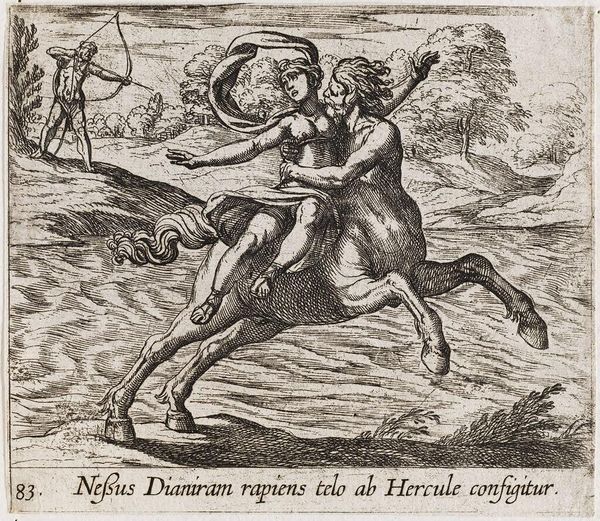
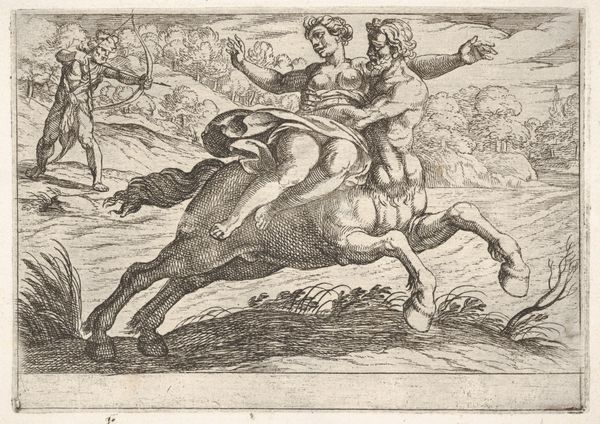
Plate 83: Nessus Attempting to Take Dejanera from Hercules (Neßus Dianiram rapiens telo ab Hercule configitur), from Ovid's 'Metamorphoses' 1606
0:00
0:00


drawing, print, engraving
#
drawing
#
baroque
# print
#
landscape
#
figuration
#
men
#
history-painting
#
engraving
Dimensions: Sheet: 4 1/8 × 4 5/8 in. (10.4 × 11.7 cm)
Copyright: Public Domain
Editor: This is Antonio Tempesta's "Plate 83: Nessus Attempting to Take Dejanera from Hercules," an engraving from 1606. It’s incredibly dynamic, wouldn't you say? There's such clear tension between the figures. How do you interpret this work? Curator: Indeed. What strikes me is how Tempesta visualizes the power dynamics embedded within this mythological scene. Think about it: we have Nessus, a centaur, abducting Dejanera, while Hercules stands in the background, bow drawn. The image reflects not just a physical struggle but a power struggle deeply entrenched in issues of consent and male dominance, something incredibly relevant even today. Editor: So, you see the engraving as more than just a depiction of a mythological event? Curator: Absolutely. Nessus’s attempted abduction can be seen as a symbol of male aggression and entitlement. Dejanera, caught in the middle, embodies a certain vulnerability. The gaze she directs toward Hercules feels like a cry for justice. And Hercules, while poised to rescue her, represents the patriarchal system promising protection, but arriving late. Doesn't the whole scene expose a societal problem rather than celebrate a heroic resolution? Editor: That’s a really powerful interpretation. I hadn’t considered the deeper implications about the dynamics of power at play. It makes the scene even more disturbing, yet also more thought-provoking. Curator: Exactly! It encourages us to consider whose stories get told, and how. This isn’t just a historical image; it's a visual text that challenges us to confront uncomfortable truths about gender, power, and violence. Editor: Thank you. Now when I look at it, I will never see the artwork in the same light. Curator: Excellent! This shows us how Baroque art often served as a powerful tool to explore cultural beliefs and hidden tensions.
Comments
No comments
Be the first to comment and join the conversation on the ultimate creative platform.
 Collect
 React
React Comment
More like this