

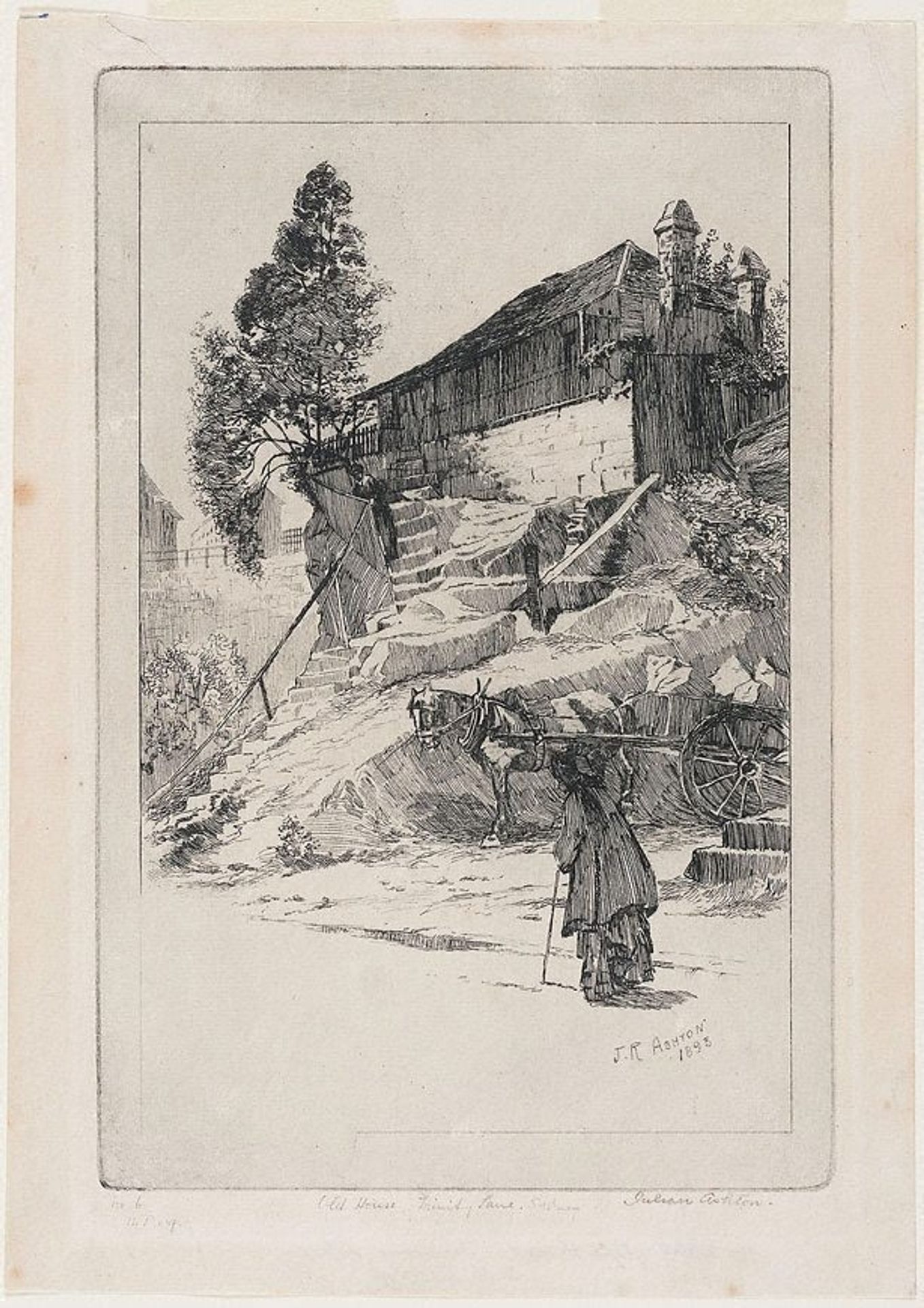
1893
Old house, Trinity Lane, Sydney

Listen to curator's interpretation
Curatorial notes
Curator: Gosh, looking at Julian Ashton's etching "Old House, Trinity Lane, Sydney" from 1893, I’m just immediately drawn into this scene—it’s got this gentle melancholy hanging in the air like morning mist. The muted palette really pulls you in, doesn’t it? Editor: Absolutely. Ashton gives us a window into a bygone era. You see the textures rendered by the etching, it feels gritty and very, very real. We're invited to think about urban development, how progress impacts working-class neighborhoods, and the social fabric being rewoven with each new building. Curator: Totally, it's more than just bricks and mortar; it's about memory, displacement, and maybe a little bit of defiance too, wouldn't you say? Editor: Definitely a sense of defiance! That woman in the foreground, leaning on her walking stick. The scene reads to me not only as realism but a form of social commentary that hints at the precarious position of marginalized people. We’re encouraged to remember Trinity Lane isn't just some forgotten street—it’s the backdrop to peoples lives and a visual record of inequality. Curator: Her resilience echoes in the tough angles of those old stone steps leading up to the house. There's also a certain, let’s call it, dignified charm in decay... Ashton really captures this juxtaposition. Editor: And I think Ashton’s commitment to representing these places is a vital intervention to highlight the inequalities within the cityspace. The lone figure emphasizes the lack of agency available to some communities who are often bypassed in favor of newer buildings. Curator: I think there’s a quiet beauty in observing this ordinary scene that allows you to connect in the moment, you know? I like the artist’s quiet commitment to recording and interpreting these moments in history. Editor: Well, I suppose, for me, this work provides a space to contemplate broader issues relating to urban marginalization—particularly with respect to gender, race, and class. Curator: Yes, but isn't it wonderful that art can provide space for contemplation? Editor: I couldn't agree more. It's vital that conversations around social inequality continue, especially with works like these serving as historical prompts.