

n.d.
Book Illustration


Listen to curator's interpretation
Curatorial notes
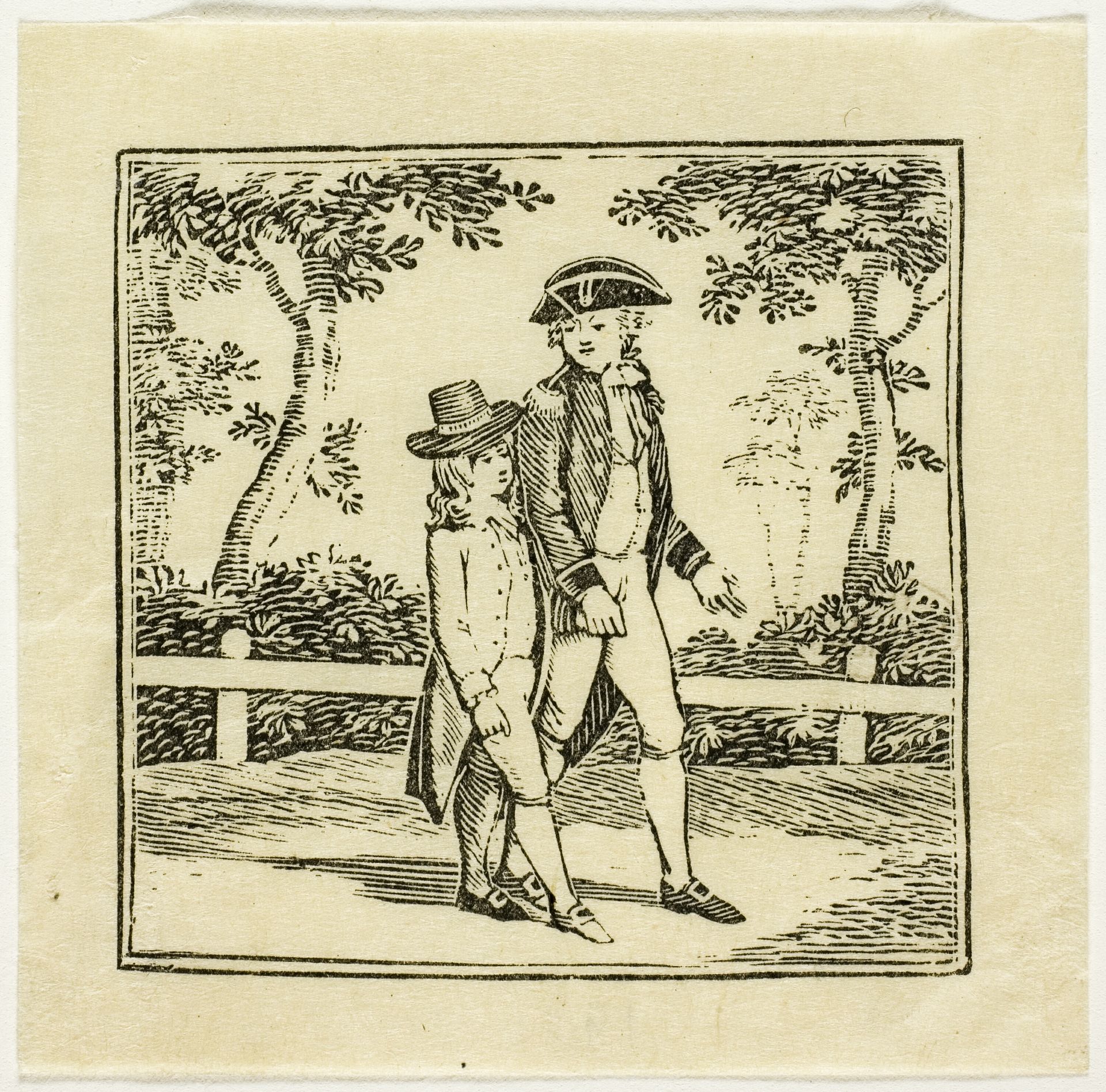
Curator: This small, square work is simply titled "Book Illustration" by Thomas Bewick. It is rendered in ink on paper using engraving. What are your initial thoughts on it? Editor: I’m struck by the formality despite the diminutive scale. The black lines are very crisp, but I immediately perceive something familial—perhaps the dawn of class structure portrayed through dress, gesture, and spatial positioning. Curator: It's compelling how such detail could be achieved through such a labor-intensive method. The printmaking process itself speaks to notions of accessibility and value. It democratized images for consumption. But before we delve into the technique, can you expand on what specific visual cues suggest class and formality to you? Editor: Certainly. The taller figure's powdered wig, tricorn hat, and long coat read as markers of affluence from a very specific era. The shorter figure seems to echo similar tailoring at a miniature level, but lacking those overt symbols. Together their stride appears like a symbolic rite of passage, from youth to adulthood, and likely, servitude. The landscape also projects power – they control the scene rather than appear part of nature. Curator: It’s astute of you to note the balance between artifice and the “natural” world, rendered entirely through constructed line work. Considering Bewick’s position as a naturalist, and a reformer interested in illustrating working-class life, could the landscape’s apparent control over natural shapes suggest a broader critique of societal structures? Editor: Possibly. Looking again, the somewhat awkward anatomy and almost caricature-like quality of the figures do perhaps undermine the formality I first perceived. Their confident procession appears subtly destabilized. And there's something interesting in the very plainness of the clothes themselves, lacking true grandeur—like their status has been thrust on them, which maybe is emphasized by the linear forms that build their features.. Curator: Absolutely. Furthermore, given the medium is print and made for books, consider its function. It’s not merely an artwork, but one part of a system that can create and shape minds. So by analyzing the style, production and dissemination methods, one might unearth larger systems and conditions. Editor: True, this illustration contains an ecosystem of inherited beliefs contained by form. Considering the power that is concentrated through symbolic portraiture here and spread wide through printed forms opens new pathways of interpreting images, wouldn’t you agree? Curator: Indeed, what started as a small observation opens into layers of economic structures, symbolist meanings and, as such, can now provide a basis of new observations regarding artistic expression and its dissemination. Thank you for this eye-opening discussion.