

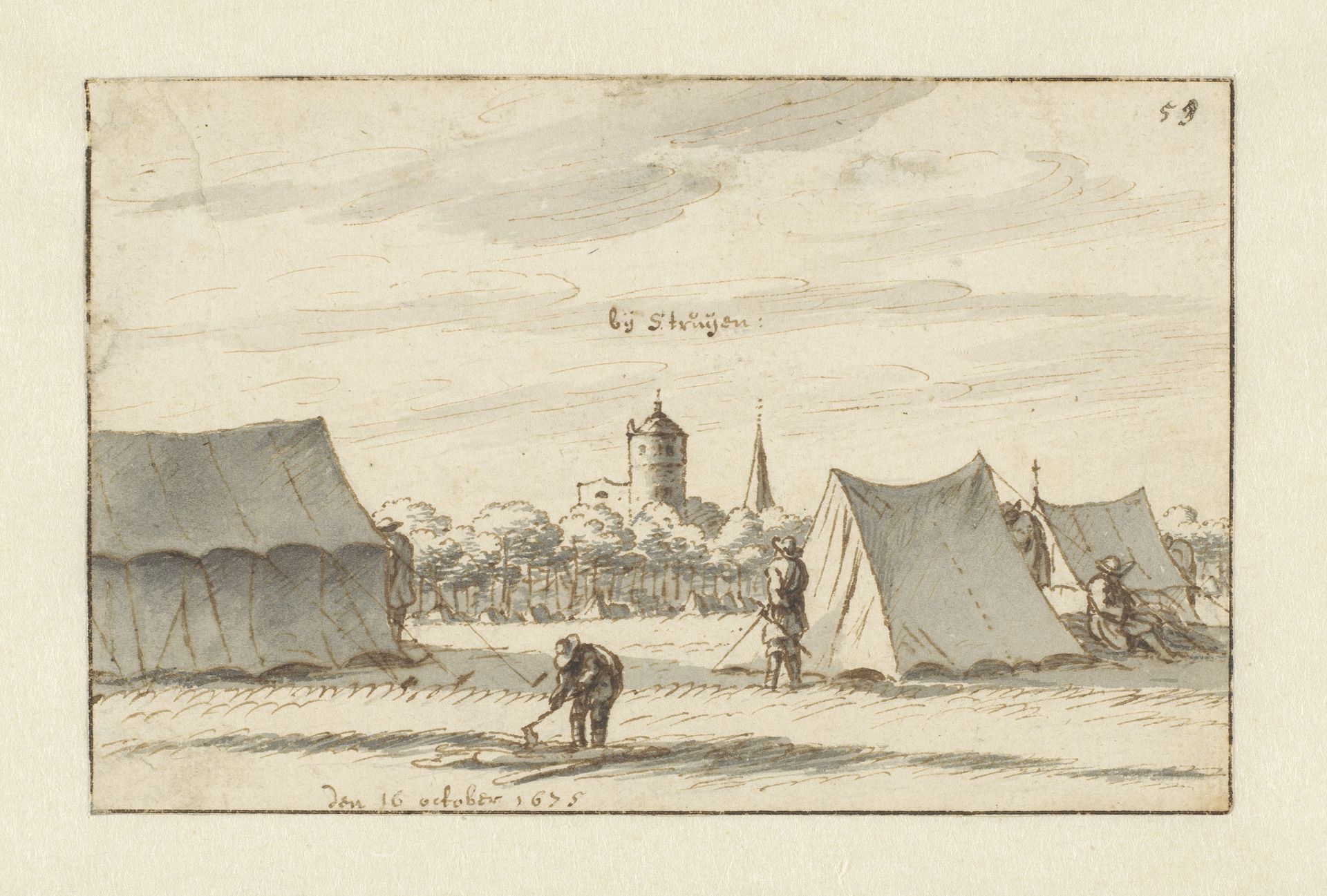
Possibly 1675
Encampment of the Army of Willem III near Sint-Truiden, Limburg

Listen to curator's interpretation
Curatorial notes
Curator: Here we have "Encampment of the Army of Willem III near Sint-Truiden, Limburg," a drawing possibly from 1675 by Barend Klotz. It’s rendered in pencil and ink on paper. Editor: My initial impression is that there’s a sense of quiet anticipation. It feels less like a bustling military camp and more like a pause, a moment to catch breath. Curator: The symbolism is intriguing. The tents, temporary shelters, suggest a transient existence, yet the soldiers are grounded, engaged in labor. What kind of work might they be doing, I wonder, in this period of upheaval? Editor: This makes me consider the socio-political climate. The late 17th century saw frequent conflicts and shifts in power. The encampment becomes a potent symbol of ongoing war, an embodiment of constant disruption to land and life. What was Willem III's strategy to engage and rally different identities to support war, can this drawing show us what different segments of the population did during this conflict? Curator: Indeed. Consider the town in the background, "By Struijen" is inscribed near the top of the paper, offering the church steeple behind the trees, and a point of visual contrast, reminding us of the society they're supposedly protecting or disrupting, depending on your perspective. The composition almost divides the temporal from the timeless. Editor: This distinction complicates my initial read of 'quiet anticipation', doesn’t it? Because within this 'moment of rest', those steeple shapes loom with the possibility of more aggression and suffering for the very communities those structures inhabit. Curator: The aged paper enhances the narrative, lending it an aura of historical weight. It’s like looking at a scene from a long-forgotten play. Editor: Yes, and the realism grounds us in the materiality of conflict. We must question whether this “realism” actually highlights war's toll. If Klotz created more "honest" representations about people, places, and nature as a means to advance cultural and political reform. This drawing allows us to remember war is also an event and a performance as well. Curator: Reflecting on this piece, I see how it captures the delicate balance between the temporary and the enduring. A moment in a grand narrative that, like those distant church steeples, reverberates through the ages. Editor: For me, the drawing reinforces the importance of examining the ethics of art itself: how artists represent events and figures. If we examine them more carefully we will gain new understandings about that society, culture, and political struggles that surround that culture during this artist’s lifetime.