About this artwork
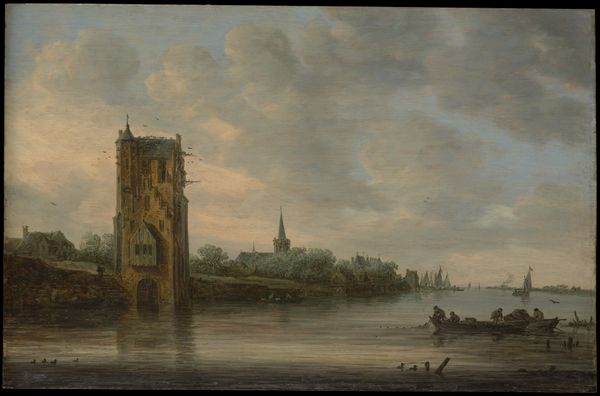
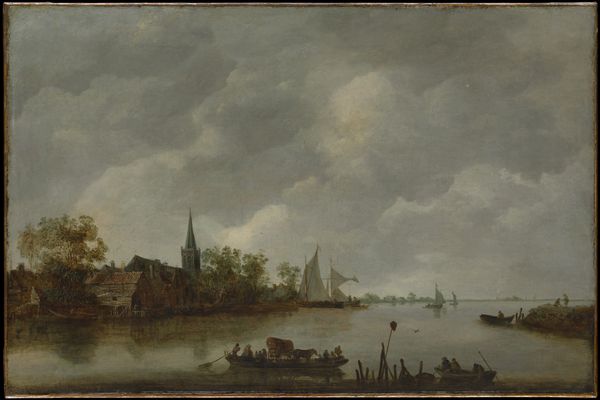
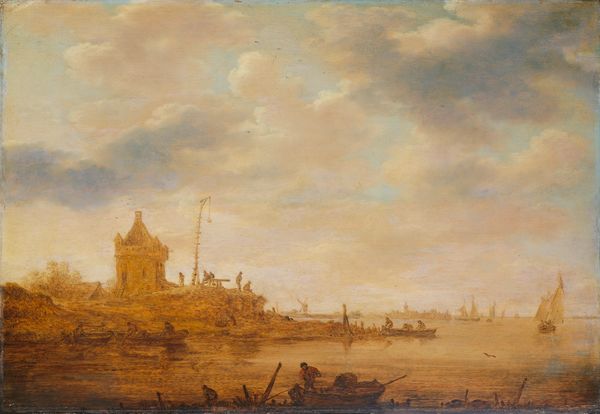
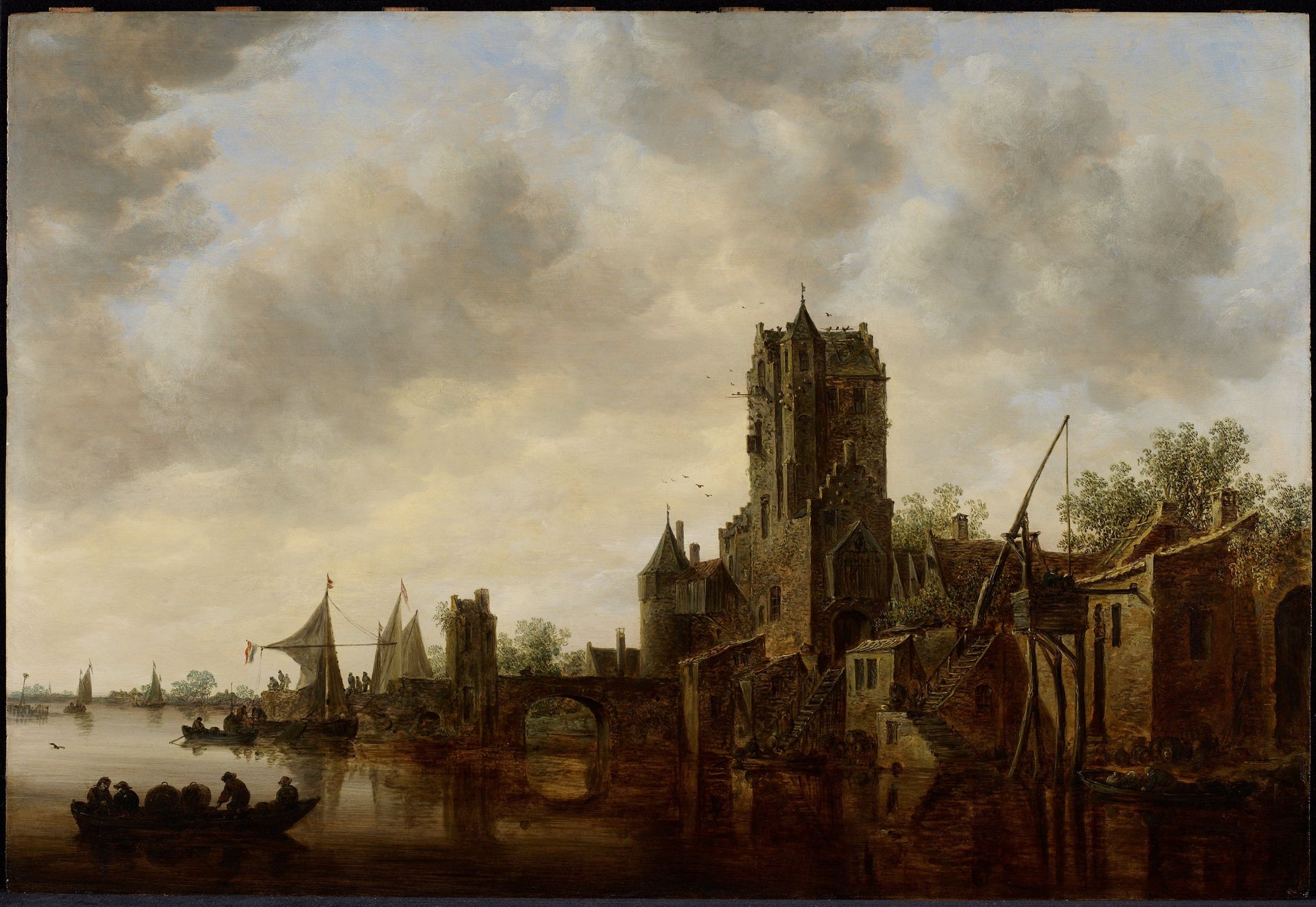
Editor: Here we have Jan van Goyen’s "River Landscape with the Pellecussen Gate near Utrecht," painted in 1648, using oil on canvas. There's such a muted palette; it feels very tranquil, almost melancholic, with that expansive sky. What do you see when you look at it? Curator: Immediately, I’m drawn to the masterful use of tonal variation. Observe how van Goyen employs a limited range of browns, grays, and ochres to create depth and atmosphere. The composition is skillfully constructed with a low horizon line, emphasizing the sky and its interaction with the water. Notice how the verticality of the gate is mirrored in the reflections, creating a powerful visual rhyme. How does that resonance between form and reflection affect your interpretation? Editor: I think it makes it more… grounded, somehow. Despite the expanse, it feels anchored. So, you are suggesting that his careful mirroring of shapes reinforces the stability of the painting’s structure? Curator: Precisely. The structural elements create a delicate balance. And, if we consider the paint application, the visible brushstrokes lend texture and vitality to the scene. It is almost as though you can feel the wind on the water. Editor: I see what you mean! The rough texture in the sky contrasts with the smoother water, giving a sense of movement. I hadn't noticed that before. Thank you! Curator: A pleasure. Focusing on these intrinsic formal qualities allows us to appreciate the painting’s inherent beauty and sophistication, beyond any narrative context. Editor: I'm beginning to notice more subtleties in its construction that were hidden at first glance. That was helpful!
River Landscape with the Pellecussen Gate near Utrecht
1648


Artwork details
- Medium
- painting, oil-paint
- Dimensions
- 25 1/4 x 37 in. (64.14 x 93.98 cm) (panel)25 7/8 x 38 1/4 in. (65.72 x 97.16 cm) (sight)36 1/16 x 48 1/2 x 3 1/4 in. (91.6 x 123.19 x 8.26 cm) (outer frame)
- Location
- Minneapolis Institute of Art
- Copyright
- Public Domain
Tags
Comments

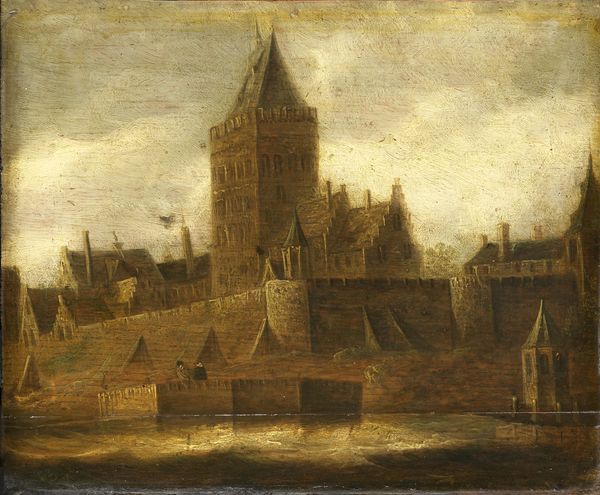
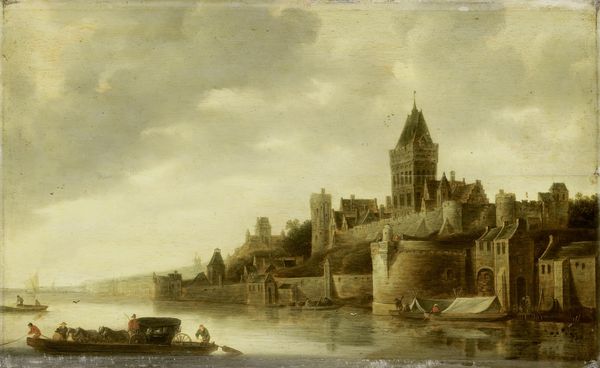
This river landscape illustrates the ambivalence of 17th-century Dutch realism, in which artists often depicted actual buildings and sites in otherwise imaginary compositions. The Pellecussen Gate shown here was a medieval tower guarding the towpath along the River Vecht between Utrecht and the village of Oud Zuilens, north of the city. But Jan van Goyen places it in an invented river town. In fact, van Goyen depicted the distinctive tower at least 12 times between 1640 and 1655, always in completely fanciful settings.
About this artwork
Editor: Here we have Jan van Goyen’s "River Landscape with the Pellecussen Gate near Utrecht," painted in 1648, using oil on canvas. There's such a muted palette; it feels very tranquil, almost melancholic, with that expansive sky. What do you see when you look at it? Curator: Immediately, I’m drawn to the masterful use of tonal variation. Observe how van Goyen employs a limited range of browns, grays, and ochres to create depth and atmosphere. The composition is skillfully constructed with a low horizon line, emphasizing the sky and its interaction with the water. Notice how the verticality of the gate is mirrored in the reflections, creating a powerful visual rhyme. How does that resonance between form and reflection affect your interpretation? Editor: I think it makes it more… grounded, somehow. Despite the expanse, it feels anchored. So, you are suggesting that his careful mirroring of shapes reinforces the stability of the painting’s structure? Curator: Precisely. The structural elements create a delicate balance. And, if we consider the paint application, the visible brushstrokes lend texture and vitality to the scene. It is almost as though you can feel the wind on the water. Editor: I see what you mean! The rough texture in the sky contrasts with the smoother water, giving a sense of movement. I hadn't noticed that before. Thank you! Curator: A pleasure. Focusing on these intrinsic formal qualities allows us to appreciate the painting’s inherent beauty and sophistication, beyond any narrative context. Editor: I'm beginning to notice more subtleties in its construction that were hidden at first glance. That was helpful!
Comments
This river landscape illustrates the ambivalence of 17th-century Dutch realism, in which artists often depicted actual buildings and sites in otherwise imaginary compositions. The Pellecussen Gate shown here was a medieval tower guarding the towpath along the River Vecht between Utrecht and the village of Oud Zuilens, north of the city. But Jan van Goyen places it in an invented river town. In fact, van Goyen depicted the distinctive tower at least 12 times between 1640 and 1655, always in completely fanciful settings.