

About this artwork
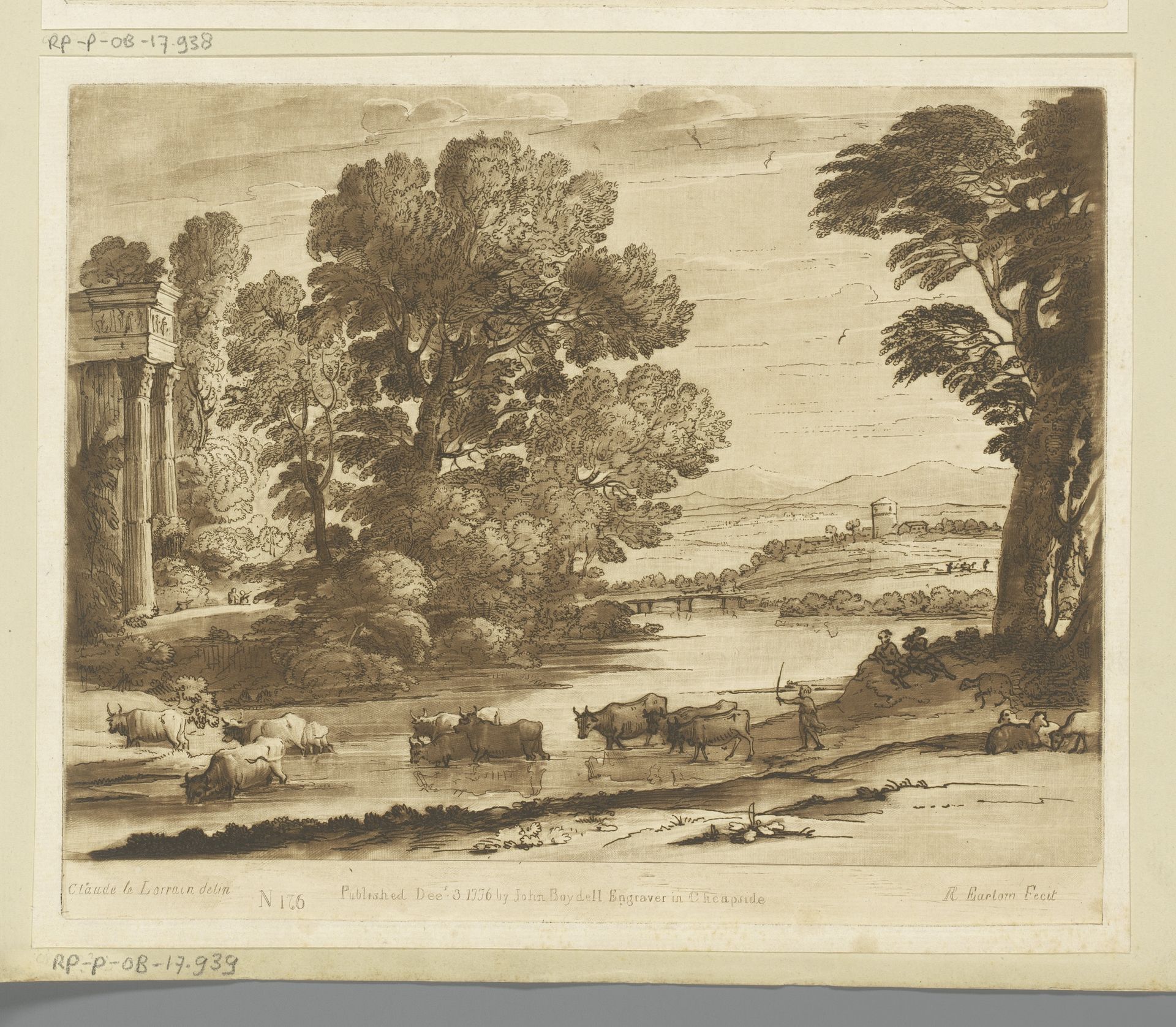
Richard Earlom created this sepia-toned print, "Landschap met ruïne en vee dat een rivier oversteekt," using etching and engraving techniques. The monochrome palette focuses our attention on the interplay of light and shadow, creating depth and atmosphere. Earlom’s print invites us to consider how its composition directs our gaze. The ruined structure on the left balances the dense trees on the right, framing a river crossing. The composition directs our eyes from the foreground of cattle wading through the river to the distant hills. The landscape is not merely a backdrop but an active participant in conveying meaning. The print functions as a semiotic system, a series of signs that invite interpretation. The ruin, the trees, the river and the cattle are not just representational elements but signs loaded with cultural and historical meanings. Earlom masterfully employs formal elements to invite us into a dialogue with the artwork. The romantic allure of ruins and nature as a space for contemplation is an ongoing conversation through visual art.
Landschap met ruïne en vee dat een rivier oversteekt
Possibly 1776

Richard Earlom
1743 - 1822Location
RijksmuseumArtwork details
- Medium
- print, etching, engraving
- Dimensions
- height 208 mm, width 258 mm
- Location
- Rijksmuseum
- Copyright
- Rijks Museum: Open Domain
Tags
etching
landscape
classical-realism
engraving
Comments
Be the first to share your thoughts about this work.
About this artwork
Richard Earlom created this sepia-toned print, "Landschap met ruïne en vee dat een rivier oversteekt," using etching and engraving techniques. The monochrome palette focuses our attention on the interplay of light and shadow, creating depth and atmosphere. Earlom’s print invites us to consider how its composition directs our gaze. The ruined structure on the left balances the dense trees on the right, framing a river crossing. The composition directs our eyes from the foreground of cattle wading through the river to the distant hills. The landscape is not merely a backdrop but an active participant in conveying meaning. The print functions as a semiotic system, a series of signs that invite interpretation. The ruin, the trees, the river and the cattle are not just representational elements but signs loaded with cultural and historical meanings. Earlom masterfully employs formal elements to invite us into a dialogue with the artwork. The romantic allure of ruins and nature as a space for contemplation is an ongoing conversation through visual art.
Comments
Be the first to share your thoughts about this work.