Dimensions: sight: 20.8 x 15.3 cm (8 3/16 x 6 in.) framed: 46.2 x 38.2 x 2 cm (18 3/16 x 15 1/16 x 13/16 in.)
Copyright: CC0 1.0
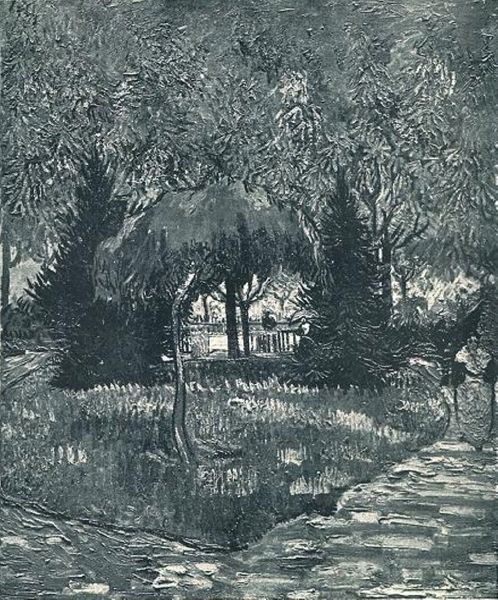
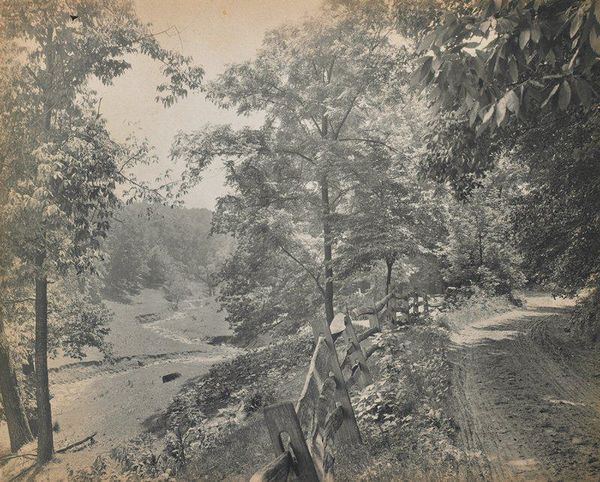
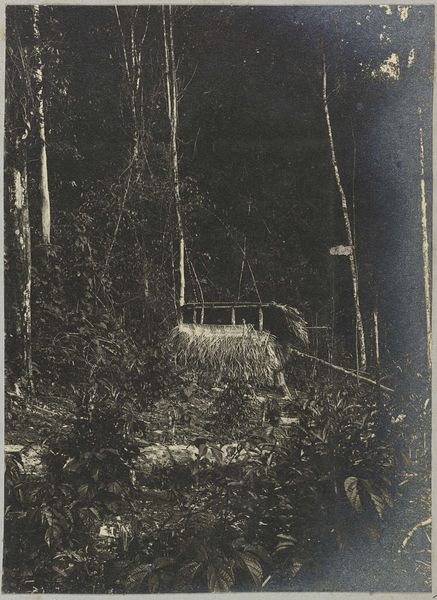
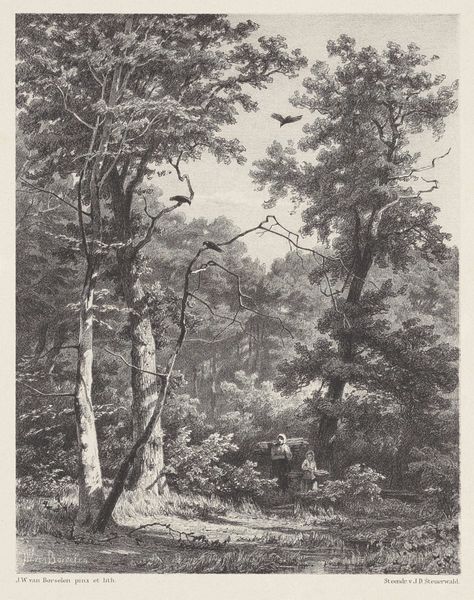
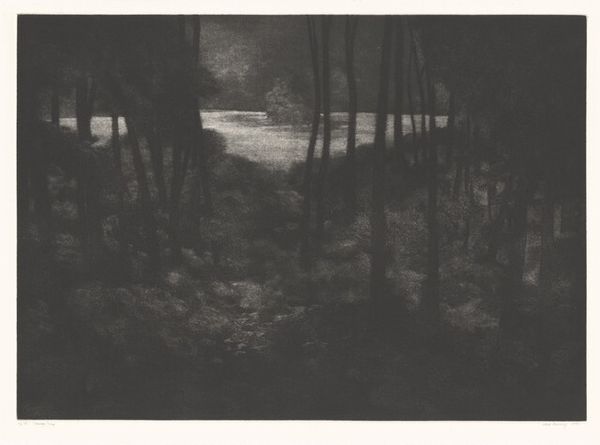
Curator: Welcome. Before us is Denman Waldo Ross's "Wooded Grove," currently residing here at the Harvard Art Museums. Editor: This small painting emits an almost primordial gloom; its stark monochromatic palette creates an atmosphere of profound stillness. Curator: The limited palette certainly directs our gaze. The fence, for instance, separating the foreground from the deeper woods, suggests a boundary, a transition between states of being. It evokes a sense of the liminal. Editor: Indeed, and note how the artist uses variations in texture to define space. The foreground is loose, almost abstract, while the trees possess a stark linearity, contrasting the organic and the geometric, nature, and... well, civilization, if we can call a rudimentary fence such a thing. Curator: Ross, deeply influenced by Eastern art and philosophy, may have sought to express the underlying unity between these apparent opposites. The dark forest as a source of both fear and renewal is a recurring motif. Editor: Perhaps. Or it’s simply a study in tonal relationships, pushing the limits of value to achieve a kind of visual quietude. Curator: Ultimately, it’s a dialogue, I think, between the visible and the unseen. Editor: A somber, beautiful one.
Comments
No comments
Be the first to comment and join the conversation on the ultimate creative platform.
 Collect
 React
React Comment
More like this