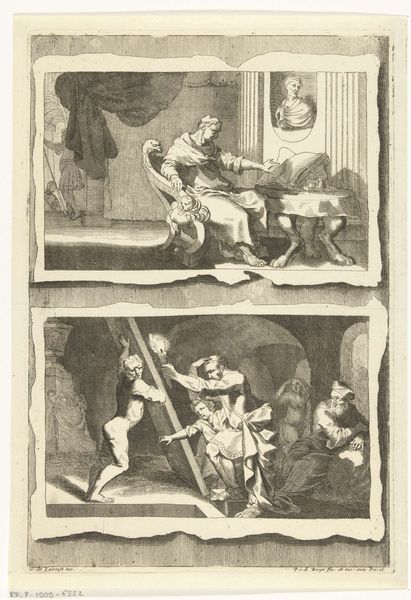
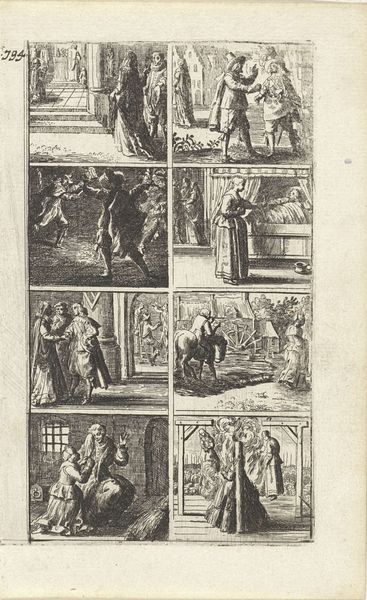
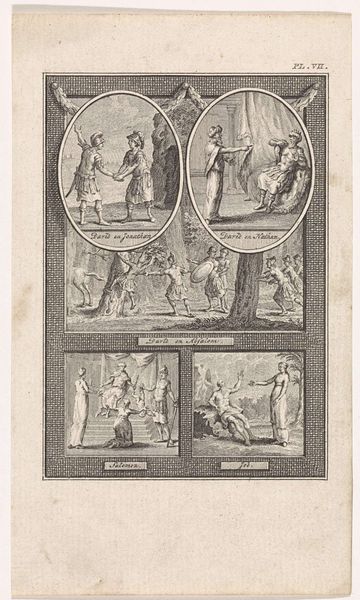
Scenes from "El ingenioso hidalgo Don Quijote de la Mancha" by Miguel de Cervantes Saavedra 1808 - 1818


print, textile, sculpture
toned paper
narrative-art
landscape
textile
house
figuration
coloured pencil
sculpture
romanticism
horse
men
decorative-art
Dimensions: Overall: 47 x 31 3/4 in. (119.4 x 80.6 cm)
Copyright: Public Domain
Editor: So, here we have "Scenes from 'El ingenioso hidalgo Don Quijote de la Mancha' by Miguel de Cervantes Saavedra," created sometime between 1808 and 1818 by François Joseph Heim. It's currently at the Metropolitan Museum of Art, but it’s…fabric! It feels so odd to see scenes from such a famous book on textile. What jumps out to you? Curator: The shift from painting to textile production is incredibly significant. Rather than being hung on a wall in a private home, this becomes something functional, circulated and consumed within daily life. It’s fascinating to consider how this impacts the narratives depicted. It is not “high art,” instead becomes domesticated and commodified. Editor: That makes sense! So it’s not just about *what* is shown but *how* it’s made and where it ends up? Does this change the way stories were traditionally received? Curator: Exactly! Before the rise of mass media, textiles often served as a primary method for distributing visual narratives, albeit at a cost. These images, now part of clothing or furnishings, engage a very different audience and have a different social value. Considering that "Don Quixote" lampoons aristocratic ideals, does this fabric serve a satirical function within a bourgeois home? Editor: So interesting to think of a piece of literature working through the production and consumption of decorative objects. Curator: Yes, by focusing on the material and its social life, we can move beyond interpreting symbolic meaning of figures or landscape to understand the economic context that made this work possible. Editor: It's amazing to realize how the story shifts so fundamentally based on how it’s produced and consumed. I’ll definitely be paying more attention to material choices now. Curator: And to the social implications inherent in those choices, which really shape meaning!
Comments
No comments
Be the first to comment and join the conversation on the ultimate creative platform.
 React
React Comment