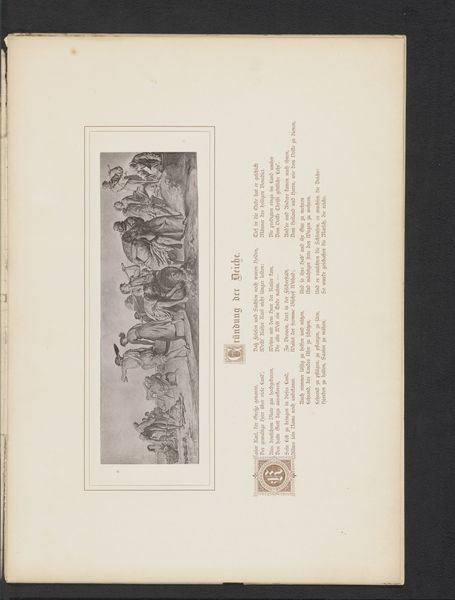
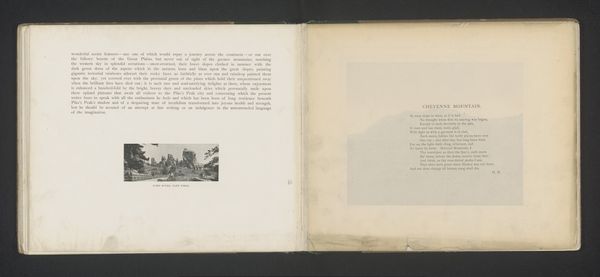
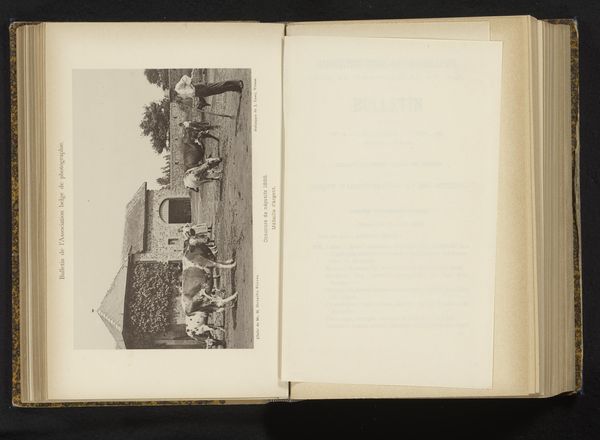
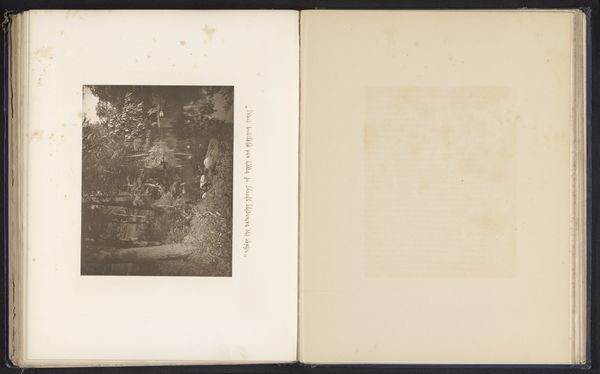
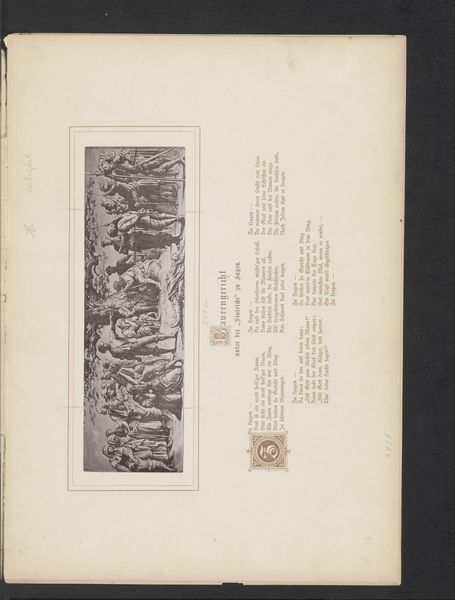
Reproductie van een schilderij van boeren en koeien bij een landweg Heinrich von Dörnberg before 1881
0:00
0:00

print, engraving
# print
#
landscape
#
genre-painting
#
engraving
Dimensions: height 80 mm, width 263 mm
Copyright: Rijks Museum: Open Domain
Editor: So this is a reproduction, a print - more specifically an engraving - of a painting called 'Reproductie van een schilderij van boeren en koeien bij een landweg' by Heinrich von Dörnberg, made sometime before 1881. It depicts a very tranquil rural scene with peasants and their livestock. What do you make of it? Curator: What strikes me is the very construction of this image. The print places an aestheticised, idyllic vision of rural life—genre painting, as they call it—within a textual frame. Look how the poem accompanies the image. Do you think that is accidental? Editor: No, I suspect that’s deliberate, but I’m not entirely sure why. Curator: Consider how these images circulated and what role these mass-produced reproductions played in constructing ideas about nationhood, class, and labour. Editor: So you mean this kind of image naturalizes the idea of an organic German landscape as essential for German national identity? Curator: Precisely! It presents a harmonious, pre-industrial, even *moral* vision of agricultural labor at a time when Germany was rapidly industrializing. Consider the appeal of such imagery. What needs does this fill in society? Editor: It's interesting how it romanticizes a hard way of life, creating a comforting contrast to the anxieties of a changing world. Curator: Exactly. It reveals a carefully constructed relationship between image and text to advance particular notions. I wonder how the audiences at the time might interpret the scene and interact with such artworks! Editor: That is a perspective I had not previously considered. Now I realize the engraving carries complex messages beyond its face value, highlighting the social tensions and yearnings of its time. Thanks!
Comments
No comments
Be the first to comment and join the conversation on the ultimate creative platform.
 Collect
 React
React Comment
More like this