About this artwork
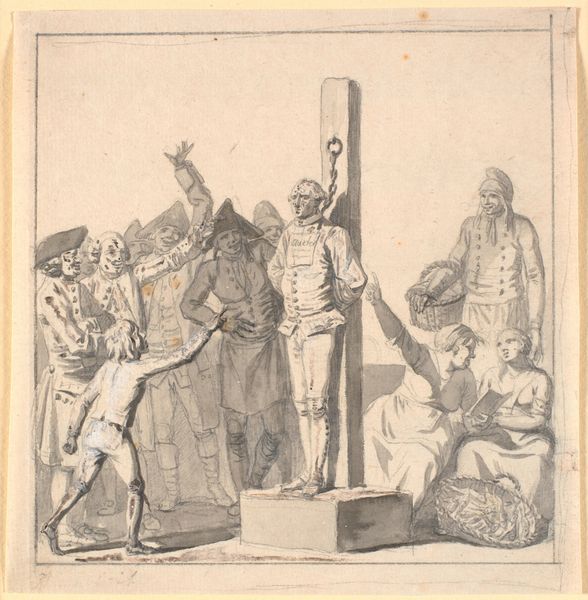
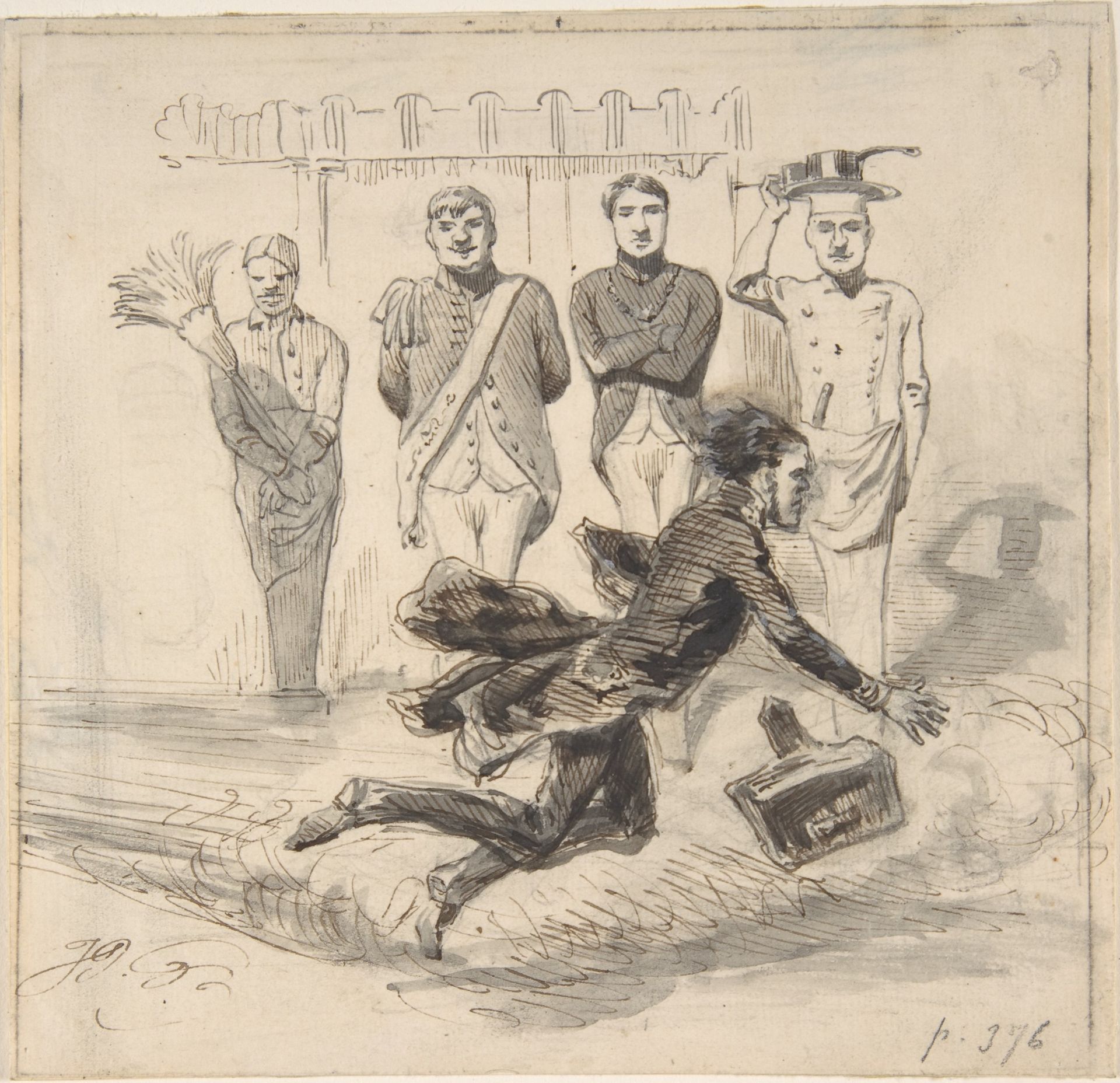
This ink illustration made in 1846 by J. J. Grandville, comes from Louis Reybaud’s novel, "Jérôme Paturot." It encapsulates the social and political anxieties of post-revolutionary France. Grandville satirizes the bourgeois aspirations of individuals like Jérôme Paturot, who clumsily navigates the complex social hierarchies of 19th-century Paris. The work invites a dialogue on class, status, and identity. We see Jérôme in mid-fall, briefcase tumbling ahead, while he is observed by a line of uniformed men. The uniforms indicate positions of power within the social order. The Black man standing to the side with a broom speaks volumes about race and class within the French social structure. Grandville was known for his ability to blend the real and the surreal. The characters in this illustration seem suspended between mockery and empathy. The illustration’s strength lies in its commentary on the human condition, reflecting our struggles to find our place in society.
Illustration in Jérôme Paturot, by Louis Reybaud, Paris, 1846 1841 - 1851


Artwork details
- Medium
- drawing, lithograph, print
- Dimensions
- sheet: 4 15/16 x 5 3/16 in. (12.6 x 13.2 cm)
- Location
- Metropolitan Museum of Art, New York, NY
- Copyright
- Public Domain
Tags
drawing
narrative-art
lithograph
caricature
romanticism
Comments
No comments
About this artwork
This ink illustration made in 1846 by J. J. Grandville, comes from Louis Reybaud’s novel, "Jérôme Paturot." It encapsulates the social and political anxieties of post-revolutionary France. Grandville satirizes the bourgeois aspirations of individuals like Jérôme Paturot, who clumsily navigates the complex social hierarchies of 19th-century Paris. The work invites a dialogue on class, status, and identity. We see Jérôme in mid-fall, briefcase tumbling ahead, while he is observed by a line of uniformed men. The uniforms indicate positions of power within the social order. The Black man standing to the side with a broom speaks volumes about race and class within the French social structure. Grandville was known for his ability to blend the real and the surreal. The characters in this illustration seem suspended between mockery and empathy. The illustration’s strength lies in its commentary on the human condition, reflecting our struggles to find our place in society.
Comments
No comments