carving, sculpture, marble
#
portrait
#
statue
#
carving
#
narrative-art
#
classical-realism
#
charcoal drawing
#
figuration
#
ancient-mediterranean
#
sculpture
#
marble
#
realism
#
statue
Dimensions: height 176 mm, width 138 mm
Copyright: Rijks Museum: Open Domain
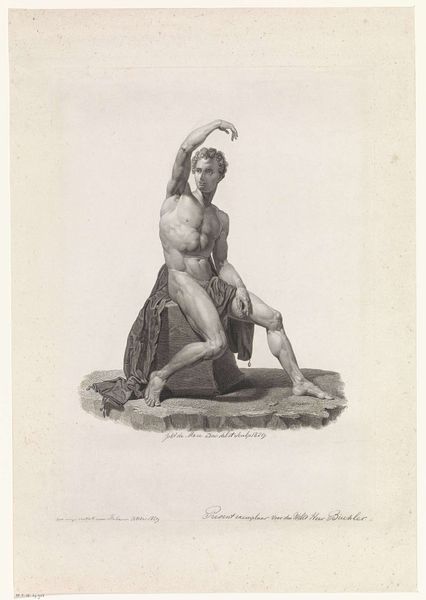
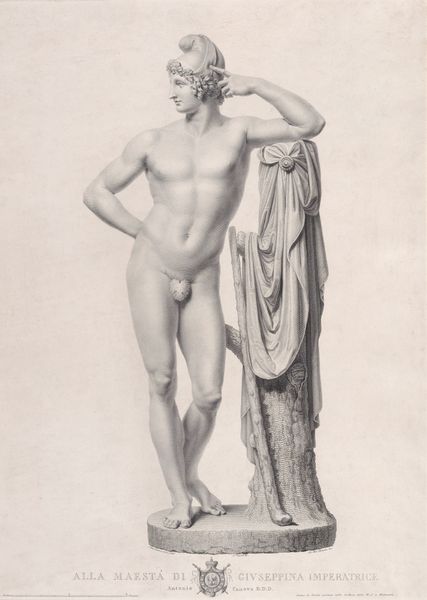
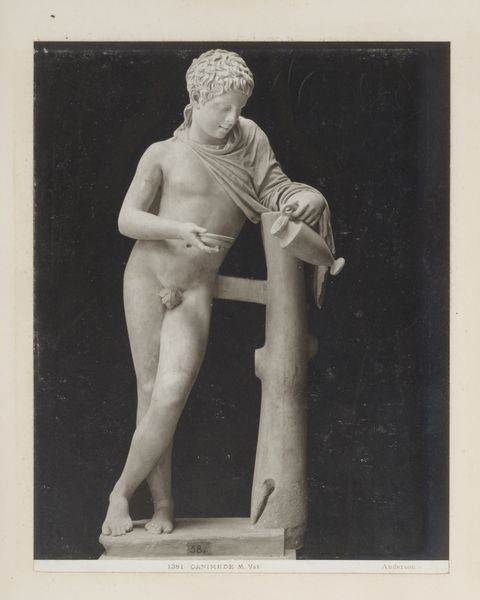
Curator: A somber yet noble figure rendered in marble. What stands before us is a portrayal of Abel. The work dates from between 1826 and 1886 and is currently housed in the Rijksmuseum. Editor: It evokes a powerful sense of melancholy. I'm immediately struck by the juxtaposition of the polished smoothness of the human figure against the rougher texture of the plinth and the sacrificial lamb at his side. Is the contrast intentional, perhaps emphasizing the human and the divine? Curator: It could be argued that it serves as a stark premonition. He looks heavenward, his offering accepted, and we, of course, are privy to what he is not: the jealous rage brewing within his brother Cain, the seed of the world's first murder. He is enshrined here as an exemplar of virtue, and his lamb signifies, among many other interpretations, innocence. Editor: I'm particularly drawn to the fringed garment draped across his torso. Its texture appears quite deliberate. Was there a conscious effort to showcase a specific weaving or decorative technique, something tied to the culture's material practices? Is the animal on the altar just a detail, or integral to the symbolic weight? Curator: One might read this carving as a testament to sacrifice, devotion, and ultimately, injustice. The figure embodies purity, and the plinth with his name elevates his spiritual status, casting him as a virtuous icon to remember across generations. The artist, Dirk Jurriaan Sluyter, aimed to render in three dimensions more than a figure, and has delivered an entire symbolic architecture. Editor: Considering its creation within the period between 1826 and 1886, it would be interesting to understand what impact shifts in marble availability might have played on production, not only of art objects but, more simply, its impact as decorative construction material. Marble surely was a material signifier of something important at that time? Curator: I see Abel's lasting legacy within the history of representation and faith. It’s an object meant for contemplation, reflection and remembrance through archetypes of divine law, a concept this culture knows all too well. Editor: An enduring testament to human ambition, technical process, material culture, and its social ramifications. I'm now even more interested in how marble intersects with 19th-century industry and artistry.
Comments
No comments
Be the first to comment and join the conversation on the ultimate creative platform.
 Collect
 React
React Comment
More like this