About this artwork
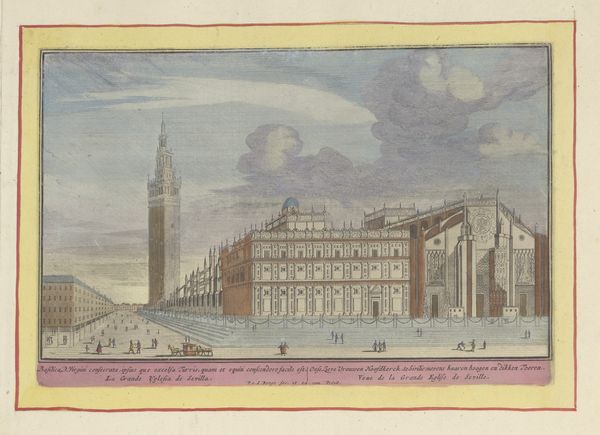
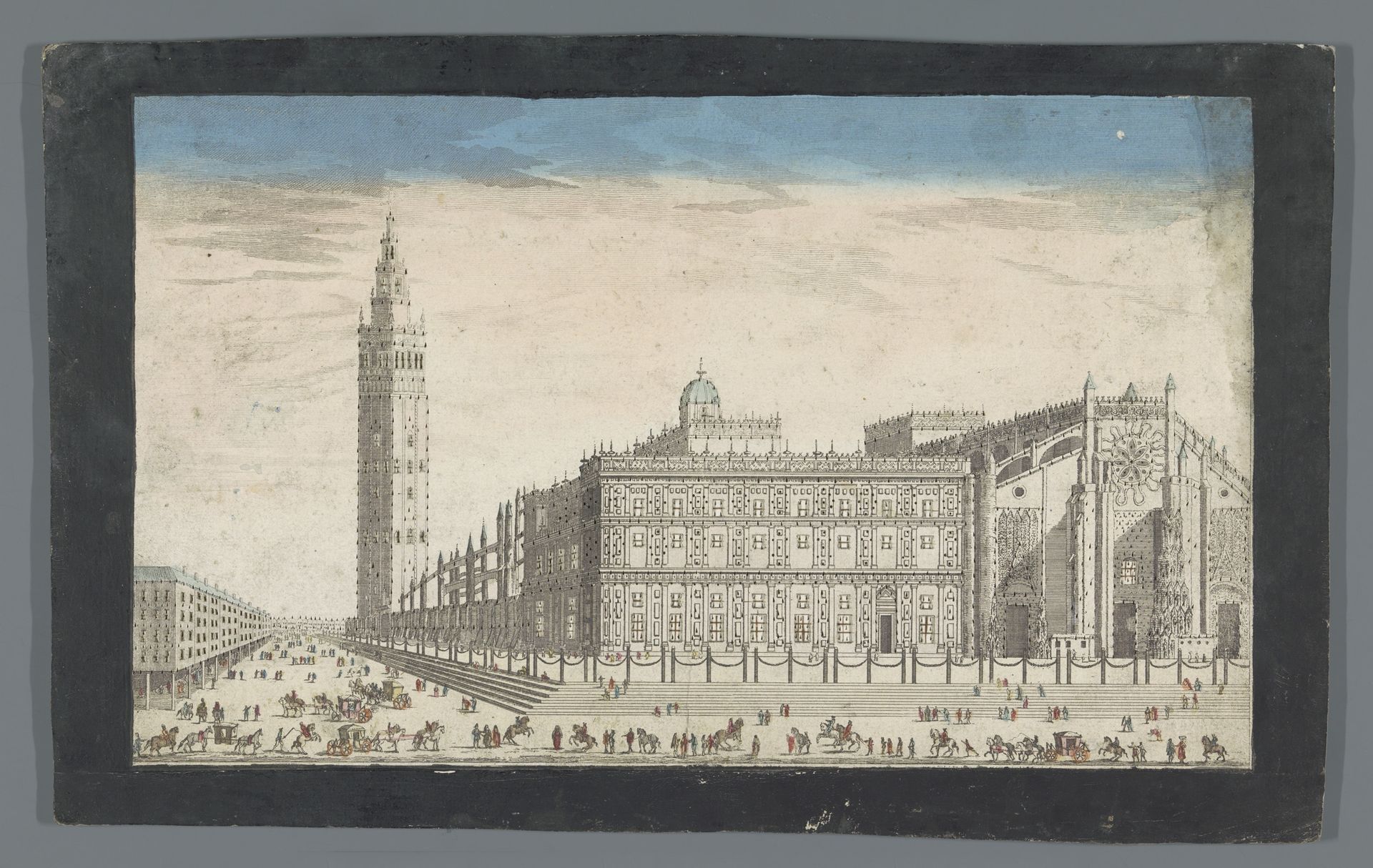
Editor: We're looking at "View of the Cathedral of Seville," a drawing by Jean-François Daumont, dating somewhere between 1745 and 1775. It's a wonderfully detailed cityscape rendered in ink on paper. What strikes me is the almost mathematical precision of the perspective; it's both impressive and a little…sterile? What do you see in this piece? Curator: Sterile? Perhaps! But I also see a yearning for order, for reason – ideas swirling in the Enlightenment air. It reminds me of those meticulously crafted architectural models, not just documenting a place but also celebrating human ingenuity, the capacity to build and control. Notice how the towering Giralda commands the scene. Does that make you think of anything? Editor: Well, its height definitely establishes a hierarchy of power. It makes me wonder who the artwork was originally intended for. Was it commissioned to project an image of grandeur and control? Curator: Exactly! And think about printmaking at that time, not just an artistic pursuit but a booming business of circulating images and ideas. Now, do you suppose that exactitude you felt might also serve a commercial purpose, to offer, say, a truthful depiction of the city's iconic architecture? The clean lines, that cool objectivity – selling points, perhaps? Editor: That's a good point! The level of detail would definitely appeal to a market interested in accurate representations. I hadn't considered the economic side of things so explicitly. I think I was too caught up on its style. Curator: Always dig a little deeper, my friend! It’s amazing how understanding context –the marketplace, the intellectual climate– can breathe new life into even the most seemingly straightforward image. Editor: Absolutely. Looking at it now, I see it not just as a depiction, but a statement about human achievement, carefully crafted for both art and commerce. Curator: A beautifully complex perspective, all brought forth through shared observation and some simple curiosity. The work suddenly comes alive!
Gezicht op de Kathedraal van Sevilla 1745 - 1775

Jean-François Daumont
1775Location
RijksmuseumArtwork details
- Medium
- drawing, print, paper, ink, engraving, architecture
- Dimensions
- height 274 mm, width 439 mm
- Location
- Rijksmuseum
- Copyright
- Rijks Museum: Open Domain
Tags
drawing
baroque
perspective
paper
ink
coloured pencil
line
cityscape
engraving
architecture
Comments
No comments
About this artwork
Editor: We're looking at "View of the Cathedral of Seville," a drawing by Jean-François Daumont, dating somewhere between 1745 and 1775. It's a wonderfully detailed cityscape rendered in ink on paper. What strikes me is the almost mathematical precision of the perspective; it's both impressive and a little…sterile? What do you see in this piece? Curator: Sterile? Perhaps! But I also see a yearning for order, for reason – ideas swirling in the Enlightenment air. It reminds me of those meticulously crafted architectural models, not just documenting a place but also celebrating human ingenuity, the capacity to build and control. Notice how the towering Giralda commands the scene. Does that make you think of anything? Editor: Well, its height definitely establishes a hierarchy of power. It makes me wonder who the artwork was originally intended for. Was it commissioned to project an image of grandeur and control? Curator: Exactly! And think about printmaking at that time, not just an artistic pursuit but a booming business of circulating images and ideas. Now, do you suppose that exactitude you felt might also serve a commercial purpose, to offer, say, a truthful depiction of the city's iconic architecture? The clean lines, that cool objectivity – selling points, perhaps? Editor: That's a good point! The level of detail would definitely appeal to a market interested in accurate representations. I hadn't considered the economic side of things so explicitly. I think I was too caught up on its style. Curator: Always dig a little deeper, my friend! It’s amazing how understanding context –the marketplace, the intellectual climate– can breathe new life into even the most seemingly straightforward image. Editor: Absolutely. Looking at it now, I see it not just as a depiction, but a statement about human achievement, carefully crafted for both art and commerce. Curator: A beautifully complex perspective, all brought forth through shared observation and some simple curiosity. The work suddenly comes alive!
Comments
No comments