drawing, print, engraving
#
drawing
#
baroque
# print
#
figuration
#
history-painting
#
engraving
Dimensions: height 228 mm, width 150 mm
Copyright: Rijks Museum: Open Domain
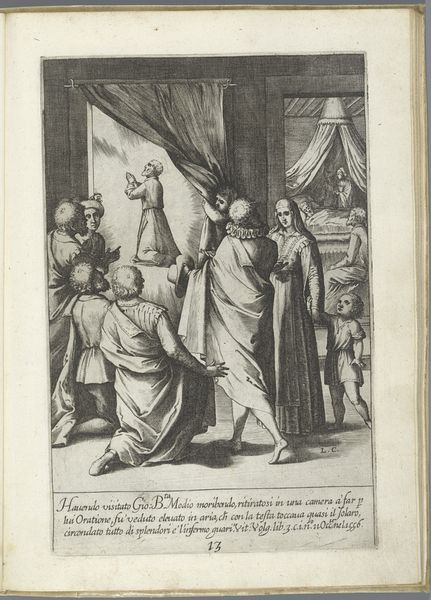
Curator: This print by Luca Ciamberlano, dating from 1630 to 1641, depicts Filippo Neri rejecting the cardinalate. It’s held here at the Rijksmuseum. Editor: Immediately, the composition strikes me as one of refusal and quiet strength. The figure on the right, presumably Filippo Neri, seems resolute despite the cardinal's evident authority. Curator: Precisely. Let's consider the historical context. Neri was a prominent figure in the Counter-Reformation, known for his piety and service to the poor in Rome. He founded the Congregation of the Oratory, a community of priests and brothers. Editor: The very act of refusing the cardinal's hat has symbolic resonance. During the Counter-Reformation, the Church sought to reform from within, addressing corruption and reaffirming its doctrines. Neri's refusal can be interpreted as a rejection of worldly power, a choice for genuine spirituality over institutional prestige. What could his choice communicate to a society grappling with theological debates and the implications of religious reform? Curator: Yes, the politics of imagery were critical during this period. Prints like these disseminated ideas and narratives, influencing public perception of religious figures and events. The engraving itself would have played a part in shaping Neri's image as a humble, virtuous individual within that contested historical moment. Note how the accoutrements of the cardinal are placed on a table as if on display or waiting to be worn; the power is present, but he declines to embrace it. Editor: I’m struck by the tension between the two figures. The Cardinal gestures and pleads; meanwhile Neri looks inward with clasped hands. How did gendered roles or even class affect the church dynamic during that time? And in what ways was refusing power in itself a political act that women were, perhaps, denied? Curator: Well, Ciamberlano likely based this on earlier accounts or commissioned narratives that emphasized Neri's humility. It contributes to a specific image construction. Editor: Regardless, its effectiveness as a statement speaks across time. What might an audience take away today when considering integrity and resistance within large power structures? Curator: It makes us consider the various facets of influence and the potential impact of challenging hierarchical establishments even now. Editor: Indeed. Power dynamics have continued to permeate even how we encounter visual arts, from accessibility in galleries to curatorial voice.
Comments
No comments
Be the first to comment and join the conversation on the ultimate creative platform.
 Collect
 React
React Comment
More like this