About this artwork
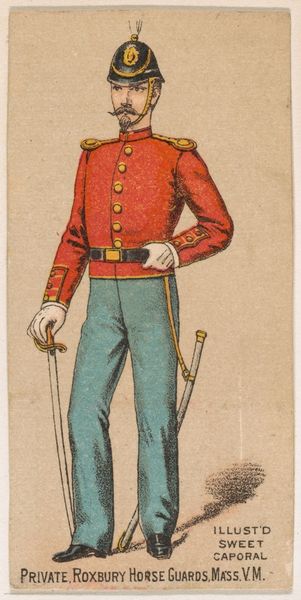
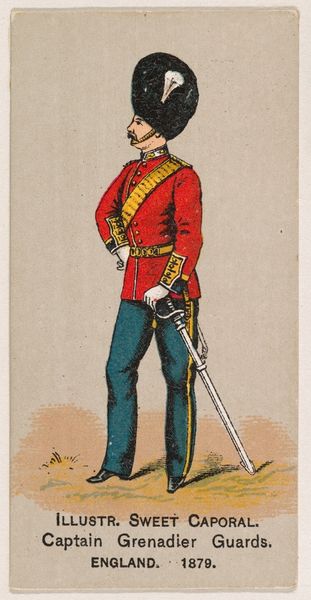
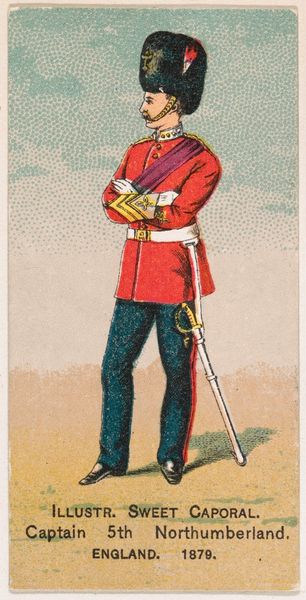
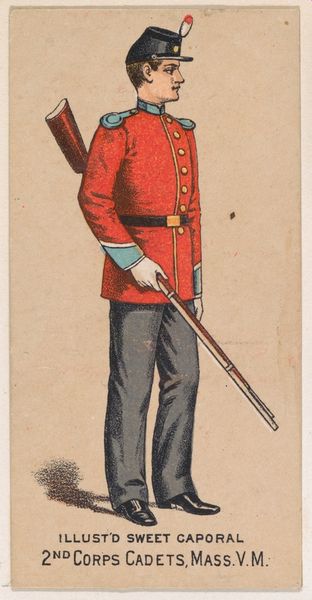
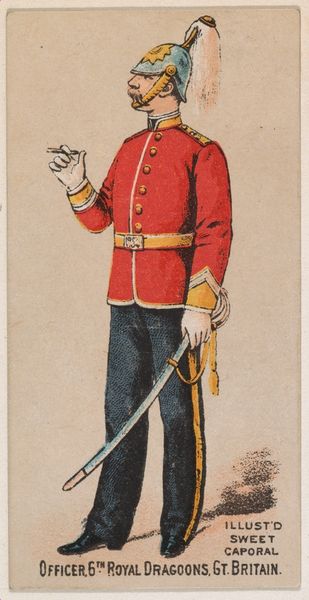
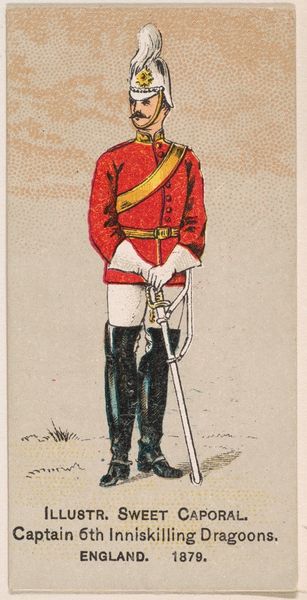
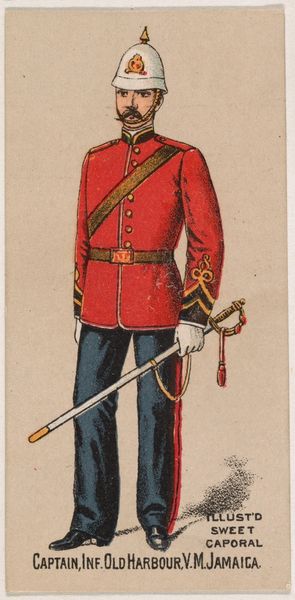
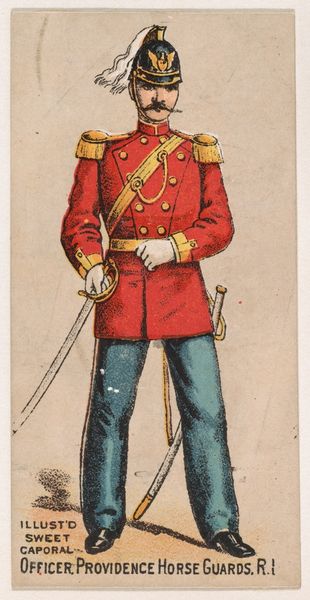
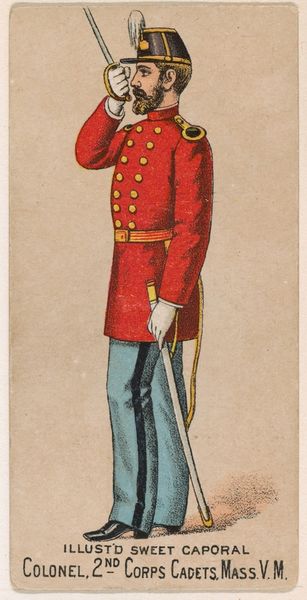
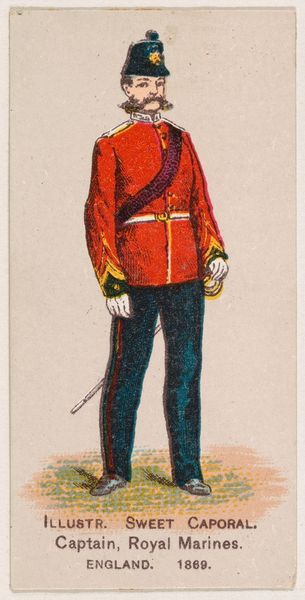
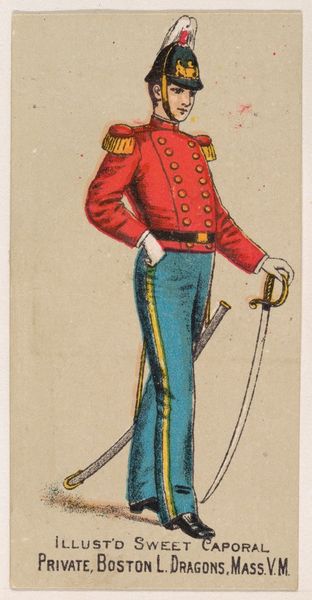
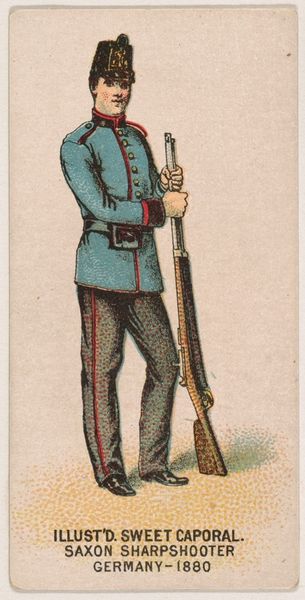
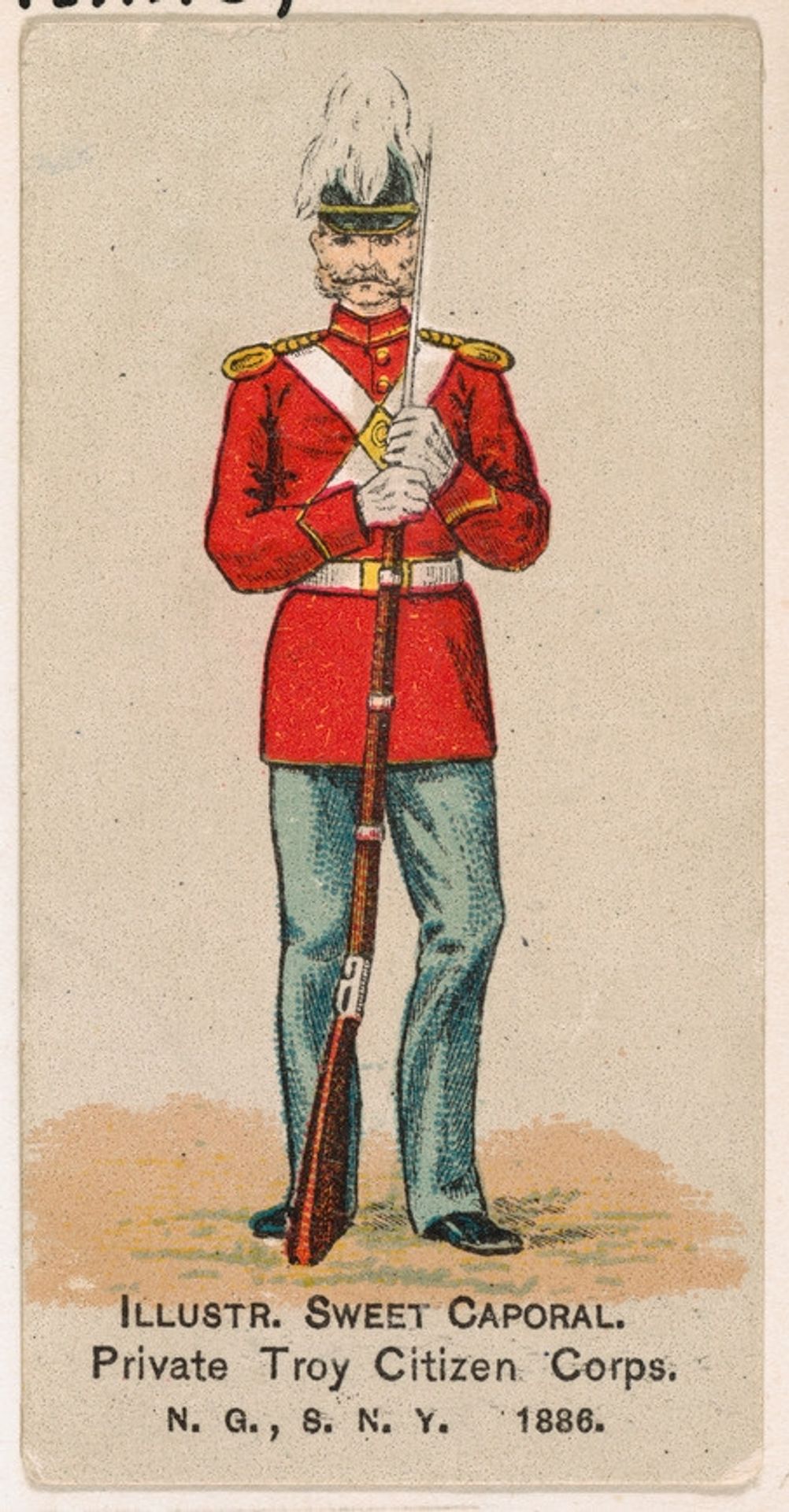
Editor: This lithograph, titled "Private, Troy Citizen Corps," from 1886, comes from a series of tobacco cards issued by Kinney Tobacco Company. It's charmingly rigid and slightly comical – almost like a toy soldier, with that bright red coat. What do you see in it? Curator: I see a potent symbol of both civic pride and burgeoning consumer culture. The figure himself, though seemingly generic, represents the ideal of the citizen-soldier: a civilian, yes, but one readily mobilized to defend community and nation. He's archetypal, referencing an image of strength. Editor: A connection between civic duty and consumerism, then? Curator: Precisely. Consider the context: the rise of mass production, the explosion of advertising. The Kinney Tobacco Company isn's selling just cigarettes; it's selling an idea: buy Sweet Caporals, and you're buying into this vision of American strength and virtue, subtly associating tobacco with masculinity. Think about the colors. The vibrant red and gold conjure royalty or aristocracy but applied to a "private", one of the people. It's revolutionary, using visual language of prestige to validate the working man's consumer choice. Does that seem intentional to you? Editor: That’s fascinating, I hadn’t considered the subtle link between consumer choice and civic duty. It's more complex than just a simple advertisement. Curator: Exactly. It is less a snapshot, more a cultural artifact, layered with social aspirations, class dynamics, and the shrewd marketing tactics of a bygone era. Editor: I'll definitely be thinking about visual rhetoric differently from now on! Thanks for that rich breakdown.
Private, Troy Citizen Corps., National Guard of the State of New York, 1886, from the Military Series (N224) issued by Kinney Tobacco Company to promote Sweet Caporal Cigarettes
1888

Kinney Brothers Tobacco Company
1869 - 2011
The Metropolitan Museum of Art
Metropolitan Museum of Art, New York, NYArtwork details
- Medium
- drawing, print
- Dimensions
- Sheet: 2 3/4 × 1 1/2 in. (7 × 3.8 cm)
- Location
- Metropolitan Museum of Art, New York, NY
- Copyright
- Public Domain
Tags
Comments
Share your thoughts
About this artwork
Editor: This lithograph, titled "Private, Troy Citizen Corps," from 1886, comes from a series of tobacco cards issued by Kinney Tobacco Company. It's charmingly rigid and slightly comical – almost like a toy soldier, with that bright red coat. What do you see in it? Curator: I see a potent symbol of both civic pride and burgeoning consumer culture. The figure himself, though seemingly generic, represents the ideal of the citizen-soldier: a civilian, yes, but one readily mobilized to defend community and nation. He's archetypal, referencing an image of strength. Editor: A connection between civic duty and consumerism, then? Curator: Precisely. Consider the context: the rise of mass production, the explosion of advertising. The Kinney Tobacco Company isn's selling just cigarettes; it's selling an idea: buy Sweet Caporals, and you're buying into this vision of American strength and virtue, subtly associating tobacco with masculinity. Think about the colors. The vibrant red and gold conjure royalty or aristocracy but applied to a "private", one of the people. It's revolutionary, using visual language of prestige to validate the working man's consumer choice. Does that seem intentional to you? Editor: That’s fascinating, I hadn’t considered the subtle link between consumer choice and civic duty. It's more complex than just a simple advertisement. Curator: Exactly. It is less a snapshot, more a cultural artifact, layered with social aspirations, class dynamics, and the shrewd marketing tactics of a bygone era. Editor: I'll definitely be thinking about visual rhetoric differently from now on! Thanks for that rich breakdown.
Comments
Share your thoughts