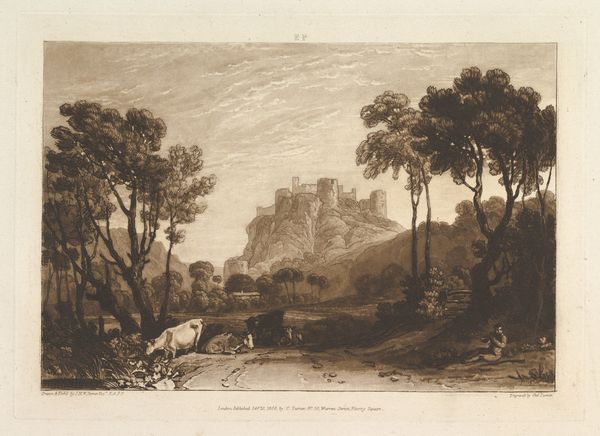
Ragland, from "Remarks on a Tour to North and South Wales, in the year 1797" 1800
0:00
0:00


drawing, print
#
drawing
# print
#
landscape
#
pencil drawing
#
romanticism
#
19th century
Dimensions: Sheet: 5 1/4 × 7 7/8 in. (13.4 × 20 cm)
Copyright: Public Domain
Curator: My immediate impression is one of nostalgia, almost melancholy. The subdued grays accentuate the ruined castle and hint at stories lost to time. Editor: Indeed. This is "Ragland, from Remarks on a Tour to North and South Wales, in the year 1797" by John Hill, dating back to 1800. It's currently housed here at the Metropolitan Museum of Art. It exemplifies the Romantic era, both in style and subject matter, created as a drawing then rendered as a print. Curator: Notice how Hill contrasts the imposing but ruined castle—a symbol of fading feudal power—with the everyday life unfolding in the foreground: figures walking a country road, the cozy cottage scene, an assertion that local and domestic life can thrive despite the fading power of political entities. The choice to feature rural Welsh inhabitants signals a rising awareness of peripheral communities within a greater nation, shifting the focus from only those with nobility and riches. Editor: Precisely, this artwork provides a wealth of visual information through the masterful handling of light and shadow. Note the architectural precision in depicting the castle ruins and the surrounding topography; his use of line suggests a keen interest in geometric form and proportion. Curator: And considering the historical context—post-Enlightenment and on the cusp of industrial revolution—the composition might further read as a quiet act of resistance, honoring traditional ways of life amid encroaching modernization. Are those commoners and their quotidian lives actually centered amidst the decaying architecture? The emphasis may point to class inequities in that era. Editor: Or perhaps the castle ruins and landscape itself become semiotic structures reflecting the sublimity and transient nature of earthly power and institutions, highlighting a sense of change as an inexorable condition of life? The piece certainly invites sustained semiotic analysis. Curator: A compelling possibility! What resonates most with me, in the end, is its quiet reverence for those enduring on the margins of grand historical narratives. Editor: For me, it is how Hill successfully constructed an evocative representation using only a delicate matrix of line and shading to make for a compelling meditation on ruin and home.
Comments
No comments
Be the first to comment and join the conversation on the ultimate creative platform.
 Collect
 React
React Comment
More like this