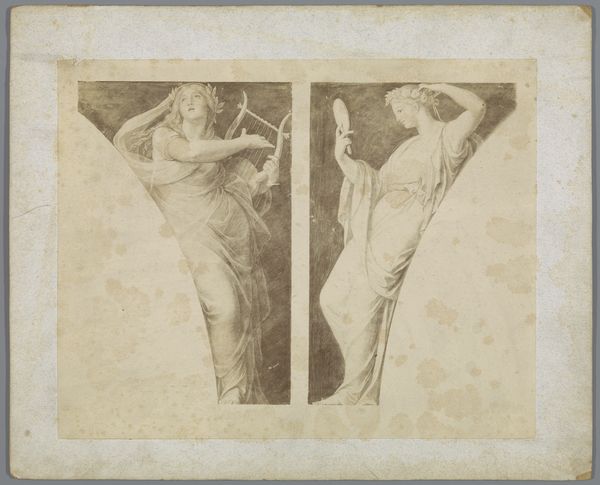
The philosophical works of Voltaire (L'Encyclopédie, les Essais, Les Pensées) 1890
0:00
0:00

albertmaignan
Petit Palais, Paris, France
painting, watercolor
#
water colours
#
painting
#
figuration
#
watercolor
#
history-painting
#
academic-art
#
nude
#
watercolor
Dimensions: 25.2 x 86.2 cm
Copyright: Public domain
Curator: The subdued color palette and almost academic style of this 1890 watercolor by Albert Maignan lends it a quiet, contemplative air. The piece is titled 'The philosophical works of Voltaire (L'Encyclopédie, les Essais, Les Pensées).' Editor: My first thought is that it feels more like a fragment, or perhaps a preparatory study for a larger project. The composition, with its segmented arches and the repetition of figures, offers an interesting visual rhythm. Curator: Indeed. Maignan was known for his large-scale historical and allegorical paintings, and often did mural work, making the 'fragment' reading a valid one. This piece, although academic in its rendering of the human form, points to the revival of classicism, specifically within the academic art circles of late 19th century France. We can consider the implications for artistic labor and social consumption—were pieces like this conceived for salon exhibition? Were these exercises? Editor: Well, what interests me particularly are the relationships formed through shape and implied narratives. How do those arching divisions affect the unity of the piece? And how are we meant to interpret those figures engaged in contemplation and creation? It seems almost allegorical—though perhaps leaning a bit too heavily on traditional symbolism to spark genuine interpretive creativity on its own. Curator: But consider also that 1890 in France was the calm after decades of social, political and aesthetic upheaval. Academic art held strong as a signifier of tradition and order. This could also be read as a material assertion of classical ideals. Even watercolor, sometimes dismissed as 'lesser,' is given serious attention. Editor: I appreciate that thought. It's certainly a well-executed demonstration of technical skill. Though for me the interest in that sort of traditional skill will never surpass the way the artwork seems to play with established motifs. Perhaps even critiquing them through repetition. Curator: Interesting—seeing as both materialism and idealism coexist here! I will now consider what its creation and context imply in fresh light. Editor: Precisely, and perhaps the conversation of art history always cycles that way: revisiting established truths and looking anew!
Comments
No comments
Be the first to comment and join the conversation on the ultimate creative platform.
 Collect
 React
React Comment
More like this