

before 1900
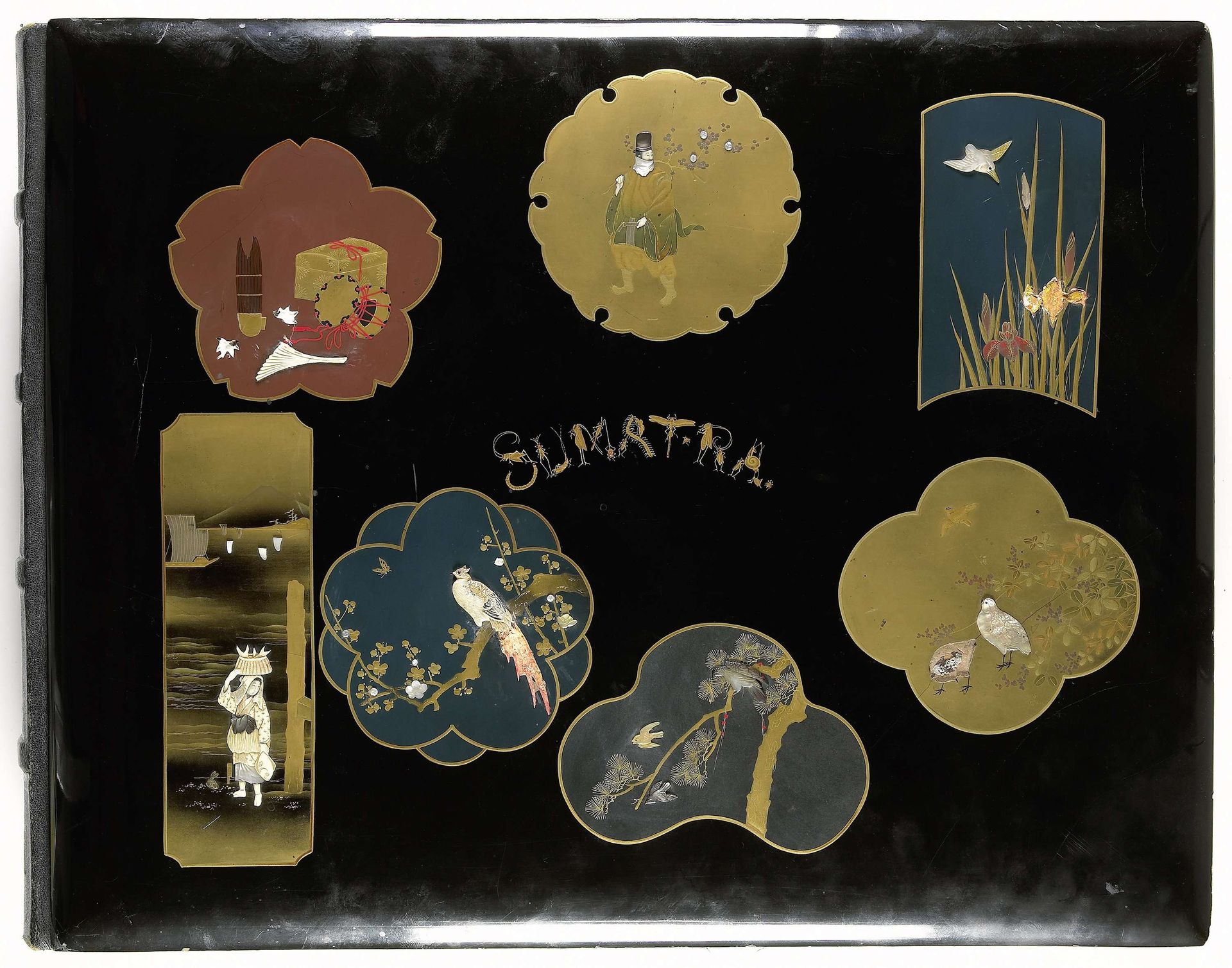
Cover of 'Sumatra' album belonging to Paul and Lucie Sandel

Carl J. Kleingrothe
1864 - 1925Location
RijksmuseumListen to curator's interpretation
Curatorial notes
Curator: The artwork we are looking at is the cover of the ‘Sumatra’ album, which belonged to Paul and Lucie Sandel. It dates to before 1900. Editor: It's quite striking, this stark contrast of jet-black lacquer against those iridescent miniature scenes. I immediately see it as something both decorative and deeply contemplative. Curator: Yes, it presents a fascinating example of Orientalism within decorative arts. Observe the precise arrangement of the inlaid panels and how their varying shapes create a dynamic visual rhythm across the surface. Editor: It’s clearly referential to Sumatran life and nature—there’s the figure carrying goods, evocative birds in natural settings, lush flora—but transformed through a Western lens. I wonder about its acquisition and display; what role did pieces like this play in shaping European perceptions of Southeast Asia? Curator: Indeed. And the materials! Mother-of-pearl, perhaps some lacquer or enamel work too? Each contributes textural variance to what could easily have been a flat, monotonous expanse. It is as though each panel represents a different facet of Sumatran beauty, carefully curated and placed. Editor: And those small vignettes, how might we interpret them individually? I am drawn to the panel depicting the figure beneath the moon; a quiet, isolated moment which speaks of long journeys. This piece is loaded with symbolism, ready for an audience. It hints at trade routes and cultural exchange, perhaps? Curator: It is also a reminder of the historical context of collection and display. As museums are constantly being asked to grapple with repatriation and ethical acquisitions, viewing something like this should compel us to consider those topics more intently. Editor: Absolutely. The album cover isn't simply beautiful; it’s a complex intersection of artistry, history, and politics. Curator: Quite. A powerful intersection indeed!