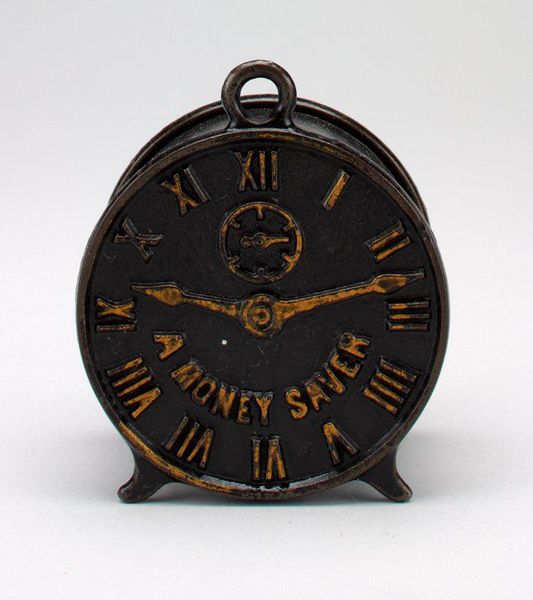
-Time to Save (tree-stump clock)- still bank c. 20th century
0:00
0:00


mixed-media, carving, wood
#
mixed-media
#
carving
#
ceramic
#
wood
#
decorative-art
Dimensions: 3 1/2 x 3 3/8 x 2 1/8 in. (8.89 x 8.57 x 5.4 cm)
Copyright: Public Domain
Editor: This is "Time to Save (tree-stump clock) - still bank," a mixed-media piece from around the 20th century. It looks like a wooden log carved into a clock and coin bank. The folksy simplicity is quite charming! What's your take on this quirky object? Curator: It's a fascinating object! These types of handmade pieces often reflect the social and economic anxieties of their time. A clock combined with a bank explicitly links time and money. What kind of statement do you think it makes? Editor: Maybe it’s about the importance of being diligent and using time wisely to save money. It has a slight Depression-era feel to it. Curator: Precisely. The "Time to Save" inscription emphasizes that thrifty habit, which took on greater urgency during economic hardships. Everyday objects like this clock-bank also became instruments for conveying larger societal values about the morality of thrift. How does the natural medium of wood play into that, in your view? Editor: Well, the wood feels very grounded and simple – like something someone could easily make. Maybe it’s hinting at self-reliance or being resourceful when resources are scarce? Curator: Good point. Consider also the possible socio-economic backgrounds from which something like this arises. For example, was the artist professionally trained or self-taught? Such knowledge impacts our evaluation of its aesthetic and functional intent. Editor: This object made me think about the historical value people placed on saving. It wasn't merely practical but also represented personal values. Curator: Absolutely. This piece reminds us that everyday items can be powerful storytellers about cultural norms, when examined critically within their specific social and political moments.
Comments
No comments
Be the first to comment and join the conversation on the ultimate creative platform.
 Collect
 React
React Comment
More like this