

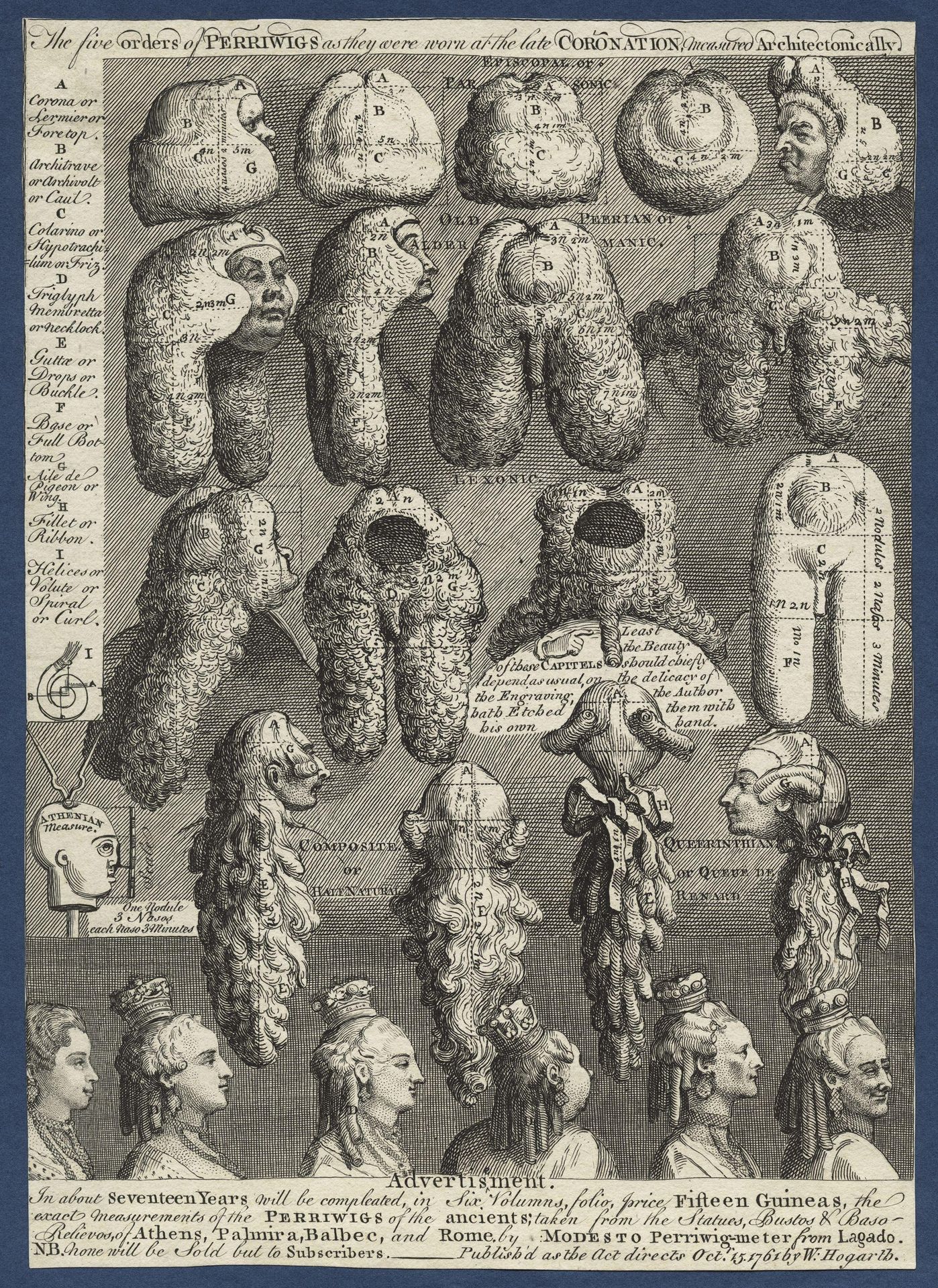
The Five Orders of Perriwigs

William Hogarth
1697 - 1764Location
Private CollectionListen to curator's interpretation
Curatorial notes
Curator: Here we have a rather fascinating engraving entitled "The Five Orders of Perriwigs," created by William Hogarth. Editor: It's incredibly detailed! The crisp lines and textures bring an almost architectural quality to these elaborate wigs. There's a curious sense of both the ornate and the absurd that strikes me immediately. Curator: Exactly! Hogarth positions these perriwigs as if they were architectural orders, like Corinthian or Doric columns. He’s engaging with contemporary fashion but also satirizing it. Consider the date and the social context. These wigs weren’t just adornments, they were potent symbols of status, profession, and political allegiance. Editor: I see it! There's a clear analogy between the structured, hierarchical nature of architecture and the rigid social hierarchy reflected in wig fashion. Hogarth is visually arguing that fashion, in its own way, imposes rules and classifications, mirroring those of the built environment. Curator: And Hogarth underscores that parallel even more with detailed annotations labeling different parts of the wigs, much like one would label the components of a classical column. It’s social commentary at its finest. Look closely at the variety of faces he gives to these wigs. The implications of identity performance here are so striking. How did this type of exaggerated presentation play out? Editor: A sharp question indeed! Visually, the work strikes me with the almost mathematical precision of its composition, while emotionally, it hints at both grandiosity and a biting sense of humour. I keep noticing little things -the tiny, almost comical faces peeking out from under some of the larger perriwigs Curator: I'm particularly interested in the implications these hairstyles had within the gender dynamics of the time. Did certain styles afford more power or respect to the wearer, and if so, how? Editor: I agree. This really compels you to consider how something as seemingly frivolous as a wig could become such a significant marker of social identity and power. It is really much more profound than at first glance. Curator: Indeed, a layered composition. These perriwigs present an interesting reflection on identity, and this analysis provided new layers of context to appreciate!