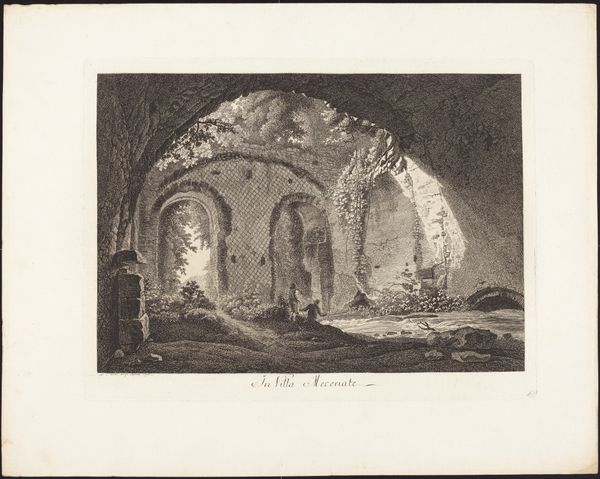
Dimensions: height 179 mm, width 231 mm
Copyright: Rijks Museum: Open Domain
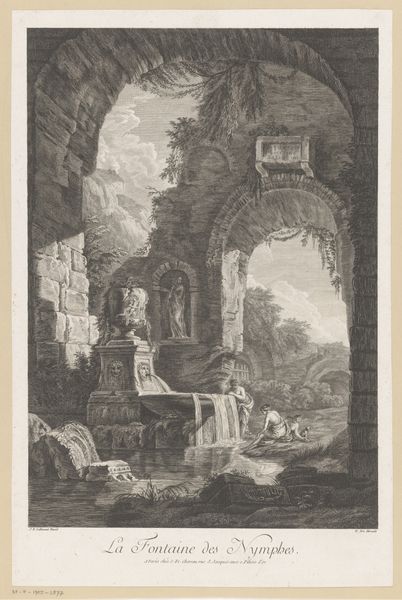
Curator: This is a captivating engraving, "Herders met vee bij een ruïne," or "Herdsmen with cattle by a ruin," a print dating from 1823 to 1900. Editor: It has a beautifully melancholy atmosphere. The deep blacks against the bright opening truly frame that light as something hopeful. I immediately feel drawn into this antiquated vista. Curator: Indeed, the artist, Johann Wilhelm Kaiser, masterfully employs chiaroscuro to guide our gaze. Notice how the lines of the arched ruin pull us towards that distant landscape, creating depth and a powerful sense of perspective. The interplay of shadow and light provides strong pictorial order. Editor: And the ruin itself speaks volumes. It acts almost as a stage, placing those everyday figures of the herdsmen and their animals against a backdrop of a fallen empire. Are we meant to consider mortality and the fleeting nature of glory here, I wonder? The human desire to monumentalize themselves through building against the power of nature. Curator: Precisely! The crumbling architecture serves as a stark reminder of temporal impermanence, in opposition to a sense of nature’s persistence beyond this collapse. Editor: This print seems to epitomize the Romantic vision. You see figures dwarfed by the vastness of their surroundings. A reflection on our insignificance relative to time. It also romanticizes, perhaps unintentionally, an almost idealized simplicity through its central figures, though even the rural workers appear still dwarfed beneath the landscape. Curator: Yes, the figures, though central, are consciously placed to interact and indeed even contrast with their surrounding, as opposed to functioning as a singular focus. What do we make of their social interaction and how it works together in balance with its landscape setting, however unbalanced itself? It's a complex dynamic captured through these skilled lines and deliberate compositions of scale. Editor: The power lies, certainly, in Kaiser’s technical skill. Through form and medium, he is also inviting the viewer to reconsider the social hierarchy, the rural lifestyle, against this decay that functions like the shadow of old power, wealth, class—a critique through landscape. It truly elevates our understanding of historical forces, the print a time capsule of human conditions within a historical context. Curator: Yes, indeed, viewing "Herdsmen with Cattle by a Ruin" allows us to contemplate not just artistic mastery, but historical continuities and contrasts. Editor: A fascinating visual dialogue with history—and the artistry embedded in observation.
Comments
No comments
Be the first to comment and join the conversation on the ultimate creative platform.
 Collect
 React
React Comment
More like this