

1892
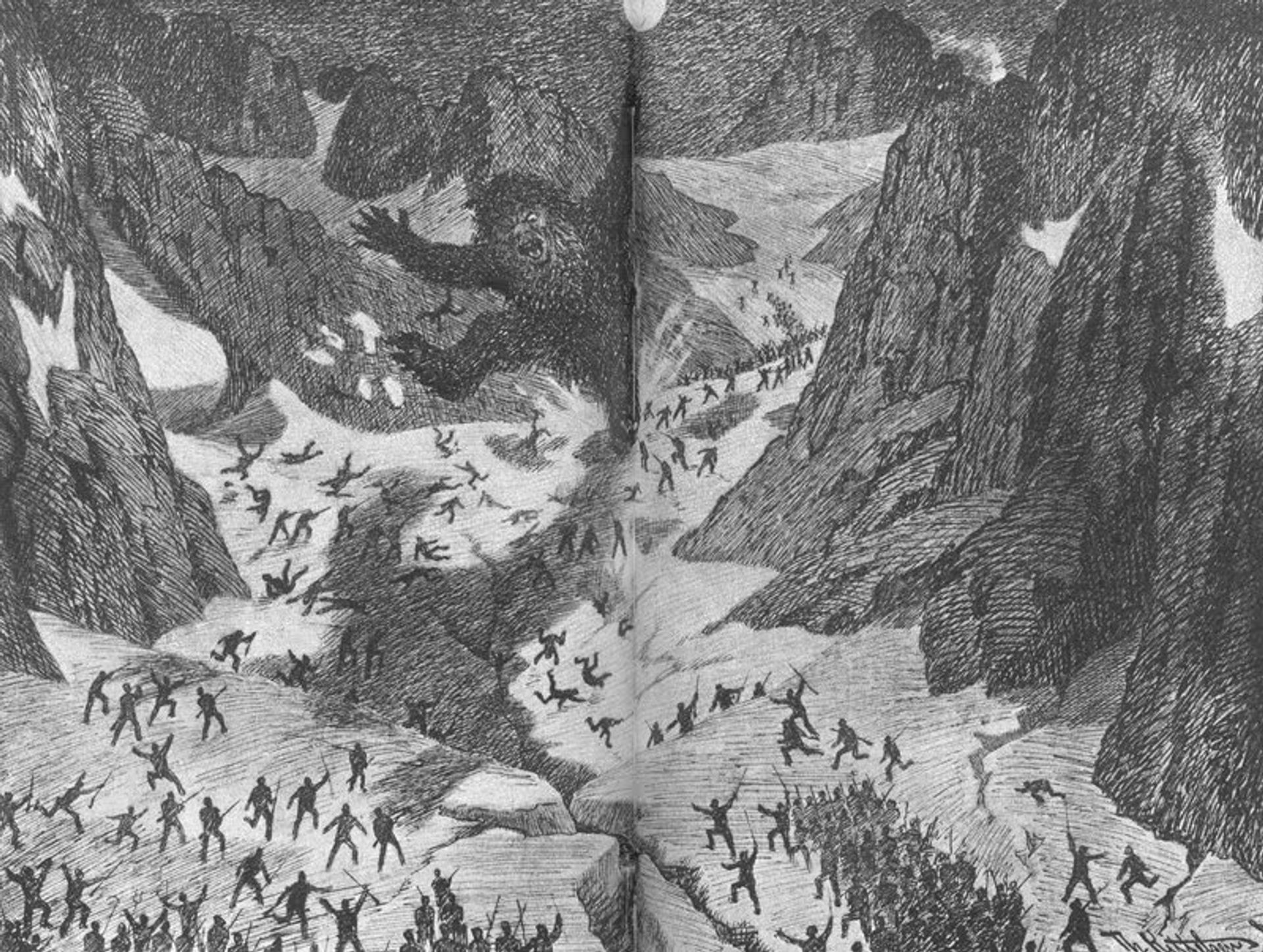
Big troll in Breifonnen - Stortrollet i breifonnen

Listen to curator's interpretation
Curatorial notes
Editor: Here we have Theodor Kittelsen's 1892 ink drawing, "Big troll in Breifonnen." It's… well, it's rather chaotic! The perspective seems almost warped, with masses of tiny figures fleeing a colossal troll. What catches your eye? Curator: Immediately, the distribution of visual weight strikes me. Note how the artist deploys contrasting masses: a light area teeming with minute, fleeing figures is countered by the immense, shadowed form of the troll. The dynamism achieved through stark contrasts in value and scale creates a palpable sense of terror. How does the formal composition reinforce the narrative's emotional core? Editor: The contrast definitely emphasizes the troll's size and the people's vulnerability. But is it just about scale? Curator: Not solely. Observe the textural differences. The craggy, uneven surfaces of the mountain versus the smoother planes depicting the fleeing figures. This visual dichotomy highlights the natural versus the human, framing humanity as fragile and impermanent within the imposing landscape. It’s a romantic exploration of the sublime through formal means. Editor: So the medium itself–ink on paper–contributes to this effect of contrasting textures? Curator: Precisely. The deliberate, almost frantic, hatching and cross-hatching lend a chaotic energy, underscoring the emotional intensity. And what does that centralized, luminous orb, up top, evoke for you? Editor: It seems… distant, cold. Not offering any help to the little people at all! I hadn't noticed all of the specific formal elements until you pointed them out. Curator: Visual art operates on many levels. Through discerning how formal aspects interrelate and enhance symbolic undertones, the experience moves toward one that has meaning.