1634
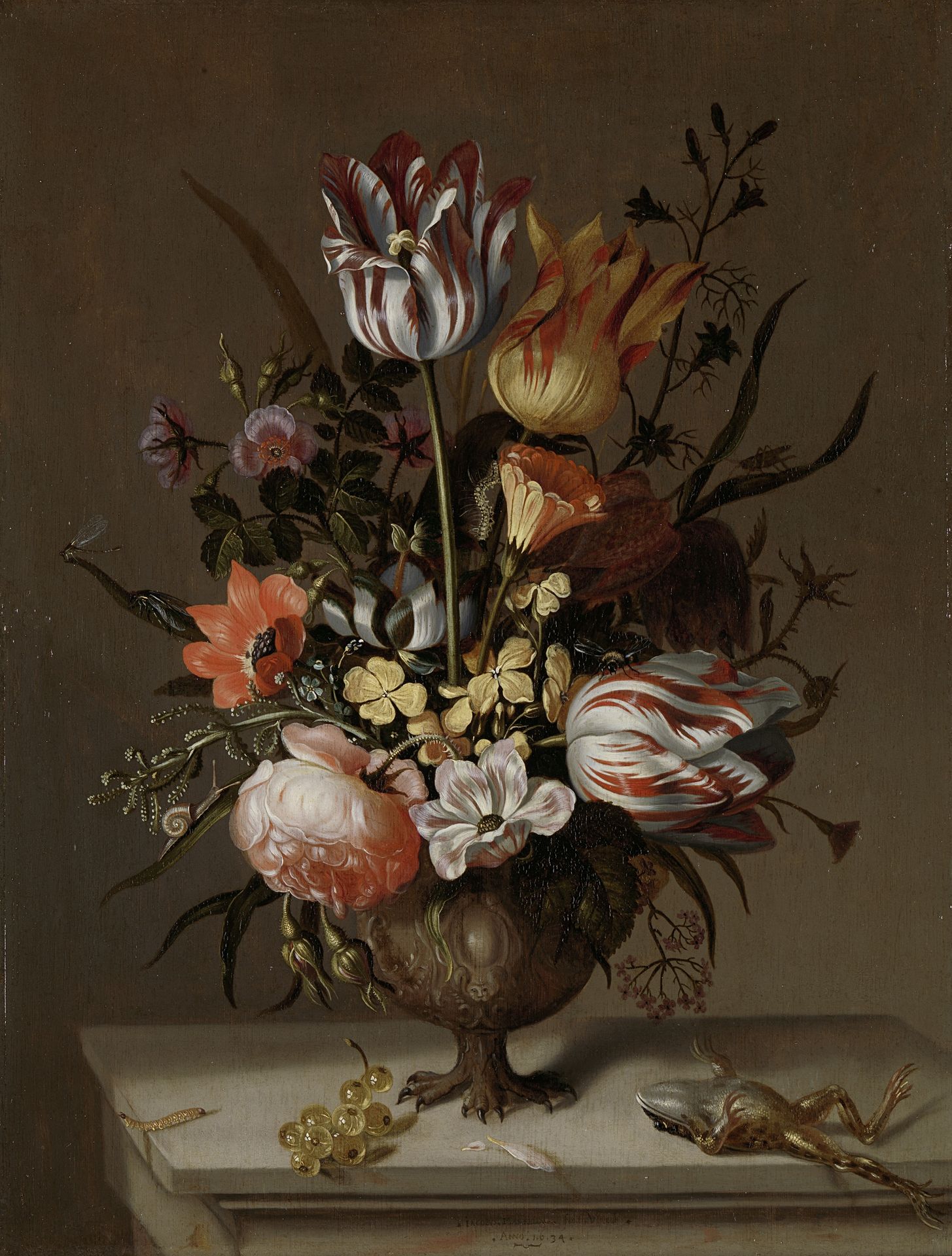
Still Life with a Vase of Flowers and a Dead Frog

Jacob Marrel
1613 - 1681Location
RijksmuseumListen to curator's interpretation
Curatorial notes
Jacob Marrel painted this still life of flowers and a frog on canvas in the 17th century. The flowers bursting from the vase represent life's beauty, but beneath, a dead frog lies on the stone ledge. This juxtaposition embodies the vanitas tradition, a popular motif meant to remind viewers of life’s fleeting nature. The frog is a complex symbol, seen in ancient Egyptian hieroglyphs, often connected with fertility, creation, and rebirth because of its life cycle. Yet, here, the dead frog takes on a darker symbolism. It is a memento mori, a reminder of mortality, much like the skull in other vanitas paintings. The frog also takes on a more sinister meaning. Consider the medieval allegories, where the frog is a symbol of sin, particularly greed, and temptation. This symbolism creates a tension within the painting, a visual battle between beauty and decay, life and death, and the sacred and profane. It evokes powerful emotions tied to our subconscious understanding of existence. How we perceive and internalize the image of the frog shifts through time, yet the presence of the frog, dead or alive, brings a profound unease.