drawing, print, engraving
#
portrait
#
drawing
# print
#
portrait drawing
#
genre-painting
#
pre-raphaelites
#
engraving
Copyright: Public Domain: Artvee
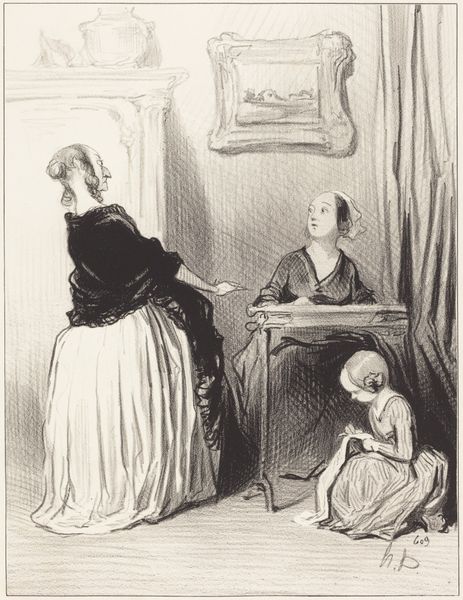
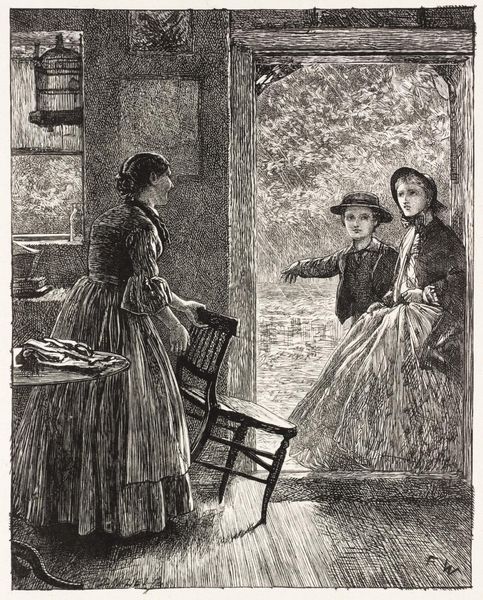
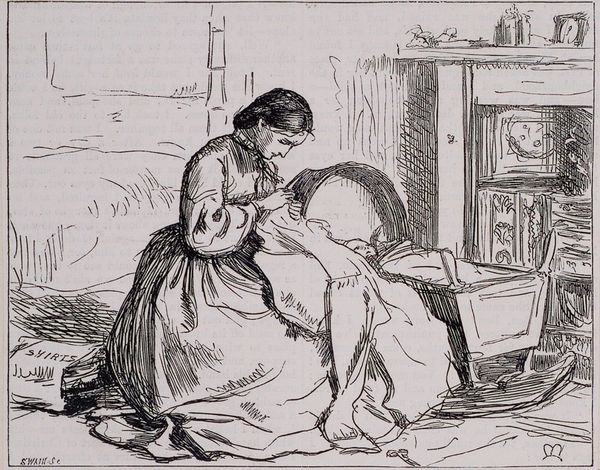
Editor: This is an engraving titled "Please, Ma’am, can we have the peas to shell" from 1862, created by Sir John Everett Millais. The stark black and white and the sharp lines really emphasize the melancholy in the girls' expressions. How do you interpret this work? Curator: Well, let's think about the socio-political context of Millais and the Pre-Raphaelites. This was a time of great social change in Victorian England, a period of immense industrial and imperial expansion alongside growing concerns about poverty and social inequality. Consider the title itself—"Please, Ma’am, can we have the peas to shell"— it hints at a domestic scene but also underlines a class division. What does the 'Ma'am' imply to you about social status? Editor: That the girls are probably asking someone of a higher status, perhaps a servant addressing their employer? There's a certain distance between them in the image too. Curator: Exactly. Millais often depicted scenes of everyday life, but within those scenes, he explored Victorian values and anxieties. Think about the rise of social realism in art, which aimed to portray ordinary people and their struggles, and its appeal to audiences, and contrast this with earlier patronage networks. This image speaks to a growing awareness, at least within some segments of society, of the plight of the poor. Editor: I hadn’t considered the social commentary aspect so directly. I was focusing more on the emotion in the faces, and the domesticity. Curator: But how does the depiction of this "domesticity" itself reflect and possibly shape those societal perceptions and attitudes of poverty, class and work? Editor: So, rather than just being a simple scene, it's actively engaging in the conversations of the time, maybe even trying to influence them by presenting a view of working-class life? Curator: Precisely. And by examining the artwork through the lens of its social context, we gain a much deeper understanding of its meaning and purpose, which ultimately reveals its complex role in a quickly changing society.
Comments
No comments
Be the first to comment and join the conversation on the ultimate creative platform.
 Collect
 React
React Comment
More like this