oil-paint, oil
#
narrative-art
#
baroque
#
dutch-golden-age
#
oil-paint
#
oil
#
landscape
#
impressionist landscape
#
oil painting
#
14_17th-century
#
cityscape
#
realism
Dimensions: 44.3 x 36.2 x 1.0 cm
Copyright: Public Domain
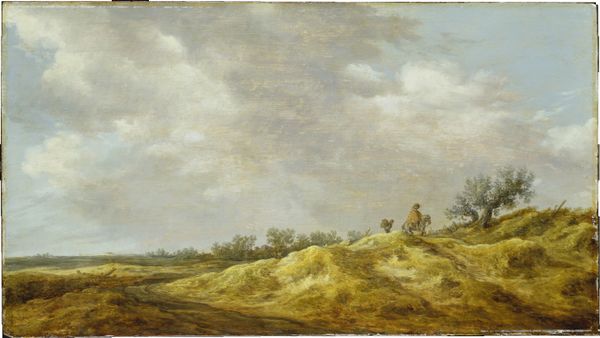
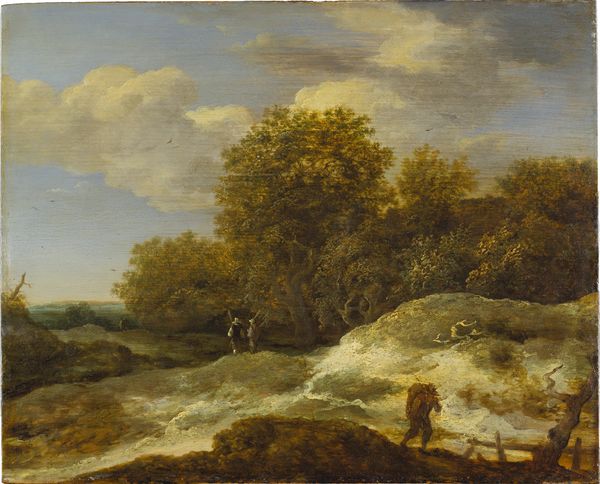
Editor: So, here we have Jacob van Ruisdael’s "Dune Landscape with Fence," from around 1647, done in oil. The scene has an overall somber feel to it. What’s your interpretation? Curator: It's compelling, isn't it? This isn't just a landscape; it reflects the socio-political landscape of the Dutch Golden Age. Consider the broken fence, the expansive sky—do these elements not suggest ideas about land ownership, perhaps the vulnerability or the limits of human control versus the power of nature? How might contemporary ideas of property or enclosure influence our reading of such a landscape? Editor: I see what you mean. The fence *is* quite prominent, and broken down. So the painting isn't only about the beauty of nature? Curator: Exactly. During this era, the Dutch Republic was expanding economically and globally, but also grappling with issues of social hierarchy and access to resources. Could the dilapidated structure be symbolic of those tensions, of a changing social order and access to natural resources, played out on a smaller scale? Editor: That's a pretty interesting idea. It adds a whole other layer. The tiny figure walking down the path - is that a narrative element too? Curator: Indeed. It could be viewed as the individual confronting the immensity and perhaps the indifference of nature. Consider this in terms of gender and class, how might identities be shaped through these landscapes and societal pressures represented by this rural depiction? What limitations or possibilities might this pathway offer to individuals within 17th-century Dutch society? Editor: This gives me a completely new way of approaching landscape painting. Curator: I hope it inspires you to interrogate visual landscapes and contextual frameworks for more nuanced understandings.
Comments

stadelmuseum about 2 years ago
⋮
This is a painting composed with the thriftiest of means. Sunlight plays the leading role. It shines through a break in the clouds for the brief moment captured by the artist, lighting up a section of the sandy back of a dune and a weather-beaten board fence. The dune landscape so typical of the environs of Jacob van Ruisdael’s native Haarlem turns up repeatedly in his oeuvre. Unlike the otherwise customary ideal landscapes, works such as this one offered his Dutch contemporaries a special means of identifying with their newly independent country.


Join the conversation
Join millions of artists and users on Artera today and experience the ultimate creative platform.
 Collect
More like this