

1874
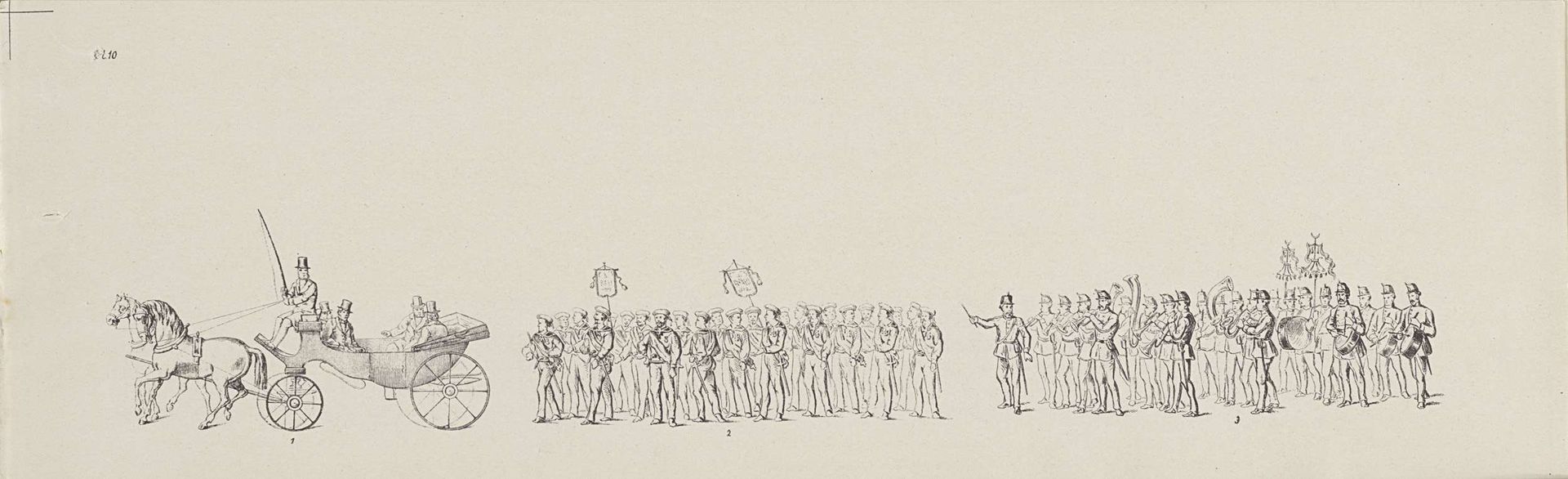
Historische gekostumeerde optocht te Amsterdam bij het 25-jarige regeringsjubileum van koning Willem III in 1874 (plaat 10)

Listen to curator's interpretation
Curatorial notes
Curator: Let’s examine this pencil drawing from 1874, depicting a historical costumed parade in Amsterdam. The event commemorated the 25th anniversary of King Willem III’s reign. Editor: It’s remarkably sparse, almost spectral. The pale wash of the paper contrasts so starkly with the fineness of the pencil lines, making it feel more like a fleeting impression than a fixed historical document. Curator: Indeed. Yet that sparseness underscores its documentary function. The event, so vital in its moment, lives on now only as a faint shadow in collective memory, a residue evoked here. What strikes me is how meticulously rendered these figures are, capturing specific cultural markers of class, authority, and belonging. Editor: Structurally, the procession stretches across the visual plane without a real focal point, save perhaps for the carriage on the left. The even distribution diffuses the image's semiotic force; power is portrayed, but also democratized somehow across this uniform visual field. Curator: Precisely! While the drawing represents monarchical power, the act of staging the past serves to construct a certain identity for the present. Notice how historical accuracy bends to suit contemporary ideological concerns. Editor: And even the medium itself—the modest pencil drawing—softens the statement. There's no grand oil painting to bolster any dynastic pretensions here. Curator: In visual culture, costume possesses significant agency. Costumes in the parade reflect an idealized past. The King isn’t just celebrating his time in power, but also suggesting his reign fulfills a longer, more romantic Dutch legacy. Editor: In this parade then, history becomes malleable and can be put to political use by those in power. Curator: These symbolic representations carry more weight than one might initially presume. Ultimately, they tell the stories a nation wants to tell about itself, masking, perhaps, other versions of the national story. Editor: Fascinating how the seeming neutrality of this medium can be deceiving. I can't help but feel that this sketch, however incomplete in style, prompts deeper thoughts about the construction and display of history.