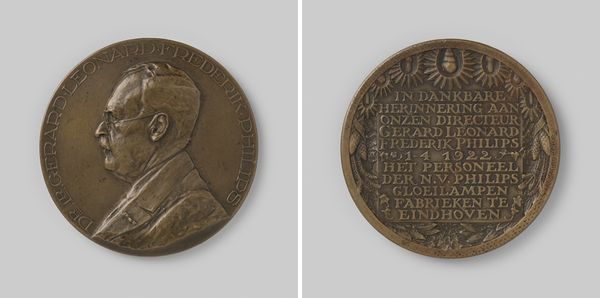
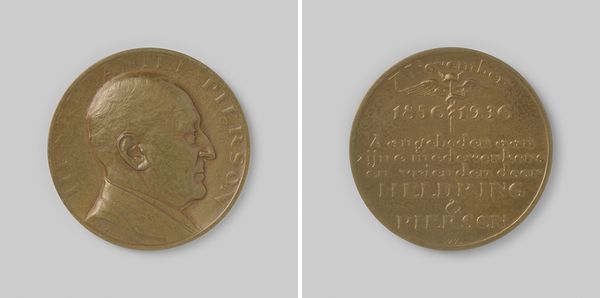
Veertigjarige herdenking van de aanstelling van W.K.F. Zwierzina, penningkundige, bij Registratie en Domeinen 1925 1925
0:00
0:00

bronze, sculpture
#
portrait
#
medal
#
sculpture
#
bronze
#
sculpture
Dimensions: diameter 9.8 cm, weight gr
Copyright: Rijks Museum: Open Domain
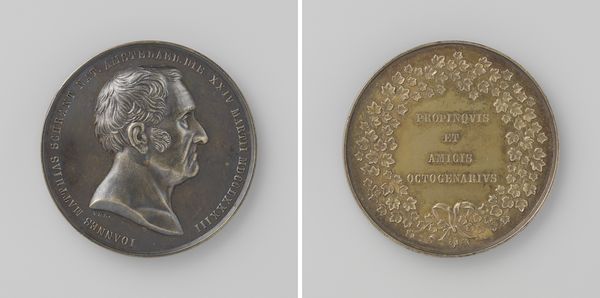
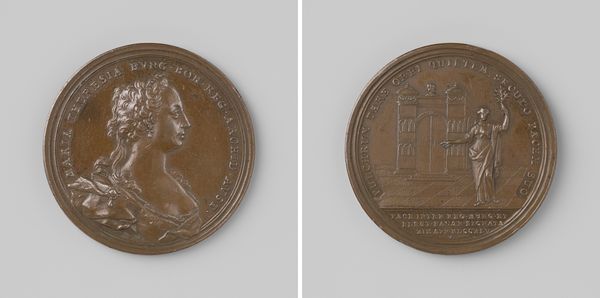
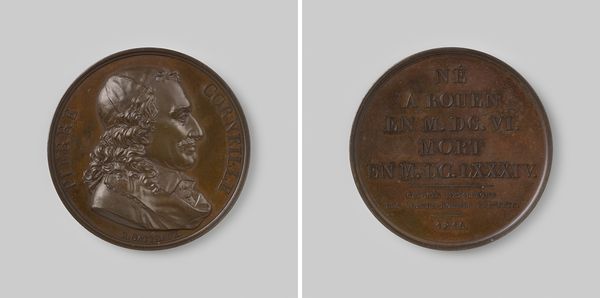
Editor: This bronze sculpture from 1925, a commemorative medal honoring W.K.F. Zwierzina by Jacob Jan van Goor, feels surprisingly modern despite its age. The crisp profile and detailed text have an almost graphic quality. What formal elements strike you the most? Curator: Observe how the composition divides the circular space into two distinct fields. The obverse presents a neoclassical profile, precise and contained. Contrast this with the reverse: the text, framed by botanical motifs, asserts a different kind of order, one concerned with record and commemoration. Do you notice how the inscription circles the edge mimicking the frame in which the subject’s face lives? Editor: I see that now! It’s like two halves of a story, a face and the words that define its history. Curator: Precisely. And consider the material: bronze. Its inherent properties – its capacity for fine detail and its potential for patination – are fully exploited here. It captures the subtlety of light, offering an impression of depth despite the work’s relatively shallow relief. Editor: So the artist is playing with contrasts, between image and text, profile and record, light and shadow, to create meaning. Curator: Indeed. Van Goor is engaging with fundamental principles of form and composition to elevate a commemorative object into a study of order, meaning and purpose. Editor: This deeper look really changed my perspective from something 'graphic' to a formally thoughtful piece. Thank you for illuminating these artistic aspects. Curator: You're welcome. Analyzing its formal language truly enriches our understanding.
Comments
No comments
Be the first to comment and join the conversation on the ultimate creative platform.
 Collect
 React
React Comment
More like this