About this artwork
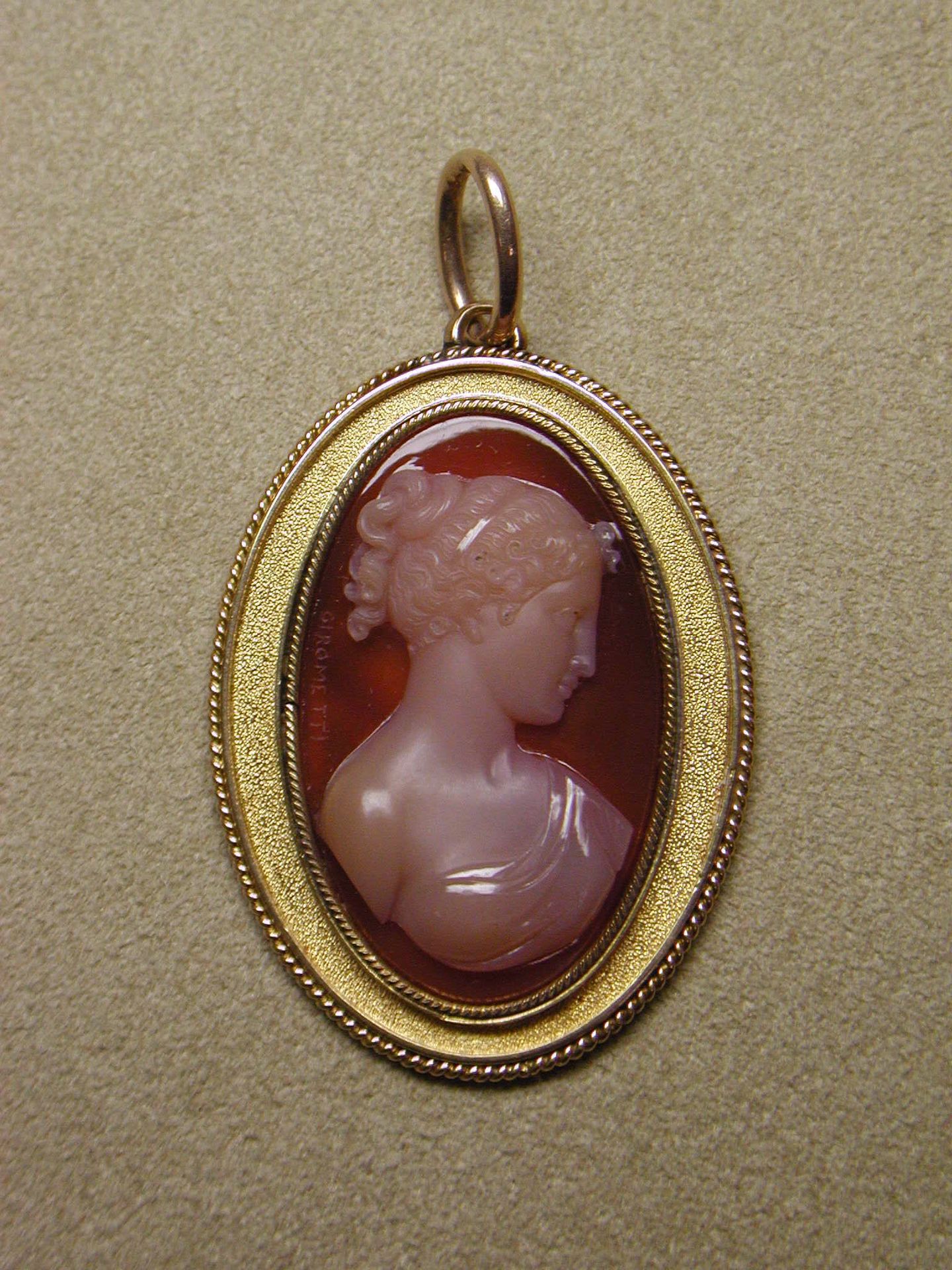
Giuseppe Girometti carved this cameo of a young woman from layered agate, a popular material in early 19th-century Rome. Girometti, who later became the Chief Engraver at the Papal Mint, excelled in the refined Neoclassical style, seen here in the delicate carving and idealized features of the figure. The image looks back to ancient Greece, a time of republics and democracies, to hint at progressive ideas. In a society still dominated by aristocratic power, artists subtly expressed new ideas. The cameo format itself had associations. As portable objects often worn as jewelry, cameos helped spread these images and, by extension, their underlying ideals, across social circles. By studying Girometti’s career and the market for cameos in Rome, we can better understand how art circulated within specific social and political contexts, and how it helped to shape the sensibilities of its time.
Bust of a young woman 1800 - 1815


Artwork details
- Medium
- carving, relief, sculpture
- Dimensions
- Overall: 1 1/2 x 1 7/16 in. (3.8 x 3.7 cm); visible cameo (confirmed): 30.4 x 18.7 mm
- Location
- Metropolitan Museum of Art, New York, NY
- Copyright
- Public Domain
Tags
portrait
neoclacissism
carving
relief
sculpture
decorative-art
profile
Comments
No comments
About this artwork
Giuseppe Girometti carved this cameo of a young woman from layered agate, a popular material in early 19th-century Rome. Girometti, who later became the Chief Engraver at the Papal Mint, excelled in the refined Neoclassical style, seen here in the delicate carving and idealized features of the figure. The image looks back to ancient Greece, a time of republics and democracies, to hint at progressive ideas. In a society still dominated by aristocratic power, artists subtly expressed new ideas. The cameo format itself had associations. As portable objects often worn as jewelry, cameos helped spread these images and, by extension, their underlying ideals, across social circles. By studying Girometti’s career and the market for cameos in Rome, we can better understand how art circulated within specific social and political contexts, and how it helped to shape the sensibilities of its time.
Comments
No comments