fibre-art, weaving, textile, cotton
#
african-art
#
fibre-art
#
weaving
#
textile
#
geometric
#
cotton
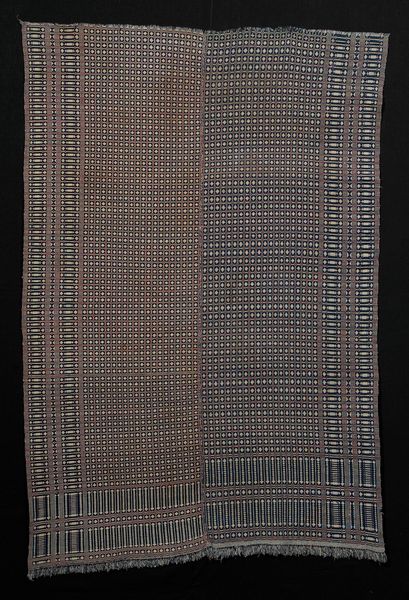
Dimensions: 112 1/2 x 77 3/4 in. (285.75 x 197.49 cm)
Copyright: Public Domain
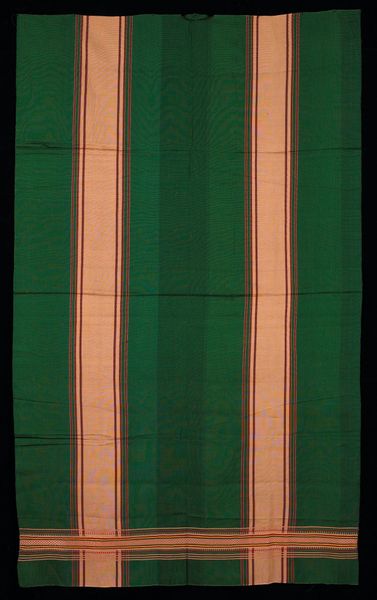
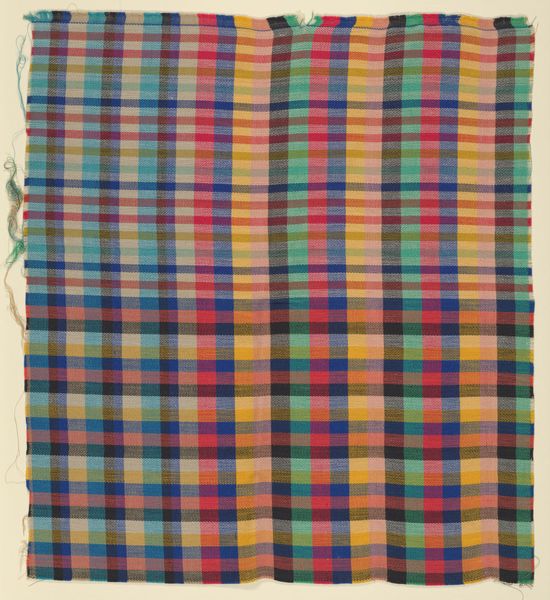
Curator: Oh, isn't this cloth soothing? I find my eyes dancing all over the vibrant green, playful geometric shapes, and stripes. What a whimsical, elegant pattern! Editor: Indeed! The “Man’s Cloth”, from the Anlo Ewe people, was probably crafted in the 20th century. We’re looking at a textile made of cotton. It’s held here at the Minneapolis Institute of Art, and when you consider its probable function, you realize it embodies complex histories of cultural exchange. Curator: It does feel…narrative somehow. Not a story I can readily name, but I imagine the weaver embedded meanings with those small dashes of ochre and gold floating amid the vertical stripes. Are those references to daily life, lineage, proverbs, do you think? Editor: Perhaps! Each design choice would have communicated a network of social meanings about its owner. Textiles were crucial to maintaining status in society. I can only wonder how its meanings shift when it migrates to a museum setting. Curator: Absolutely. Placed on a wall instead of worn or displayed during ceremonies…that very transition transforms the work, doesn’t it? What tales does it silently recount to us now? It's quite evocative of landscape... a bird's-eye view of agricultural fields maybe? Editor: I can see that. But perhaps this wasn't necessarily supposed to be read like a literal illustration. Thinking about pattern and decoration art movements, I wonder about how repeating motifs create abstract or symbolic worlds through geometric abstraction. Curator: A secret world, maybe even! Its own form of poetry, a gentle reminder that stories can live within colors, patterns, and threads. I am curious about its life, if this weaving provided warmth, celebration, or witnessed milestones. Editor: It's definitely an entry point into different ways of communicating value, visually. A piece of global culture, repurposed, redefined with each setting, but never really losing that silent language of design it holds within its fibres. Curator: Absolutely, let’s linger with the image and invite the cloth to converse silently to those visiting here today. Editor: Indeed. It encourages you to delve into this vibrant language beyond verbal narration!
Comments

minneapolisinstituteofart almost 2 years ago
⋮
The Ewe people include several distinct cultural groups, two of which have significant Kente traditions. The Ewe Anlo produce a cloth that is very different from the Asante or the Ewe Adangbe styles. Eliminating the blocks and stripes of color, Anlo weavers float typical Ewe motifs, such as umbrellas, hands, combs, and drums, on a plain ground or on a surface of subtle striping. Strips containing imagery alternate with strips segmented by narrow color bars. The effect conveys a sense of lightness and spontaneity that contrasts dramatically with the precision of the traditional basket weave layout of the other groups.


Join the conversation
Join millions of artists and users on Artera today and experience the ultimate creative platform.
 Collect
More like this