

2019
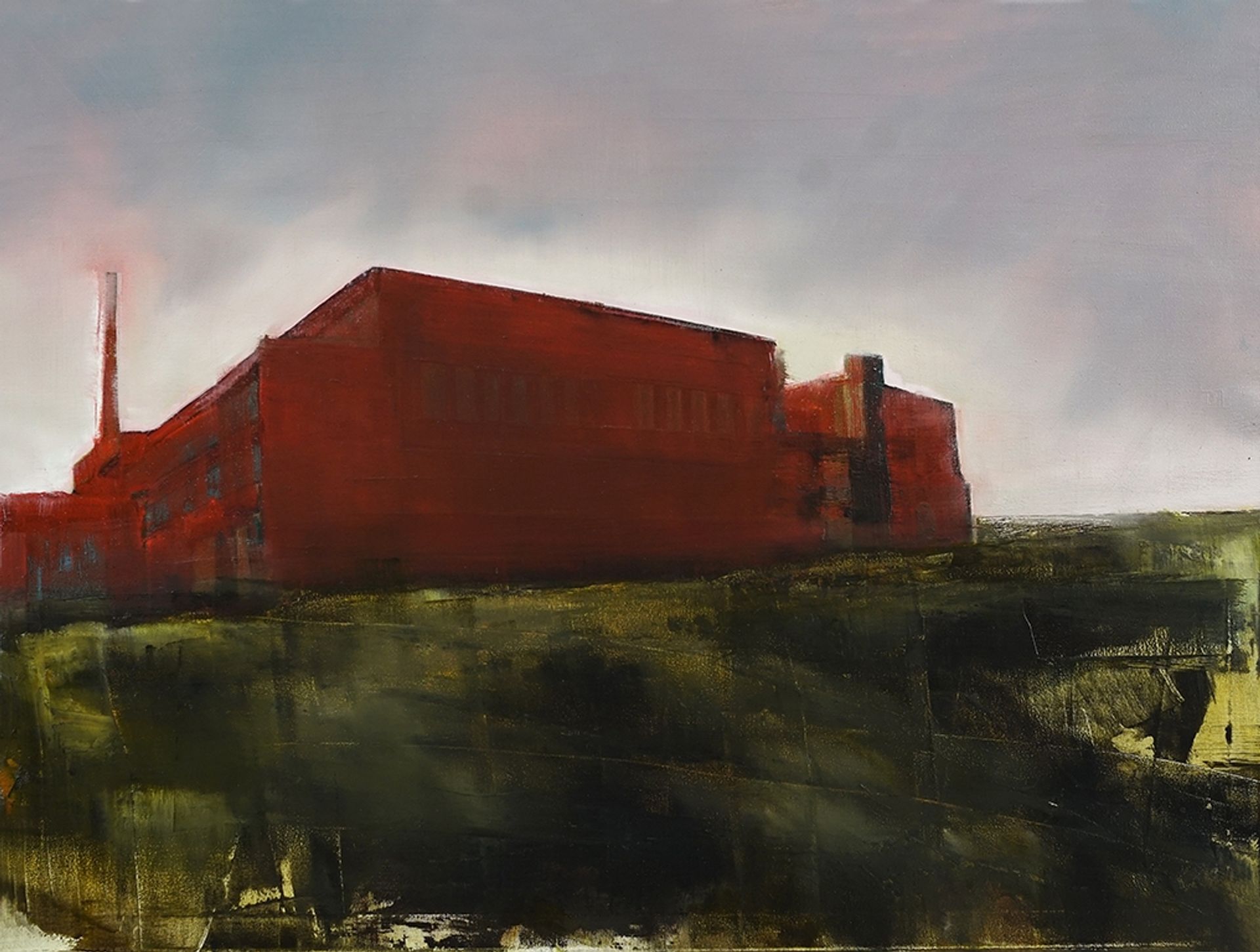
Alibaba data center, Qiandao Lake, Zhejiang, China

Listen to curator's interpretation
Curatorial notes
Curator: Before us, we have Jarik Jongman’s “Alibaba data center, Qiandao Lake, Zhejiang, China,” completed in 2019. Editor: The overwhelming feeling is… oppressive. That heavy red structure dominates the canvas. There's a starkness, an industrial weight. Curator: Indeed. Consider how Jongman has composed the painting. The imposing, block-like structure, rendered in thick strokes of oil paint, commands nearly all the pictorial space. Its stark geometry plays against the somewhat nebulous landscape. Editor: The materiality is striking. The impasto application, those dense layers of oil paint—they emphasize the sheer physical presence of this data center. It’s not just an image; it’s an object in itself. It also speaks volumes about labour, I wonder how many hours were needed to complete this. Curator: The interplay between abstraction and representation is fascinating. While the subject matter is clearly a physical structure, Jongman distorts it. It is pushed almost into pure form, a nod towards Modernist architectural ideals, wouldn’t you say? Editor: Agreed, but what of the less visible processes? What unseen labour sustains our insatiable digital demands. The Alibaba Data center, nestled at Qiandao Lake in Zhejiang China, represents a network of global proportions. Curator: The color choices heighten this tension. That muted palette of greys, greens, and the dominant red of the building establishes a palpable contrast between nature and technology, but the red, for me, evokes more of a feeling. It hints at the heat, the frenetic processing… the lifeblood of this digital entity. Editor: Exactly! The environmental impact alone—the sheer energy consumption needed to cool these facilities… Jongman’s expressionistic style evokes that environmental concern of such facilities. Curator: It prompts questions. Does technology dominate or harmonize with nature? Or neither? Editor: I see Jongman compelling us to grapple with our technological landscape. He does not offer a clean critique or glorification, only to make us think. Curator: A valuable reflection then on our contemporary existence. Editor: One that hopefully will encourage us all to rethink how we interact with our surroundings, the world, and technology.