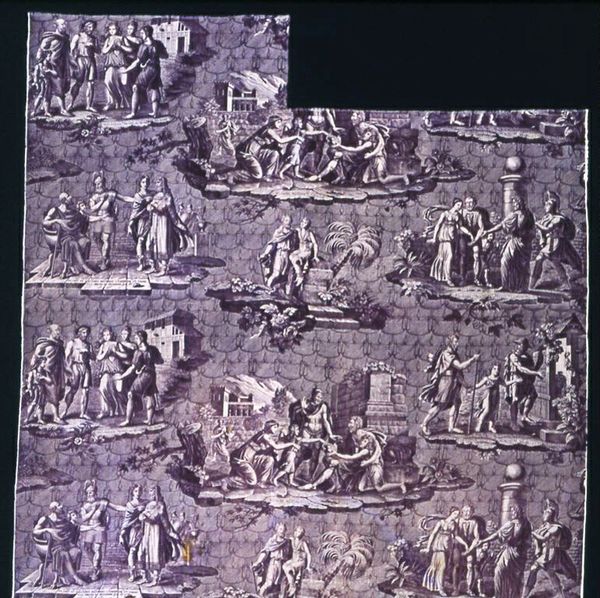
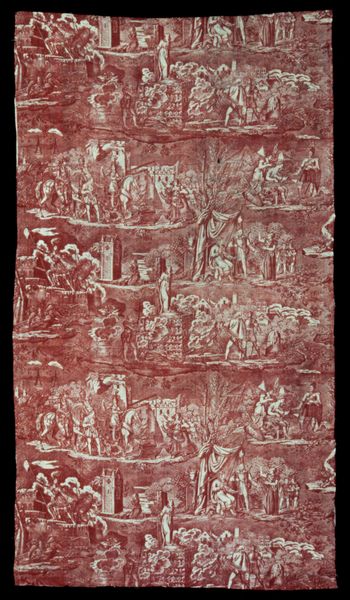
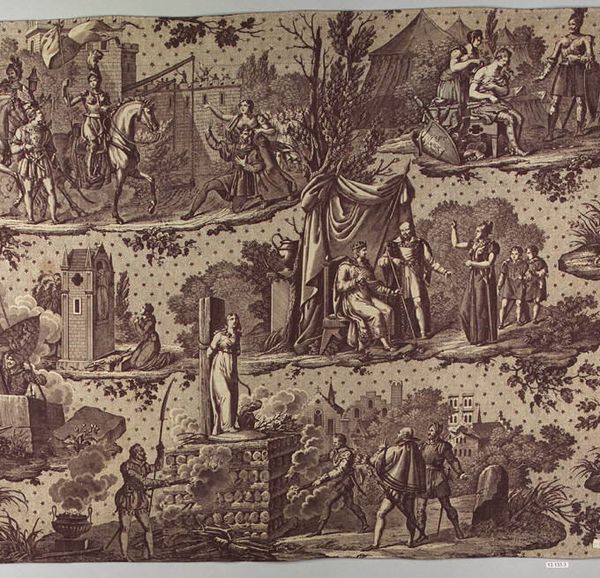
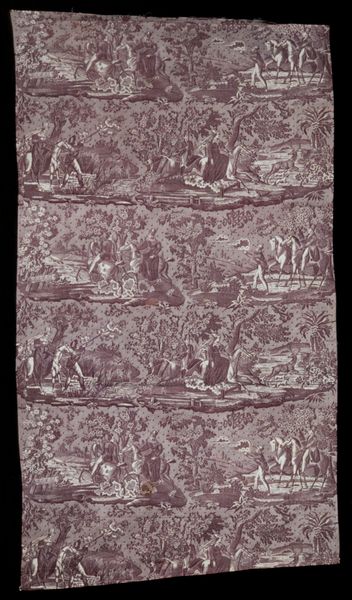
La Vie de Jeanne d'Arc (The Life of Joan of Arc) (Furnishing Fabric) after 1817
0:00
0:00


print, weaving, textile
#
narrative-art
# print
#
weaving
#
landscape
#
textile
#
figuration
#
romanticism
#
history-painting
Dimensions: 92.8 × 81.7 cm (36 1/2 × 32 1/8 in.) Warp repeat: 58.9 cm (23 1/8 in.)
Copyright: Public Domain
Editor: Here we have Charles Abraham Chasselat's "La Vie de Jeanne d'Arc," a furnishing fabric made after 1817. The monochrome palette and repeated narrative scenes give it a somewhat somber and weighty feel. What strikes you most about this piece? Curator: For me, it's about unpacking the image of Joan of Arc that Chasselat is presenting. It's not just a historical narrative, but a deeply political statement. Consider the Restoration period, when this textile was made. How might this romanticized vision of a young woman leading armies resonate within the sociopolitical landscape of post-revolutionary France? Editor: So you are saying the tapestry romanticizes Joan of Arc’s story to address the politics of its time? Curator: Exactly! And think about textiles as domestic objects, often associated with women. How does portraying Joan of Arc, a powerful female figure, in this medium challenge or reinforce contemporary notions of gender roles and national identity? Do you see any elements of the scenes that are highlighted or underplayed to serve this narrative? Editor: I see the battle scenes and her interaction with royalty...but there isn’t anything that seems to be about her trial or execution. Curator: Precisely! By focusing on her triumphs, it becomes a powerful symbol of French resilience and national pride during a period of rebuilding. But it also subtly silences a narrative of female defiance deemed dangerous, fitting Joan into a more palatable, less threatening, image. Editor: That's fascinating, I never considered how the choice of scenes would shape the political messaging. Curator: It's a reminder that art, even decorative art like furnishing fabric, can be deeply embedded in its historical and social context. Analyzing these choices gives voice to the cultural struggles embedded in everyday life. Editor: I will definitely consider the choice of narratives in artworks, thank you.
Comments
No comments
Be the first to comment and join the conversation on the ultimate creative platform.
 Collect
 React
React Comment
More like this