About this artwork
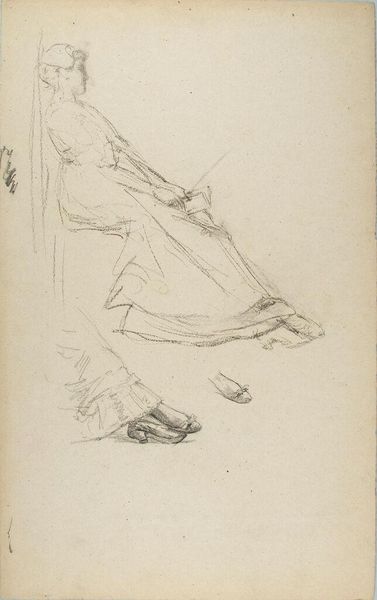
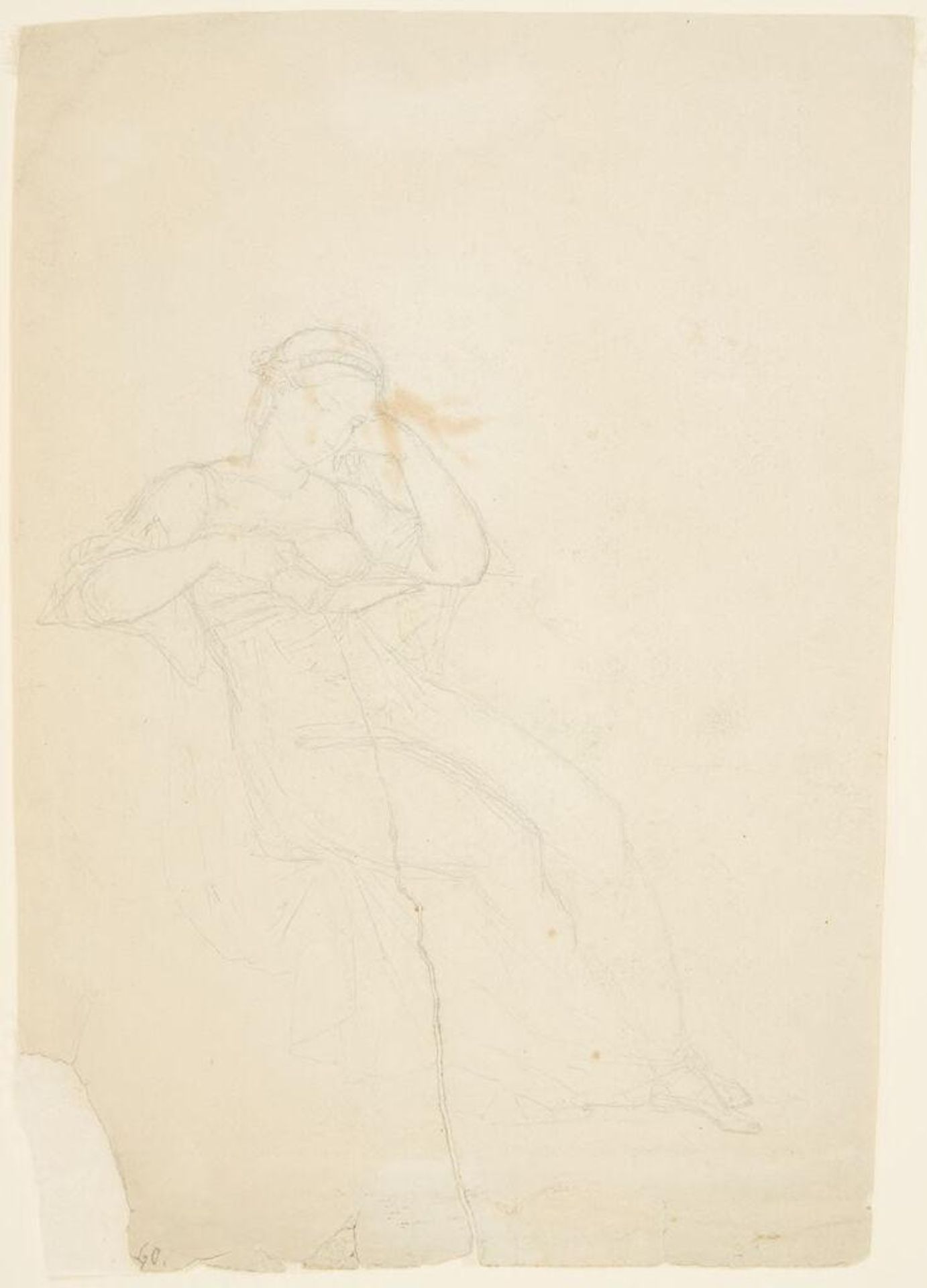
Curator: This delicate drawing by Washington Allston, titled "Full-Length Seated Woman Reading, for 'Contemplation'," captures a moment of quietude. Editor: It feels unfinished, almost ghostly. The subtle lines create a contemplative atmosphere. Curator: Allston was known for imbuing his works with symbolic weight. The act of reading itself signifies knowledge and introspection, a theme prevalent in his era. The woman's seated posture, with her hand supporting her head, is a traditional pose of melancholy. Editor: The composition, though simple, is quite effective. Note how the lines direct the viewer's eye to the figure’s face, even though it's only lightly sketched. The negative space emphasizes the figure's isolation and inward focus. Curator: Indeed. The work, though a preliminary sketch, evokes the emotional and intellectual climate of the early 19th century. Editor: It reminds us that art, even in its simplest form, can offer profound insights into the human condition.
Full-Length Seated Woman Reading, for "Contemplation"
c. 1816
Artwork details
- Dimensions
- 27.8 x 19.7 cm (10 15/16 x 7 3/4 in.)
- Location
- Harvard Art Museums
- Copyright
- CC0 1.0
Comments
Share your thoughts
About this artwork
Curator: This delicate drawing by Washington Allston, titled "Full-Length Seated Woman Reading, for 'Contemplation'," captures a moment of quietude. Editor: It feels unfinished, almost ghostly. The subtle lines create a contemplative atmosphere. Curator: Allston was known for imbuing his works with symbolic weight. The act of reading itself signifies knowledge and introspection, a theme prevalent in his era. The woman's seated posture, with her hand supporting her head, is a traditional pose of melancholy. Editor: The composition, though simple, is quite effective. Note how the lines direct the viewer's eye to the figure’s face, even though it's only lightly sketched. The negative space emphasizes the figure's isolation and inward focus. Curator: Indeed. The work, though a preliminary sketch, evokes the emotional and intellectual climate of the early 19th century. Editor: It reminds us that art, even in its simplest form, can offer profound insights into the human condition.
Comments
Share your thoughts