About this artwork
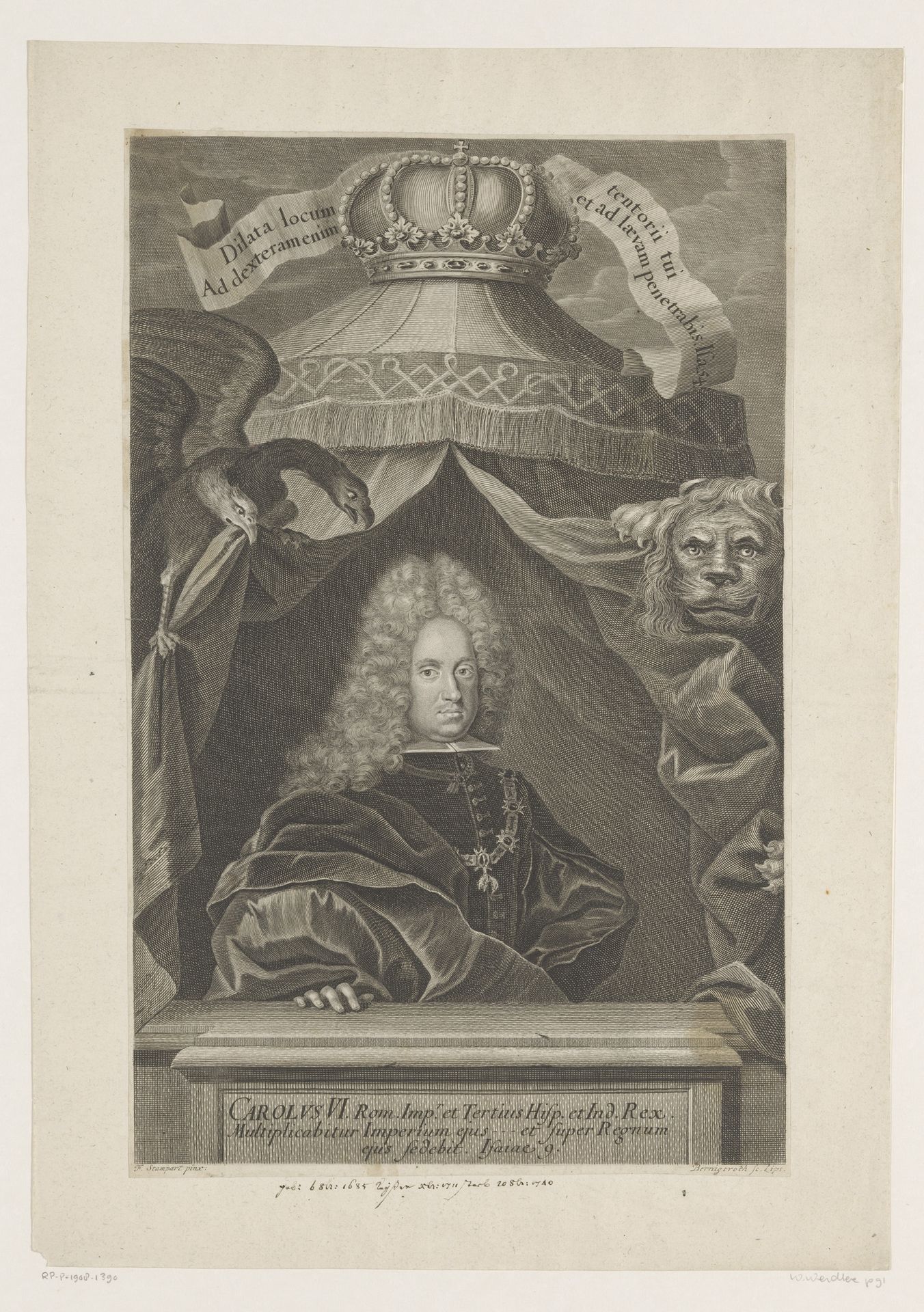
This is Martin Bernigeroth’s portrait of Charles VI, Holy Roman Emperor, made in the early 18th century. Bernigeroth, active in the courts of central Europe, captured the Habsburg emperor amidst elaborate symbols of power. Consider the weight of inherited identity: Charles embodies centuries of dynastic ambition and geopolitical strategy. Crowned by an oversized wig, itself a symbol of status, Charles is flanked by an eagle and a lion, regal emblems of empire. Note the Latin inscription, “Dilata locum tentorii tui et ad laevam penetrabis,” a divine decree to expand his territory. How might Charles have perceived his own identity, shaped by ancestral expectations and the demands of leadership? Bernigeroth's print echoes conventional displays of power. And yet, the human element persists. We see in Charles’s gaze the weight of his inherited position. This image operates at the intersection of personal identity and political representation.
Portret van Karel VI, Rooms-Duits keizer
1711 - 1733

Martin Bernigeroth
1670 - 1733Location
RijksmuseumArtwork details
- Medium
- print, metal, engraving
- Dimensions
- height 329 mm, width 212 mm
- Location
- Rijksmuseum
- Copyright
- Rijks Museum: Open Domain
Tags
Comments
Share your thoughts
About this artwork
This is Martin Bernigeroth’s portrait of Charles VI, Holy Roman Emperor, made in the early 18th century. Bernigeroth, active in the courts of central Europe, captured the Habsburg emperor amidst elaborate symbols of power. Consider the weight of inherited identity: Charles embodies centuries of dynastic ambition and geopolitical strategy. Crowned by an oversized wig, itself a symbol of status, Charles is flanked by an eagle and a lion, regal emblems of empire. Note the Latin inscription, “Dilata locum tentorii tui et ad laevam penetrabis,” a divine decree to expand his territory. How might Charles have perceived his own identity, shaped by ancestral expectations and the demands of leadership? Bernigeroth's print echoes conventional displays of power. And yet, the human element persists. We see in Charles’s gaze the weight of his inherited position. This image operates at the intersection of personal identity and political representation.
Comments
Share your thoughts