

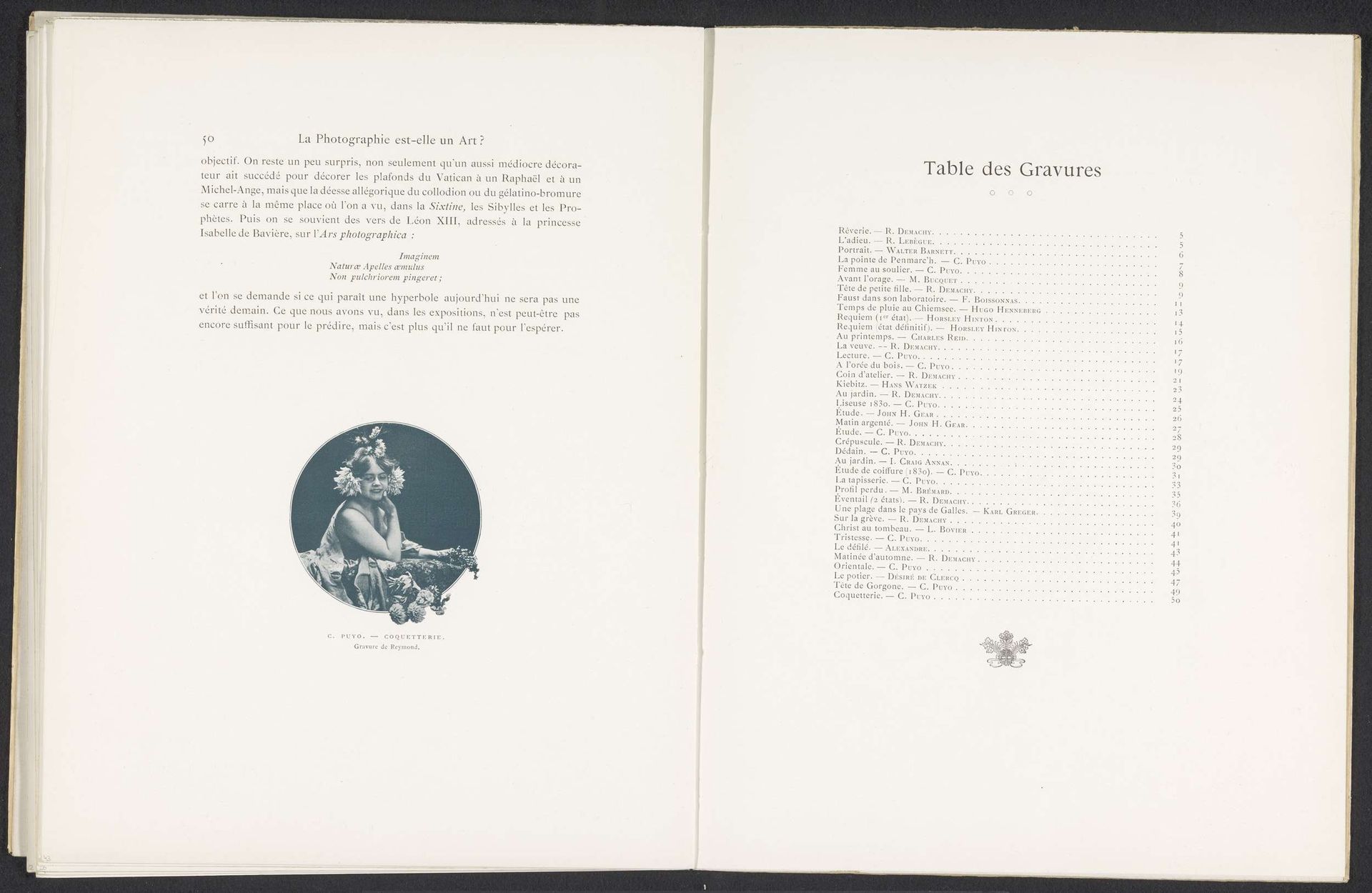
before 1899
Portret van een meisje met bloemen

Listen to curator's interpretation
Curatorial notes
Curator: What first grabs me about this Constant Puyo print, "Portret van een meisje met bloemen," made before 1899, is its wistful gentleness, an almost sighing quality to the tones. It makes me think of faded lace and the perfume of old roses. Editor: Faded it is, but the original context shouts rather than sighs, doesn't it? Pictorialist photography in this period was deeply enmeshed in debates about art versus craft, constantly performing its artistic credentials for an upper middle-class audience obsessed with status. Curator: Status absolutely, but what about the soft focus, that almost dreamlike remove? Isn't that more than just class aspiration? Editor: Well, the soft focus itself comes from a very deliberate and laborious process. These photographic prints were often manipulated extensively during development, layered with different chemicals and toners precisely to differentiate them from mass-produced images. Curator: I suppose for Puyo it was crucial that the finished photograph should aspire to the painterly style, the almost idealized composition? It gives an illusion that something unique had occurred in the encounter between sitter and artist. Editor: The making here performs a certain kind of labor. And it is not about revealing truth, it's more interested in artifice. It borrows its conventions from academic art but employs distinctly modern means of production, and moreover speaks to the rise of photography as a pursuit of amateur gentlemen. Curator: You are quite right; the artifice really does make me reconsider how spontaneous her gaze is, how fleeting that dreamy expression seems. She has a self-possession that almost wasn’t there a minute before. It reminds me of a fleeting memory trying to emerge from a dream. Editor: Exactly. What we think of now as stylistic choices were embedded in material processes that elevated certain kinds of making, reflecting both cultural anxieties and industrial innovation, a moment pregnant with possibility, not quite yet weighed down by the cheap image. Curator: I like thinking about it this way, more than simply “aspirational," which does seem like too easy a judgement. Thank you. Editor: My pleasure.