lithograph, print
#
lithograph
# print
#
cityscape
#
realism
Dimensions: 551 mm (height) x 355 mm (width) (bladmaal)
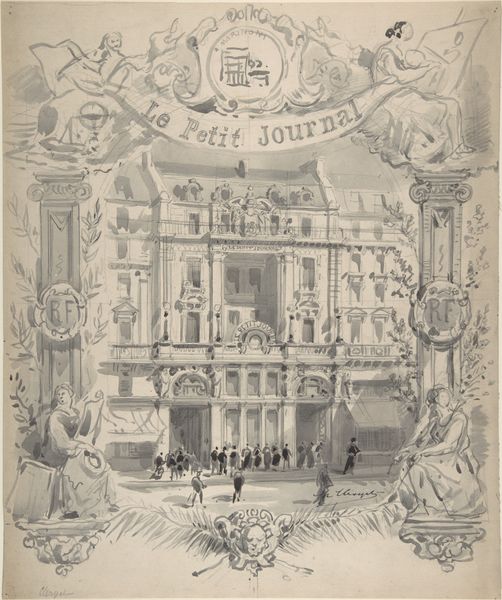
Curator: I'd like to draw your attention to this lithograph from 1855, titled "Hofskomager P.R. Schmidts Enke, reklameplakat." It resides here at the SMK, the Statens Museum for Kunst. Editor: The first thing that strikes me is the level of detail; the textures within the city street scene seem incredibly sharp. But it has a decorative and almost theatrical air to it, like a backdrop for a play rather than a document. Curator: Yes, while we might categorize it broadly as realism, it is less concerned with objective rendering than with the rhetoric of commercial art. Notice how the building of the Hofskomager P.R. Schmidt's Enke, which I gather to mean "Court Shoemaker P.R. Schmidt's Widow" dominates the pictorial space, meticulously depicted to convey prosperity and stability. The business and cityscape form a harmonious, if idealized, whole. Editor: Agreed. It speaks volumes about the burgeoning urban consumer culture in Copenhagen at the time, especially the way commercialism was shaping the very identity of the city's streets. How does it play into the historical positioning of lithography as an accessible medium? Curator: Precisely. The use of lithography allowed for mass production and distribution of images, transforming public spaces into arenas for visual persuasion. Moreover, the choice to represent not only the architecture but also figures strolling adds life and legitimacy, creating a subtle dialogue with the intended audience—perhaps a conscious reflection of contemporary societal aspirations? Editor: So, rather than passively mirroring reality, this print actively crafts a particular narrative about urban life, doesn’t it? It is intriguing how this image operates on multiple levels, both as advertisement and historical record. Thanks, I learned a lot today. Curator: An observation well put! Understanding its layered composition—from micro-architectural fidelity to the macro-socioeconomic forces—illuminates so much regarding Denmark in that era.
Comments
No comments
Be the first to comment and join the conversation on the ultimate creative platform.
 Collect
 React
React Comment
More like this