painting, acrylic-paint
#
portrait
#
contemporary
#
painting
#
acrylic-paint
#
indigenism
#
figuration
#
male portrait
#
portrait art
Copyright: Nyoman Masriadi,Fair Use
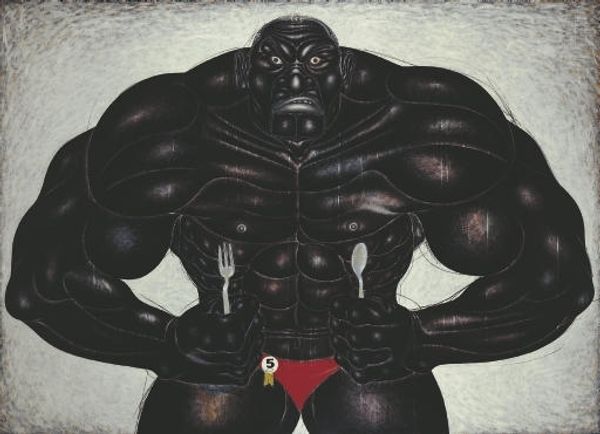
Editor: Here we have Nyoman Masriadi's "Shangri-La," a vibrant acrylic painting depicting a muscular, dark-skinned figure. The overall effect is, well, striking! What's your take on this bold piece? Curator: It certainly demands attention. Masriadi's work often grapples with themes of globalization and cultural identity, particularly within the Indonesian context. How do you see this fitting into those dialogues? Editor: The title, "Shangri-La," paired with this hyper-masculine figure…is there some kind of tension? Is it suggesting the idealized paradise has been, shall we say, colonized? Curator: Precisely! Think about the historical fascination with the 'exotic' and how that intersects with the male form, especially in a postcolonial world. The figure is literally blackened, almost as caricature, yet monumentalized, his presence unavoidable. Who controls the image, and to what end? Editor: And the bubbles? They seem so innocent and playful against the darkness of the figure, but it still strikes an unsettling balance. Are they a symbol of aspiration, floating out of reach? Curator: They add to that complexity, don't they? Are they symbols of a manufactured happiness, like a commercial jingle for paradise? Or do they mock such simple hopes when considered within the shadow of this person? Masriadi challenges us to untangle these visual cues. Editor: I never would have connected it with colonialism. So the museum's context reframes it? Curator: Absolutely. The institution plays a key role in assigning value, facilitating interpretation, and enabling the work to engage in a wider social and political discussion. Editor: This has shifted my understanding considerably. I’ll be looking at this painting, and others, very differently now. Curator: The real art, in a sense, lies in the ongoing conversation itself. The artwork's position sparks fresh debates on the nature of history and identity.
Comments
No comments
Be the first to comment and join the conversation on the ultimate creative platform.
 Collect
 React
React Comment
More like this