Dimensions: height 477 mm, width 273 mm
Copyright: Rijks Museum: Open Domain
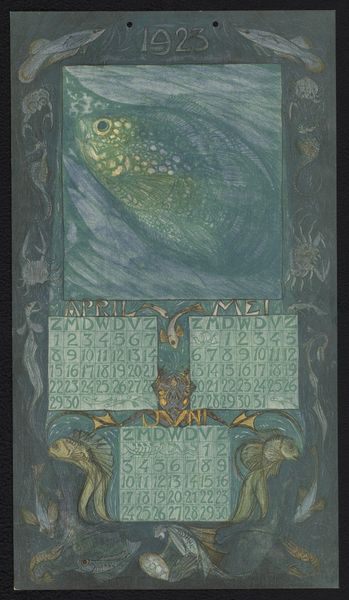
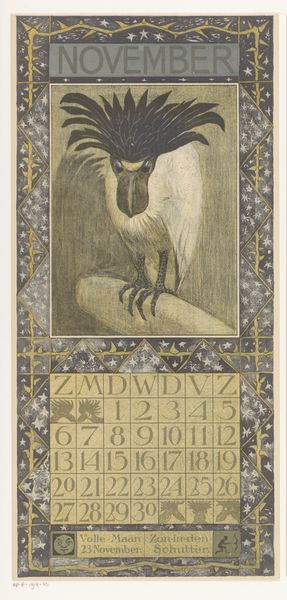
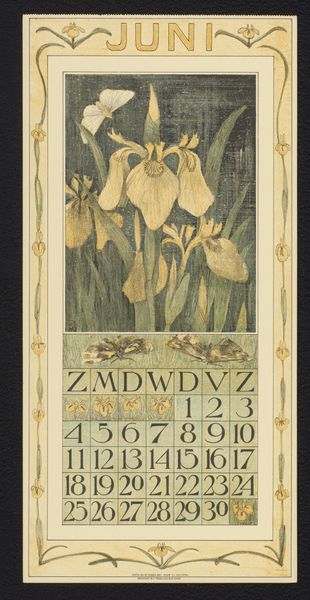
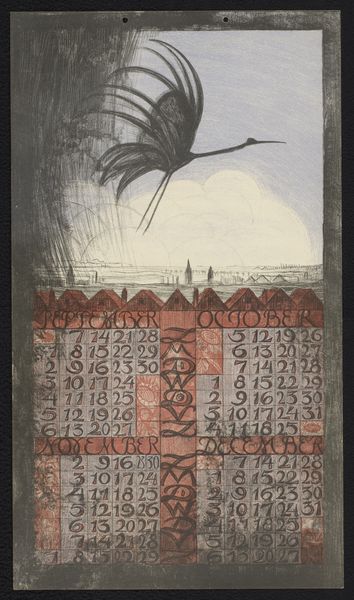
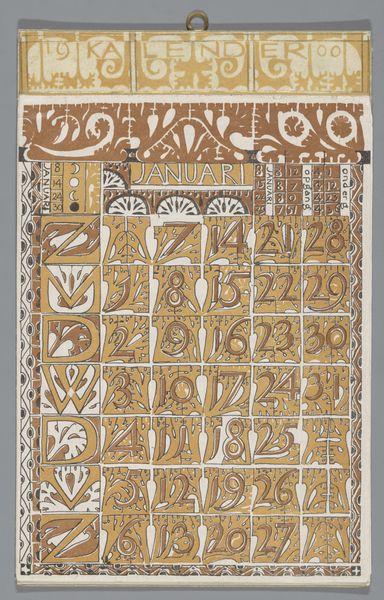
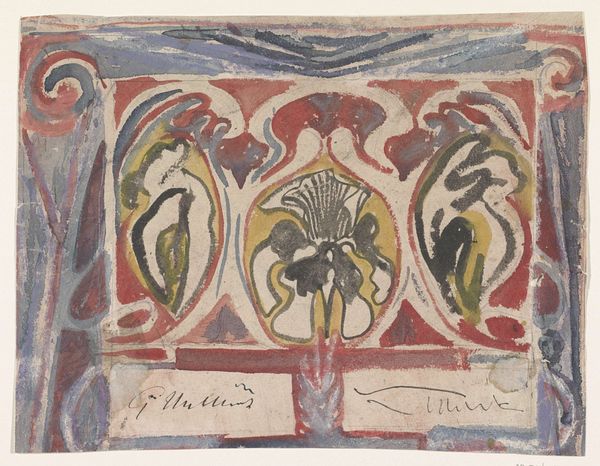
Curator: This curious calendar, designed by Leo Visser around 1923, presents the months of May through August in 1924. It's rendered in ink and pencil on paper, a beautifully handcrafted object from a bygone era. Editor: It certainly feels like a world unto itself. The composition is dense, a kind of utopian vision with its exotic flora and fauna presiding over the grid of dates. A space where our contemporary understanding of identity, gender, race and politics finds little anchoring. Curator: Let’s unpack that a bit. What readings do you see within that dense layering? My immediate inclination is towards the social function it performed, both practically, as a functional calendar, and aesthetically, embodying a turn-of-the-century Art Nouveau sensibility. Editor: Beyond that function, which, I concede is important, consider its possible reception in its own time. The stylized animals, particularly the gazelle and what appears to be a stork, are presented within the calendar, and might reflect a yearning for the 'Orient', but do they signify something deeper regarding the politics of display and colonial power at that moment in time? Curator: Perhaps, though it strikes me more as an embracing of the decorative potential that art nouveau offered, turning even the mundane – tracking dates – into an aesthetic experience. The flattened perspective, the bold outlines – it all speaks to that stylistic movement. And consider Visser himself; what are the social and historical currents influencing *his* vision? Editor: That is what is crucial; contextualizing the work not merely as art-for-arts-sake, but to investigate it’s intersectional position. Looking at similar work could bring to light colonial influence. Curator: Perhaps our own assumptions might unduly weight those readings. I mean, it's undeniable there’s a romantic exoticism, but how actively it engages with, or critiques, existing power structures of its time... that’s where the question lies. Editor: I can certainly agree with the tension that arises in evaluating it by today's values and sensibilities. At the very least, the discussion allows for those power dynamics to reveal themselves. Curator: Indeed, a tangible representation of an artistic era and also as an enduring prompt, asking us to think about its place within broader societal frameworks.
Comments
No comments
Be the first to comment and join the conversation on the ultimate creative platform.
 Collect
 React
React Comment
More like this