About this artwork
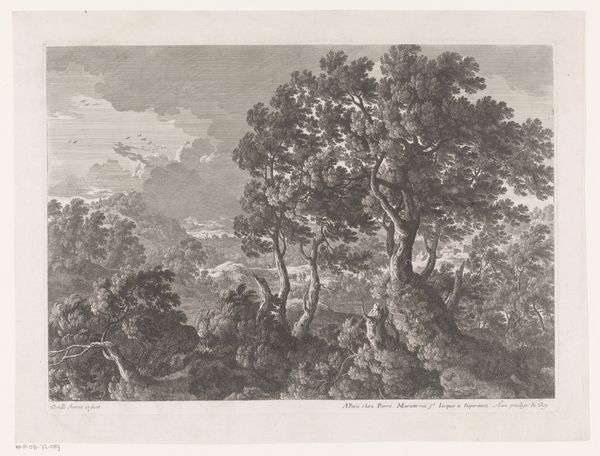
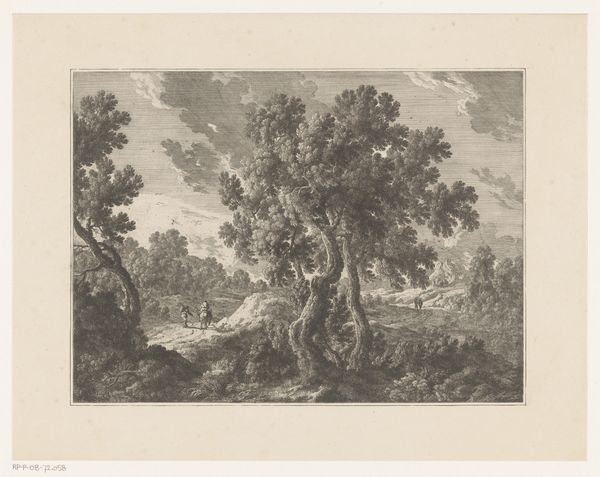
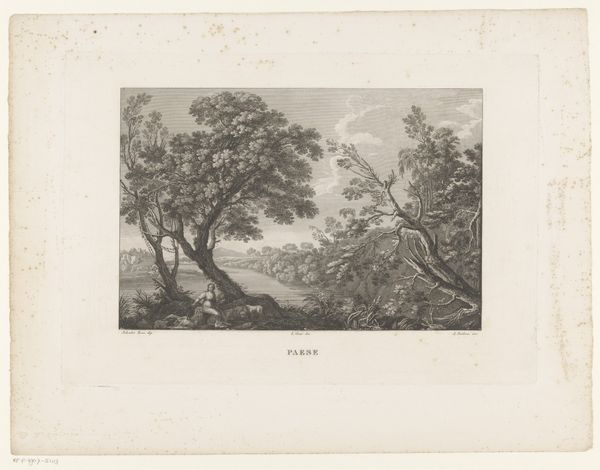
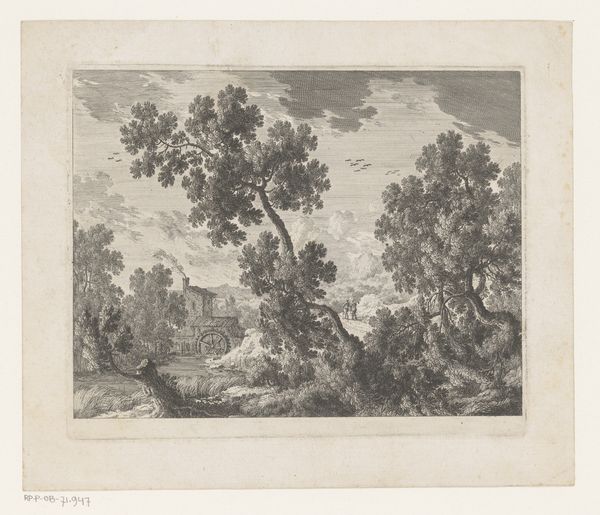
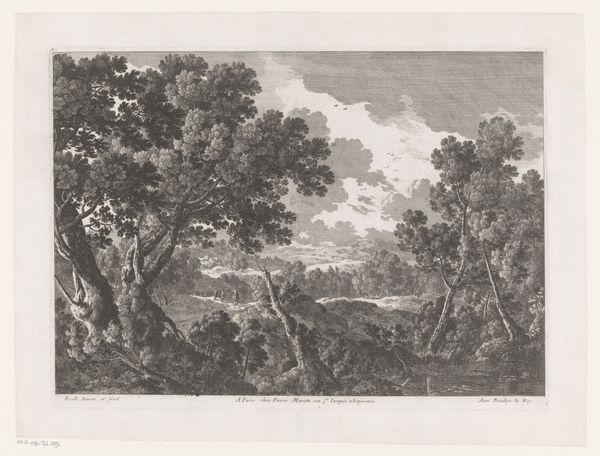
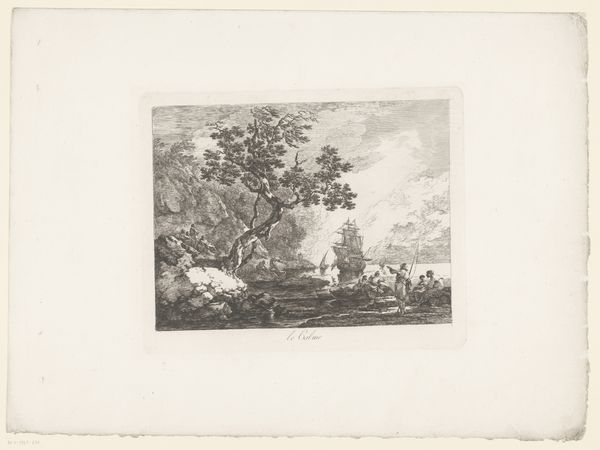
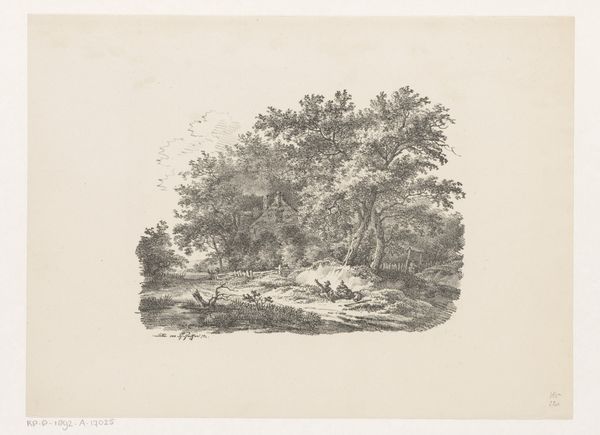
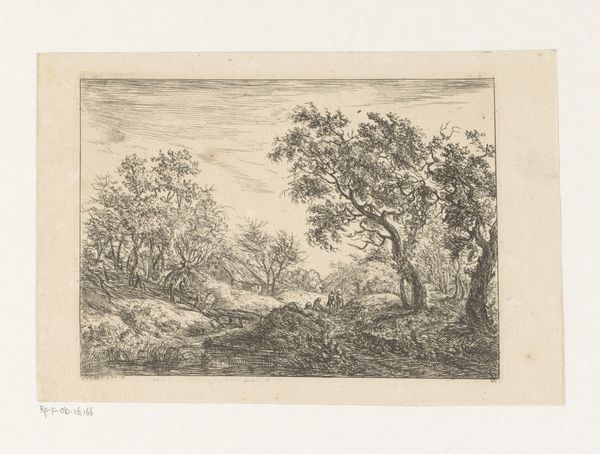
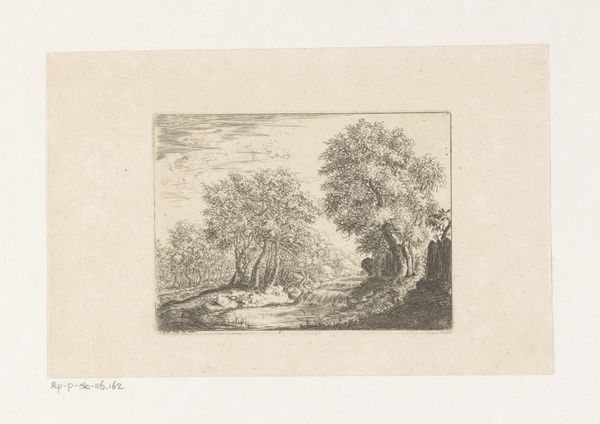
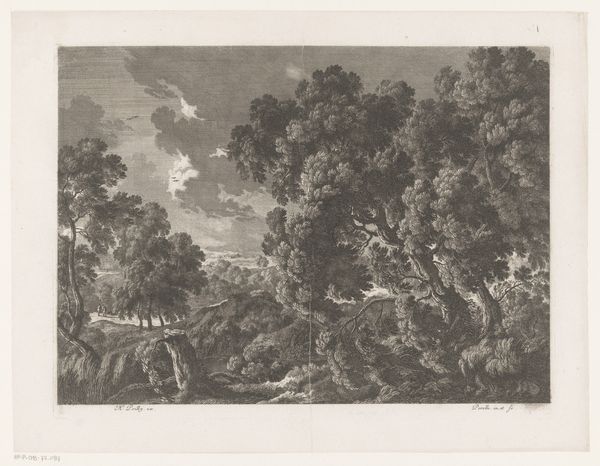
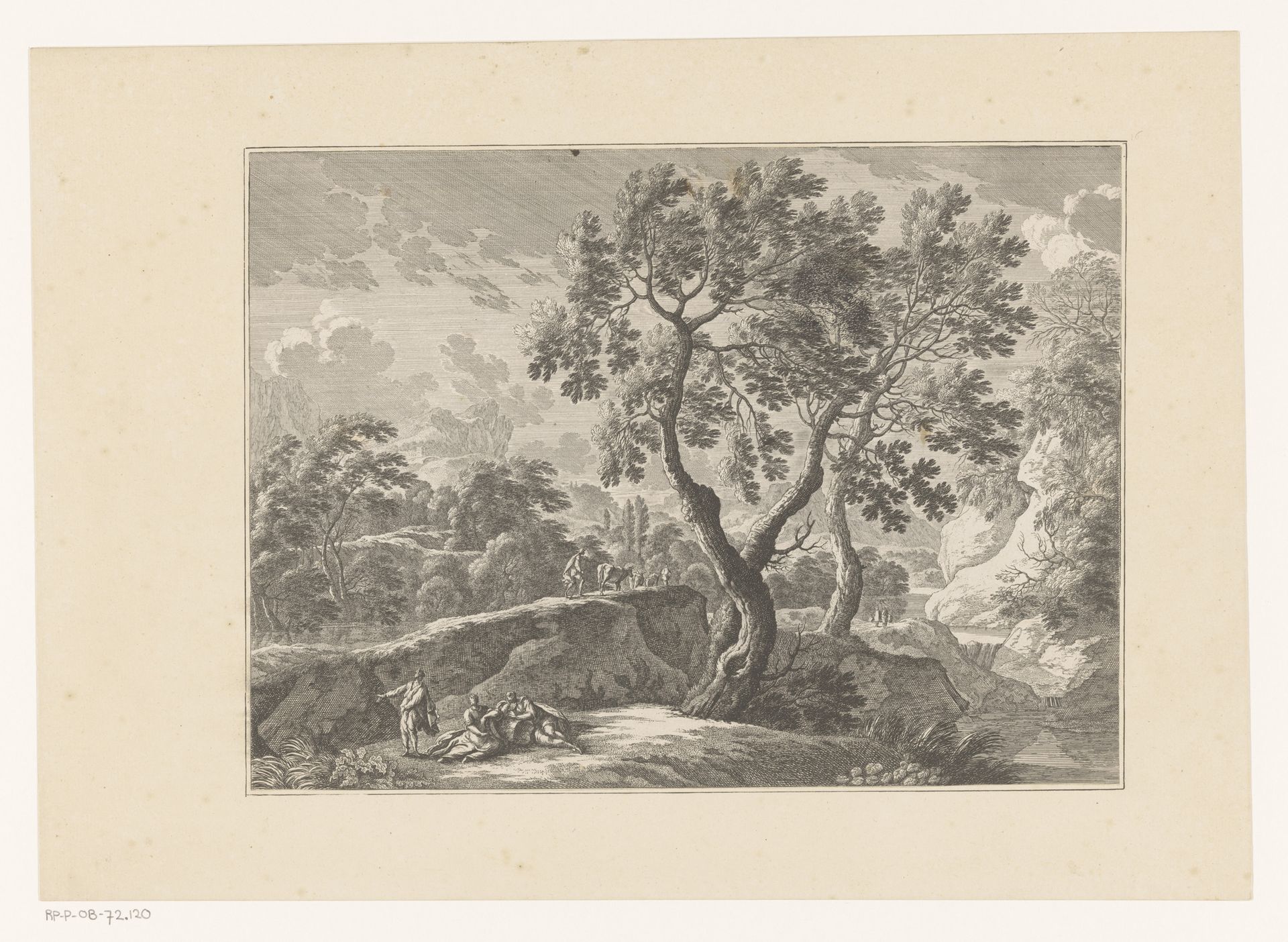
Editor: This is *Landscape with Three Trees in the Middle* by Nicolas Perelle, made sometime between 1613 and 1695. It’s an etching, so lines and textures are everything. I find it very tranquil; the figures seem to be enjoying the landscape rather than working it. What do you see in this piece? Curator: Intriguing question. Formally, the composition establishes a visual hierarchy. The trees, centrally positioned, function as a repoussoir, directing the gaze into the receding planes of the landscape. Consider the foreground figures: are they truly at rest, or do they subtly contribute to the modulation of light and shadow that articulates spatial depth? The density of the etched lines defines the tonal range, which evokes the materiality of the scene. Editor: So the positioning and darkness creates depth, almost like layers in the picture. I see your point about the figures—they're more than just details; they're compositional tools. Do you think the relative lack of detail helps draw your eye through the image? Curator: Precisely. It also speaks to the power of line. Examine how Perelle employs hatching and cross-hatching. Note that these elements aren’t merely descriptive. They define the character and texture of the leaves, the rock, the bark of the trees. Semiotically, we might consider these strokes as 'signs' that articulate 'nature' within a framework of artistic conventions. Do you see it? Editor: Definitely, and understanding those conventions can give the piece a completely different meaning to a contemporary eye. Thanks for highlighting these compositional relationships. Curator: Indeed. Visual language and its nuances allow a greater appreciation for its materiality. A pleasure.

Artwork details
- Medium
- drawing, print, etching, paper
- Dimensions
- height 229 mm, width 311 mm
- Location
- Rijksmuseum
- Copyright
- Rijks Museum: Open Domain
Tags
Comments
Share your thoughts
About this artwork
Editor: This is *Landscape with Three Trees in the Middle* by Nicolas Perelle, made sometime between 1613 and 1695. It’s an etching, so lines and textures are everything. I find it very tranquil; the figures seem to be enjoying the landscape rather than working it. What do you see in this piece? Curator: Intriguing question. Formally, the composition establishes a visual hierarchy. The trees, centrally positioned, function as a repoussoir, directing the gaze into the receding planes of the landscape. Consider the foreground figures: are they truly at rest, or do they subtly contribute to the modulation of light and shadow that articulates spatial depth? The density of the etched lines defines the tonal range, which evokes the materiality of the scene. Editor: So the positioning and darkness creates depth, almost like layers in the picture. I see your point about the figures—they're more than just details; they're compositional tools. Do you think the relative lack of detail helps draw your eye through the image? Curator: Precisely. It also speaks to the power of line. Examine how Perelle employs hatching and cross-hatching. Note that these elements aren’t merely descriptive. They define the character and texture of the leaves, the rock, the bark of the trees. Semiotically, we might consider these strokes as 'signs' that articulate 'nature' within a framework of artistic conventions. Do you see it? Editor: Definitely, and understanding those conventions can give the piece a completely different meaning to a contemporary eye. Thanks for highlighting these compositional relationships. Curator: Indeed. Visual language and its nuances allow a greater appreciation for its materiality. A pleasure.
Comments
Share your thoughts