

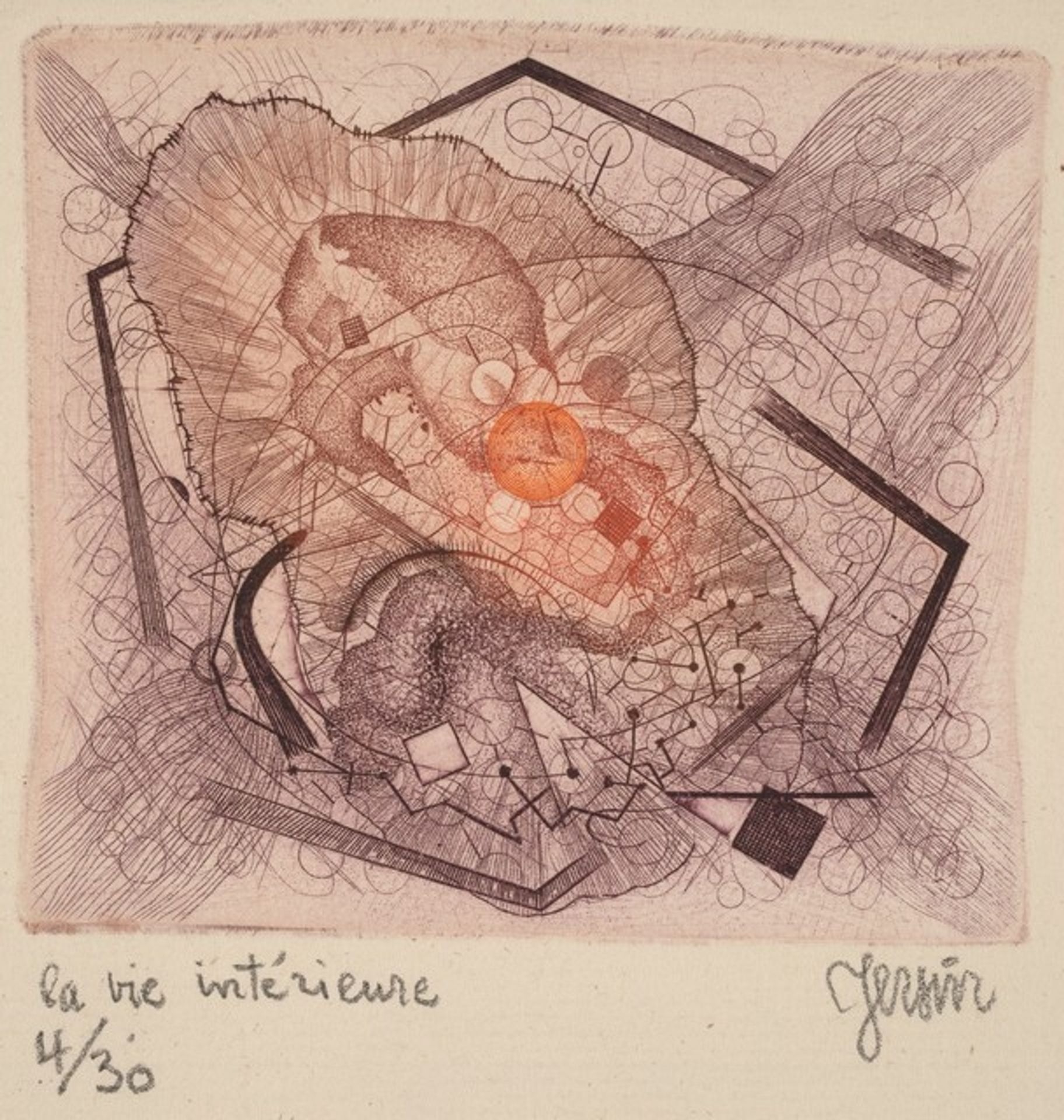
La Vie Interieure (The Interior Life)


Listen to curator's interpretation
Curatorial notes
Curator: This work is titled *La Vie Intérieure*, or *The Interior Life*. It’s a drawing and print by Albert Edgar Yersin. Editor: It's certainly… intricate. It gives the impression of something deeply layered, a sort of fragmented mental landscape. The density of lines is quite striking. Curator: Absolutely. Note how Yersin deploys geometric shapes—squares, circles—within and against what appear to be organic, almost biomorphic forms. This contrast establishes a compelling visual tension, a dialectic, perhaps, between the rational and the irrational. Editor: I find it interesting that the printing process itself must have required considerable skill. Look at the layering; you can almost feel the pressure and the sequence, not only in its visual composition but also the actual physicality, the applied labor needed to transfer the image from one surface to another. How many prints were created, do we know? Curator: It appears to be number 4 of an edition of 30. And observe how line dominates here, structuring the composition and guiding our eye. This emphasis evokes a sense of underlying structure beneath the visible surface of the interior life. Editor: The raw process adds meaning. The density and thin quality of the material—of line after line etched or drawn—mirrors how interiority may be constructed: with a constant buildup of ideas, reflections, experiences—some fragile, some firm—within the frame of our inner space. And yet this so-called intimate space is bound by a frame, the external constraints, a tension in the image itself. Curator: Precisely. It also raises the interesting question: if this is *interior* life, what makes it public once printed and put on view? What semiotic transformation does the work of reproduction impose? Editor: Interesting thought. Looking at it this way offers an unexpected commentary on the role of labor, from inception of inner thoughts and making processes of Yersin to our own mental labor as audience when faced with decoding it. Curator: I agree entirely. Editor: For all its complexity, I am finding its beauty now. Thanks for exploring it with me. Curator: My pleasure. It’s an intricate work offering multiple valid points of interpretation.