

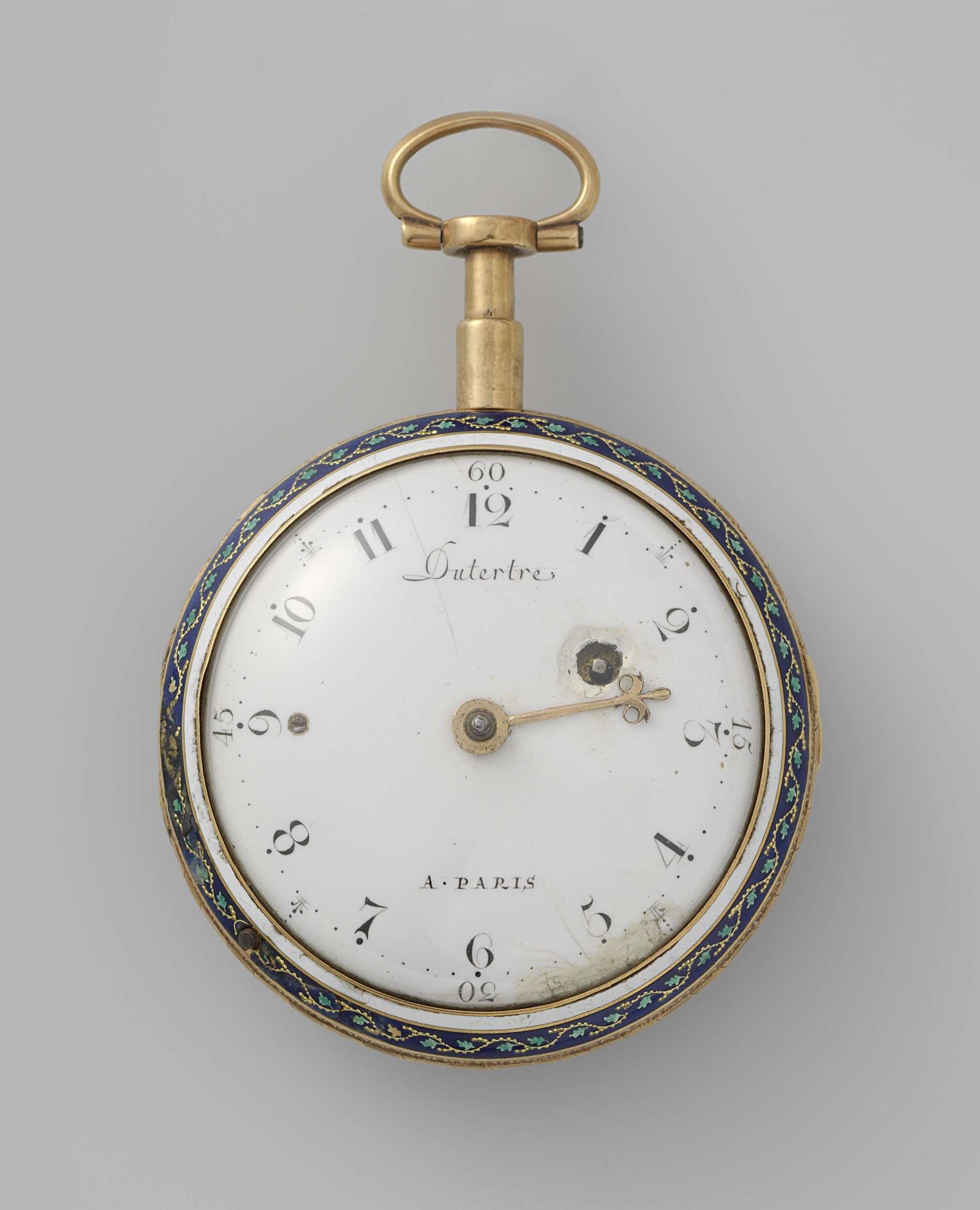
c. 1790 - 1800
Repeating Watch with Two Ladies at the Altar of Love

Listen to curator's interpretation
Curatorial notes
Curator: Oh, it’s utterly charming! Such a delicate thing. I imagine this ticking away, whispering secrets in some grand lady's pocket. A world of love, measured in moments! Editor: Indeed. What we're seeing is a repeating watch created by Firma Dutertre around 1790 to 1800. Notice how the neoclassical style, in its elegant restraint, is typical of the era. The watch isn't merely a functional object; it reflects broader cultural trends of the late 18th century. Curator: Restraint maybe, but not devoid of playful emotion, right? Look at that tiny altar of love with the two ladies...a scene on the back? I can only imagine the whispered rendezvous. What sort of narratives do you suppose a piece like this would have conjured then? Scandalous maybe? Editor: Possibly! Eroticized luxury items became increasingly popular from 1750, produced in series of around 100, sometimes with up to 50 different scenes for the clients to collect. Think of it as a status symbol, accessible enough for those who might desire access into certain social spheres. Such adornment allowed its possessor to flaunt cultural knowledge and navigate elite circles more assuredly. Curator: It's an exquisite piece of craftsmanship, every inch considered. That enamel work—the cobalt blue, with hints of gold...and just think how precise it would all have been executed. Editor: Certainly, such artisanal skill was highly prized and speaks to a culture of specialized craft production within 18th-century Parisian society. And consider this object’s place within global trade networks—the materials, from gold to enamel pigments, might have been sourced from far-flung corners of the world. These were expensive items for very rich clientele. Curator: Thinking of all the hands it must have passed through, what journeys it has seen! What are we if not stories contained within moments...like this one. Editor: Absolutely, and in viewing art objects such as this we are allowed an intricate snapshot into a specific era and place. A reminder of time's passage and the ways we choose to mark it, collectively and individually. A piece as much social artifact as time-keeping instrument.