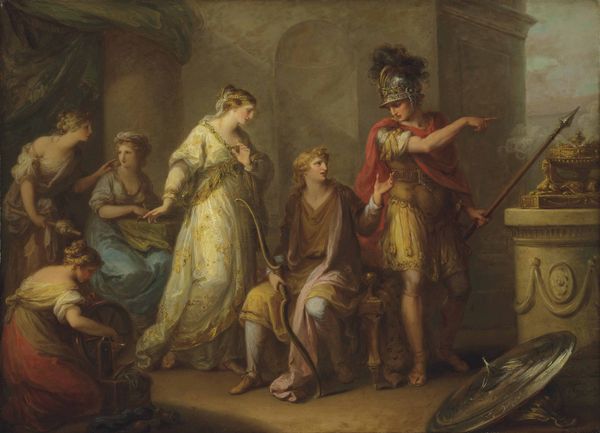
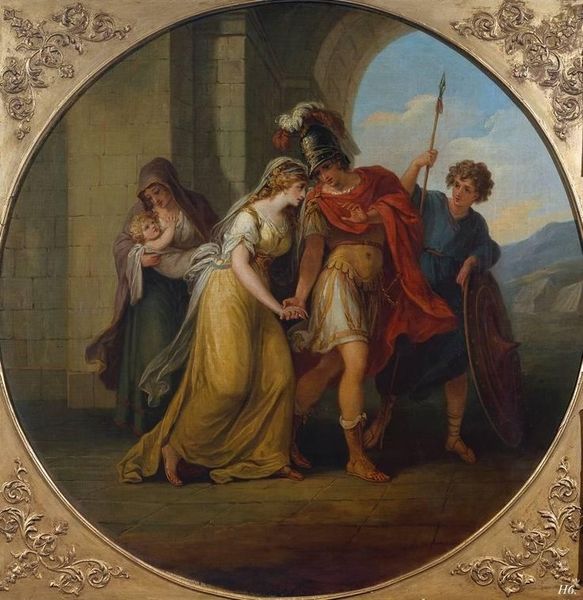
Penelope Sacrificing to Minerva for the Safe Return of Her Son, Telemachus 1774
0:00
0:00

painting, oil-paint
#
neoclacissism
#
allegory
#
narrative-art
#
painting
#
oil-paint
#
classical-realism
#
figuration
#
oil painting
#
history-painting
#
academic-art
#
portrait art
Copyright: Public domain
Angelica Kauffman painted "Penelope Sacrificing to Minerva for the Safe Return of Her Son, Telemachus" in the late 18th century, using oil on canvas. Here, the artist addresses themes of familial duty and piety within a classical framework, reflecting the Neoclassical style's revival of interest in ancient Greek and Roman culture. Kauffman, as a woman artist in a male-dominated field, often used mythological and historical subjects to comment on contemporary social structures. This piece, set against the backdrop of ancient Greece, subtly critiques the limited roles afforded to women in her own time, while also celebrating female strength and agency through Penelope's devotion. The painting's refined aesthetic aligns with the tastes of the British Royal Academy, an institution in which she was one of only two female founding members. To fully understand this work, one might explore the history of women artists within the Royal Academy, examining exhibition catalogues and critical reviews. By understanding such institutional factors, we see how Kauffman both navigated and subtly challenged the art world of her time.
Comments
No comments
Be the first to comment and join the conversation on the ultimate creative platform.
 Collect
 React
React Comment
More like this