

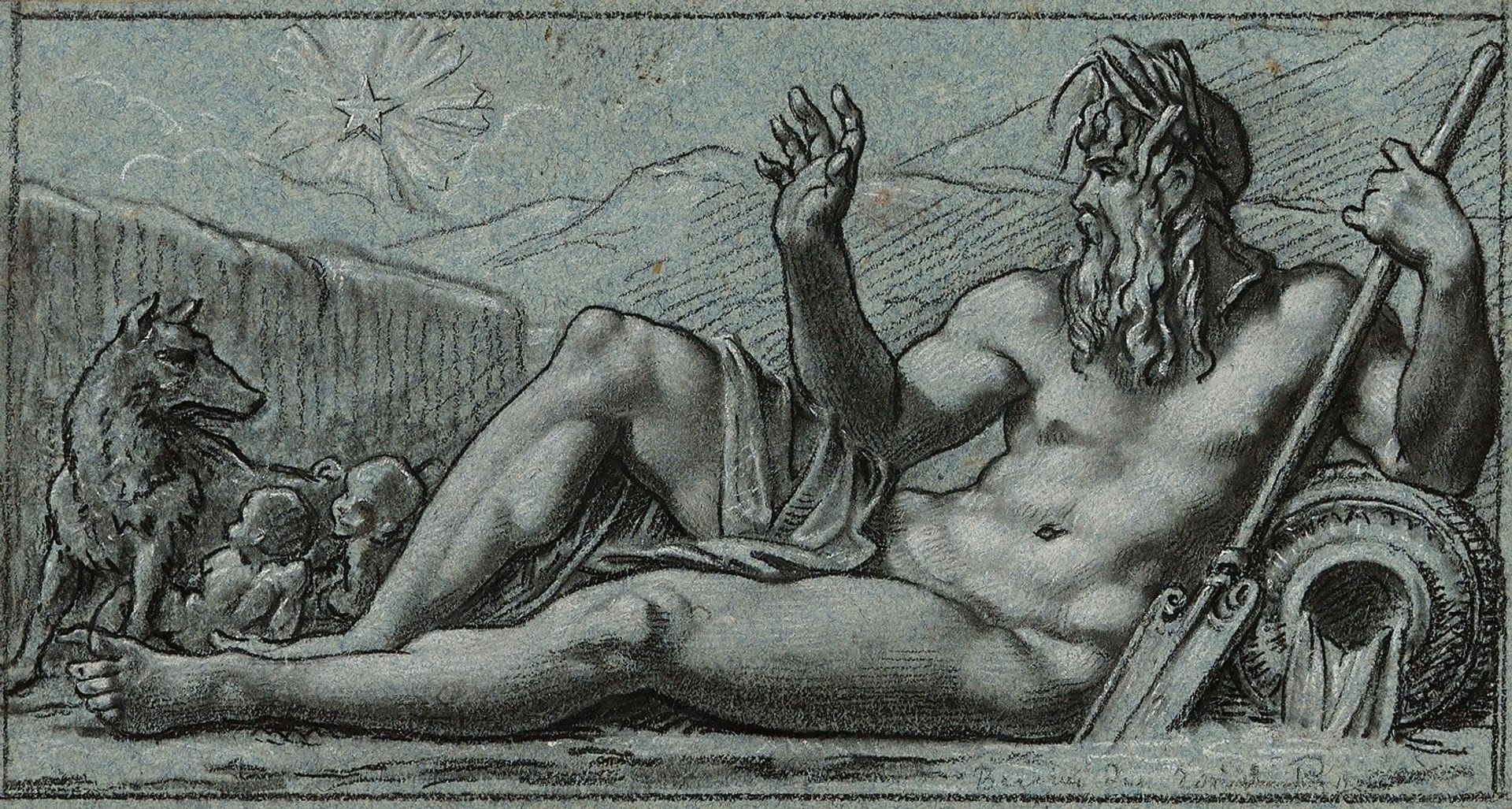
Le Tibre voit se lever l’astre naissant

Listen to curator's interpretation
Curatorial notes
Editor: This drawing is titled "Le Tibre voit se lever l’astre naissant" by Pierre-Paul Prud'hon, created using charcoal. The dramatic lighting immediately catches my eye, giving it a theatrical feel. What elements of composition or technique strike you most? Curator: Formally speaking, the dynamism inherent in the chiaroscuro is quite powerful, would you agree? Note how Prud'hon uses hatching and cross-hatching to model the figure's anatomy, thereby enhancing the play of light and shadow. It seems to me that, by strategically juxtaposing light and shadow, Prud'hon evokes a sense of both depth and emotional intensity. Do you find a similar emotional effect? Editor: Absolutely! The stark contrast definitely adds to the drama. Is it typical to see such contrast in neoclassicism? Curator: It is within the tradition of academic art of the era. Academic art placed a premium on technical virtuosity, drawing from the human form and a close observation of its anatomical structure, thus the light gives life to the bodies. See, the figure's posture directs the gaze, thereby structuring a narrative—an unveiling, if you will. Are you familiar with similar effects or contrasts in other Neoclassical drawings? Editor: I see what you mean. Now that I'm paying more attention, the lighting gives a sense of depth in an otherwise very static and centered composition. Curator: Precisely! Note the structural choices contribute significantly to this artwork. Hopefully, this gave you another viewing point to approach your own drawing projects. Editor: Definitely, thank you! Looking at how the line work and shadow can add dimension makes me want to explore charcoal even further.