About this artwork
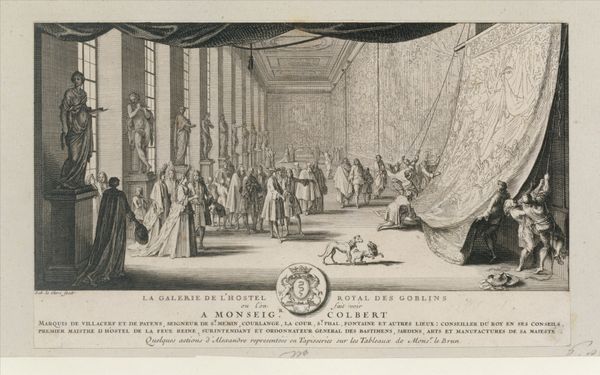
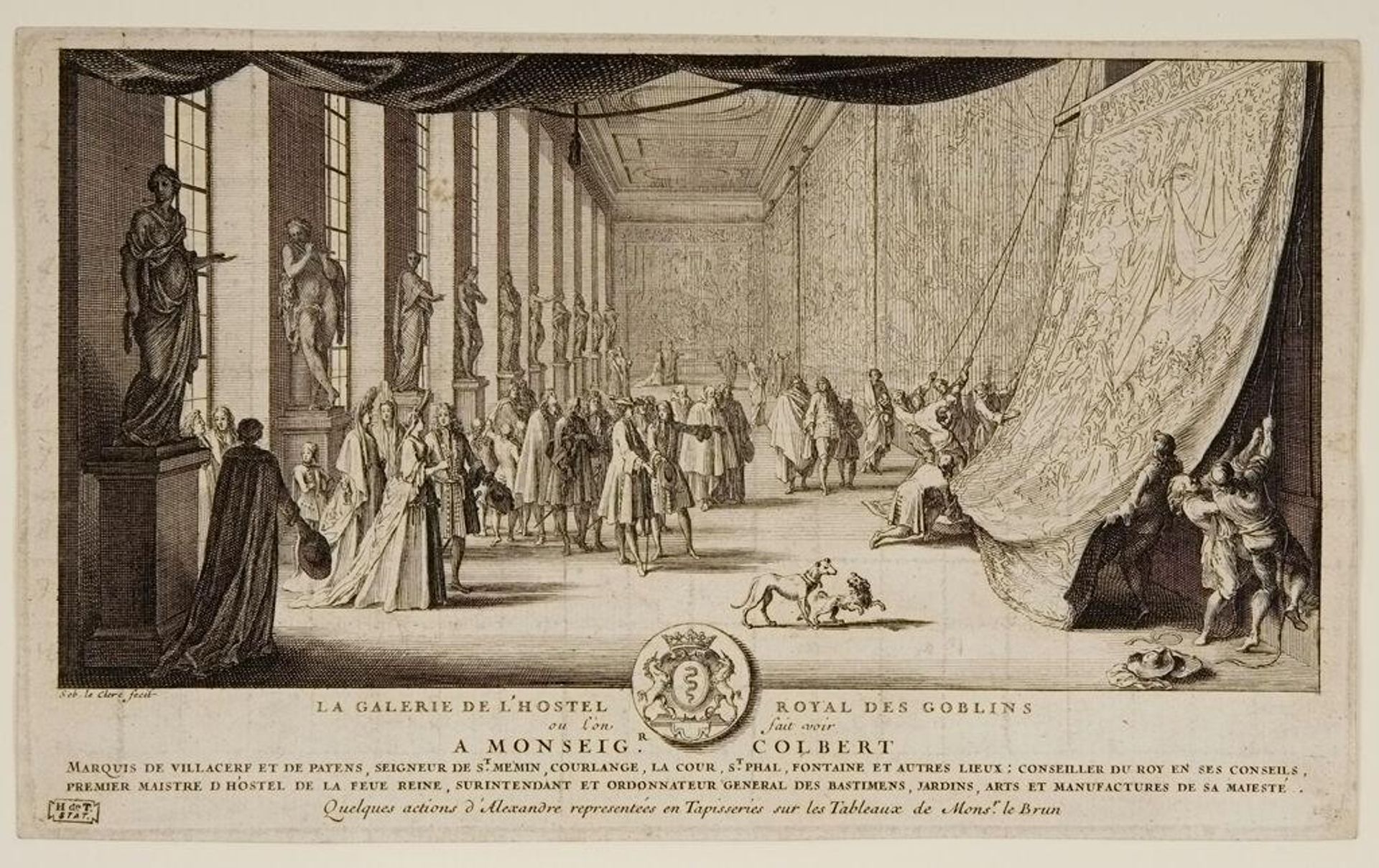
Editor: Sébastien Le Clerc's print, "The Marquis de Villacerf Viewing Tapestries at the Gobelins Factory," it’s incredibly detailed. I'm struck by how it depicts both the finished tapestries and the labor involved in their production. What do you see in this piece? Curator: I see a careful illustration of the intersection of art, labor, and social hierarchy. Note how Le Clerc positions the Marquis, an emblem of aristocratic consumption, within the physical space of production. The labor is not hidden, but displayed, almost performed for his benefit. Consider the social implications of this arrangement. Editor: So, the image highlights not just the tapestry as art, but also the conditions under which it was made? Curator: Precisely. It’s a visual record of a specific social contract, revealing the power dynamics inherent in the creation and consumption of luxury goods. Editor: That's a completely different way of viewing it; it makes me consider the roles of everyone involved, not just the artist. Curator: Exactly. By focusing on the tapestry's means of production, the artist urges us to confront the complex material and social forces that shape our understanding of art.
The Marquis de Villacerf Viewing Tapestries at the Gobelins Factory 1696


Artwork details
- Dimensions
- Image: 12.5 Ã 23.7 cm (4 15/16 Ã 9 5/16 in.) Plate: 14.6 Ã 24.6 cm (5 3/4 Ã 9 11/16 in.) Sheet: 15 Ã 25.5 cm (5 7/8 Ã 10 1/16 in.)
- Location
- Harvard Art Museums
- Copyright
- CC0 1.0
Comments
No comments
About this artwork
Editor: Sébastien Le Clerc's print, "The Marquis de Villacerf Viewing Tapestries at the Gobelins Factory," it’s incredibly detailed. I'm struck by how it depicts both the finished tapestries and the labor involved in their production. What do you see in this piece? Curator: I see a careful illustration of the intersection of art, labor, and social hierarchy. Note how Le Clerc positions the Marquis, an emblem of aristocratic consumption, within the physical space of production. The labor is not hidden, but displayed, almost performed for his benefit. Consider the social implications of this arrangement. Editor: So, the image highlights not just the tapestry as art, but also the conditions under which it was made? Curator: Precisely. It’s a visual record of a specific social contract, revealing the power dynamics inherent in the creation and consumption of luxury goods. Editor: That's a completely different way of viewing it; it makes me consider the roles of everyone involved, not just the artist. Curator: Exactly. By focusing on the tapestry's means of production, the artist urges us to confront the complex material and social forces that shape our understanding of art.
Comments
No comments