About this artwork
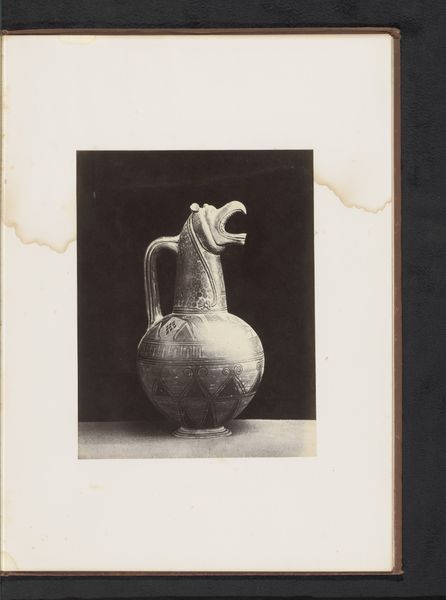
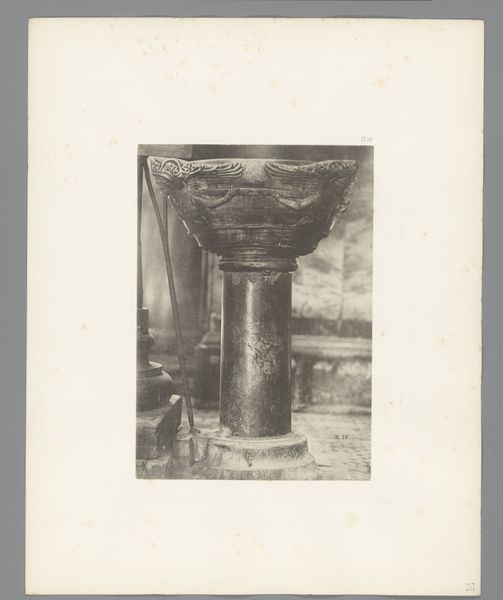
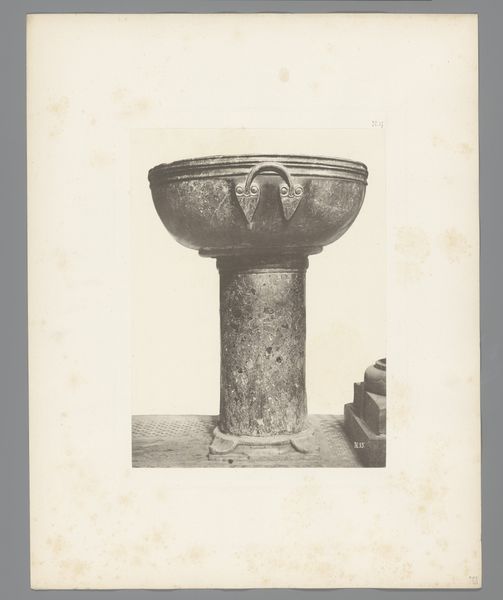
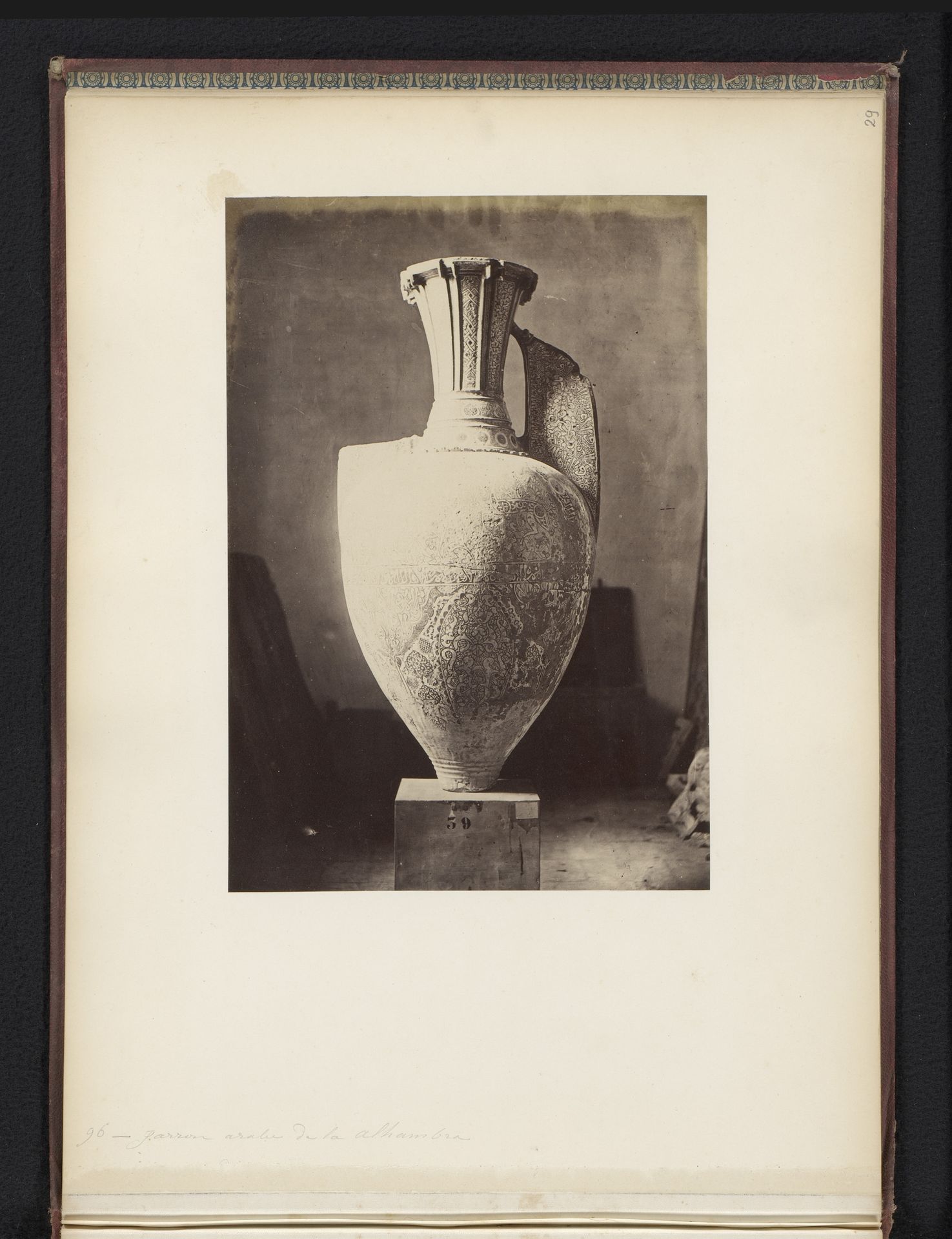
Editor: This photograph, "Arabische vaas in het Alhambra te Granada, Spanje," from 1906, captures a vase with incredible detail. It's imposing, almost like a silent witness to history. What can you tell me about it? Curator: It’s crucial to view this vase and its photographic representation within a network of power and representation. This object, carefully preserved and documented, speaks volumes about orientalism. How does the photographer, presumably European, frame and present this 'Arab' vase from the Alhambra? Editor: So, you are talking about who gets to tell which story, correct? Curator: Precisely! This image, on the surface, presents an artifact of beauty. But consider the socio-political climate of 1906. Colonialism was at its peak, and objects like these were often exoticized and used to reinforce a sense of European superiority and cultural dominance. The Alhambra itself, a monument of Moorish Spain, becomes a stage. What kind of narrative do you think is being created through the selection, framing, and subsequent display of the object? Editor: Hmmm, maybe that European cultures preserved and presented what they saw as 'important' or 'exotic' while implicitly relegating other cultures to a secondary role. It is sort of like, "We found it, we preserved it, we documented it, thus it belongs to us, to interpret and study". Is this something along the right lines? Curator: Yes, you're touching upon a key point! By framing this vase as a stand-alone object, the photographer risks isolating it from its original cultural context, transforming it into a symbol that may have been far removed from its original meaning. What do you think are the effects of this act of photographic documentation and display? Editor: I guess, by focusing on individual objects, we can easily overlook the bigger, and often more complex, histories and the messy politics behind the creation and displacement of cultural artifacts. I will never look at a photograph the same way! Curator: Exactly! And that's the first step in challenging the established narratives and creating space for more equitable perspectives in art history.

Artwork details
- Dimensions
- height 245 mm, width 182 mm
- Copyright
- Rijks Museum: Open Domain
Tags
toned paper
sculpture
vase
sculptural image
unrealistic statue
carved into stone
stoneware
carved
pencil art
watercolor
statue
Comments
Be the first to share your thoughts about this work.
About this artwork
Editor: This photograph, "Arabische vaas in het Alhambra te Granada, Spanje," from 1906, captures a vase with incredible detail. It's imposing, almost like a silent witness to history. What can you tell me about it? Curator: It’s crucial to view this vase and its photographic representation within a network of power and representation. This object, carefully preserved and documented, speaks volumes about orientalism. How does the photographer, presumably European, frame and present this 'Arab' vase from the Alhambra? Editor: So, you are talking about who gets to tell which story, correct? Curator: Precisely! This image, on the surface, presents an artifact of beauty. But consider the socio-political climate of 1906. Colonialism was at its peak, and objects like these were often exoticized and used to reinforce a sense of European superiority and cultural dominance. The Alhambra itself, a monument of Moorish Spain, becomes a stage. What kind of narrative do you think is being created through the selection, framing, and subsequent display of the object? Editor: Hmmm, maybe that European cultures preserved and presented what they saw as 'important' or 'exotic' while implicitly relegating other cultures to a secondary role. It is sort of like, "We found it, we preserved it, we documented it, thus it belongs to us, to interpret and study". Is this something along the right lines? Curator: Yes, you're touching upon a key point! By framing this vase as a stand-alone object, the photographer risks isolating it from its original cultural context, transforming it into a symbol that may have been far removed from its original meaning. What do you think are the effects of this act of photographic documentation and display? Editor: I guess, by focusing on individual objects, we can easily overlook the bigger, and often more complex, histories and the messy politics behind the creation and displacement of cultural artifacts. I will never look at a photograph the same way! Curator: Exactly! And that's the first step in challenging the established narratives and creating space for more equitable perspectives in art history.
Comments
Be the first to share your thoughts about this work.