c. 1941
Stern Board


Listen to curator's interpretation
Curatorial notes
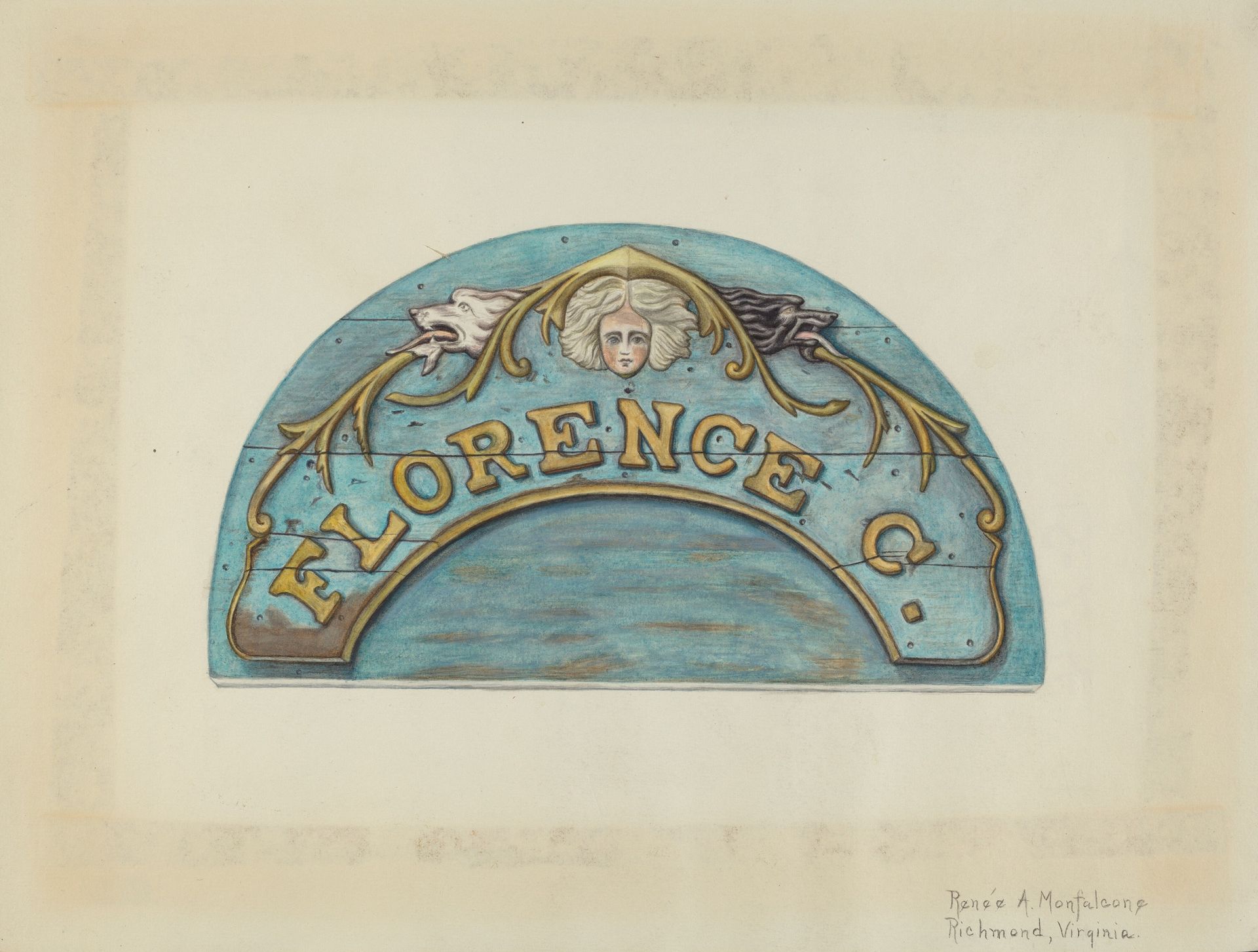
Curator: Looking at "Stern Board," circa 1941, a work rendered in watercolour, colored pencil and ink by Renee A. Monfalcone, I’m immediately struck by its whimsical, almost dreamlike quality. Editor: Yes, it presents an inviting color palette; the combination of the pastel blues with the gold lettering is delightful, and those graphic embellishments! They're just, ever so slightly unsettling in their symmetry, aren't they? Curator: The symmetry and imagery is intriguing. Knowing that Monfalcone was working in Richmond, Virginia, during a time of considerable social and political upheaval, it makes you think about the significance behind choices of materials and her utilization of traditional illustration styles. Was it perhaps a means of escape or perhaps some quiet commentary during turbulent times? Editor: Escape perhaps through construction: let’s observe how she has constructed depth with layered color. See the washes bleeding softly on that treated paper surface? It brings so much tactile texture. A paper that has been treated and aged allows the watercolor bleed, it gives it dimension but the bleed also makes me think it might speak of imperfections, almost like a sign of time. Curator: That’s a great point! We can view the aged paper as a symbol of time passing, especially significant given the social climate of the era. And what about the "Florence" inscription? Given Monfalcone’s lived experiences, perhaps the name suggests an appreciation of Italian Renaissance ideals and high culture against the realities of contemporary societal shifts? Editor: Ah, and notice the strategic positioning of "Florence." Arched perfectly as a decorative sign with angel-like figures to keep a sense of innocence within the frame. All of those gilded lettering that really comes to life against the subtle background creates visual harmony overall! The arrangement speaks so precisely about the artwork's inherent composition, its underlying structure. Curator: It certainly prompts fascinating connections. And thinking about the means of artistic creation here helps to place it into its time. Monfalcone, like many women artists of her time, may not have had the resources or access to high-art training. Perhaps such beautiful smaller-scale artwork enabled her creativity and provided artistic production opportunities within those circumstances? Editor: Indeed. After taking in that gentle scene and knowing a bit more, one cannot help but perceive it as so serene but full of untold personal thoughts that is just fascinating to decipher visually! Curator: And perhaps that is the enduring legacy that Monfalcone imparts to us, today: how we use material to construct both reality and that desired escapism, when existence warrants this the most.