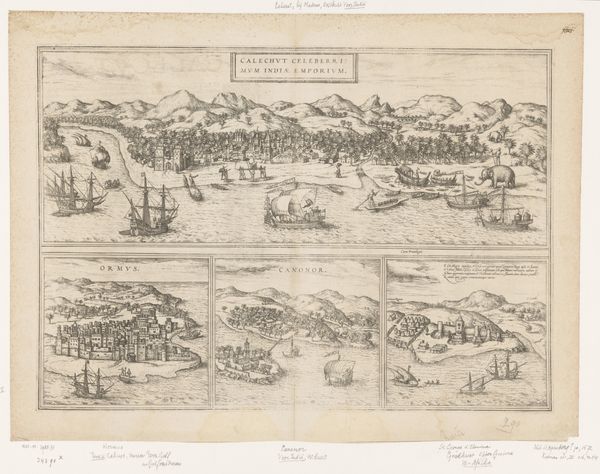
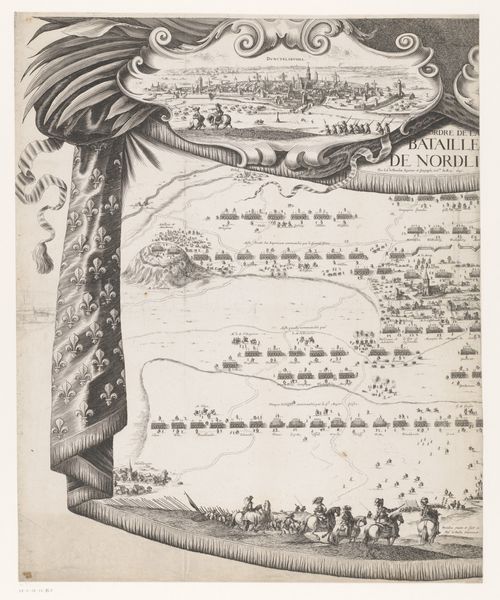
print, engraving
#
baroque
# print
#
landscape
#
cityscape
#
engraving
Dimensions: 190 mm (height) x 316 mm (width) (bladmaal)
Curator: Right now, we're looking at a work entitled "Fugleperspektiv af Trankebar" which roughly translates to "Bird's-eye view of Tharangambadi." This print, likely an engraving, comes to us from the period of 1700 to 1724 and gives us a fascinating glimpse into the Danish colony of Trankebar in India. Editor: The first thing that strikes me is its...almost playful composition? It's like a child's drawing, yet rendered with such incredible detail. A dreamlike cartography of longing, perhaps? It really pulls you in! Curator: Exactly! The print style invites this playful approach, but we must remember the heavy historical baggage carried here. It's crucial to recognize how these bird's-eye views played a key role in colonial power dynamics, shaping perceptions of distant lands and legitimizing imperial projects. How do you view the depiction of the local people? Editor: That insert showing the indigenous population is so typical of the time, isn't it? Almost like specimens pinned in a collector's cabinet. There's a distance, an...othering, that you can practically taste. Still, I feel a strange tension here; the artist does afford the population dignity of portraiture, which I do believe speaks to more layered approaches to the people, even within its historical context. Curator: It is important to recognize those complexities in what appears to be a deceptively simple picture! That panel attempts to document and define. The Danish colonizers were trying to impose a very specific narrative, both about the geography and its people. The city is perfectly grid-like to project that feeling of being highly ordered. The chaos of actual living is absent, it does create a perfect sense of cultural domination through image making. Editor: So true. Thinking about it all now I’m starting to feel a profound discomfort. The beauty, I think, comes from technical skill alone; the content carries an oppressive weight. How clever of the image makers of empire to make this appealing and not at all terrifying and offensive at first glance. Curator: Absolutely. It's a chilling reminder of how art can both reflect and reinforce unequal power structures. A valuable reminder for us here in the museum space as well. Editor: Indeed. And maybe that's why it lingers in the mind, scratching away at the veneer of beauty to reveal the complicated truths beneath.
Comments
No comments
Be the first to comment and join the conversation on the ultimate creative platform.
 Collect
 React
React Comment
More like this