About this artwork
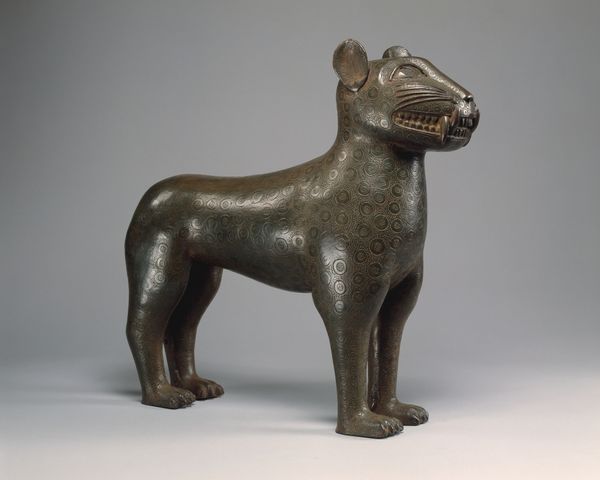
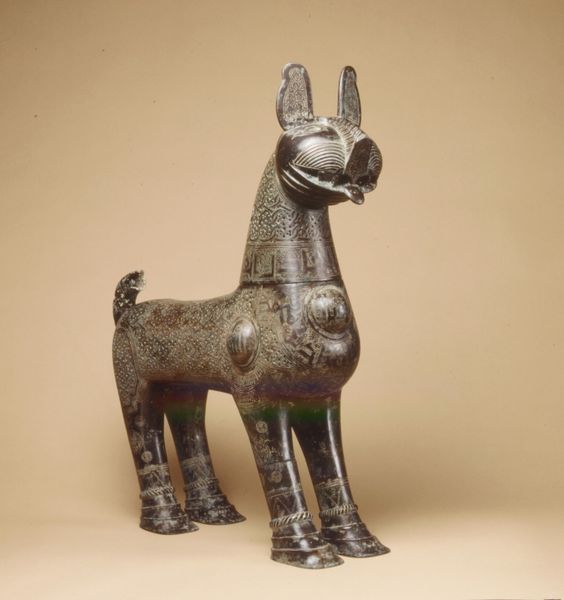
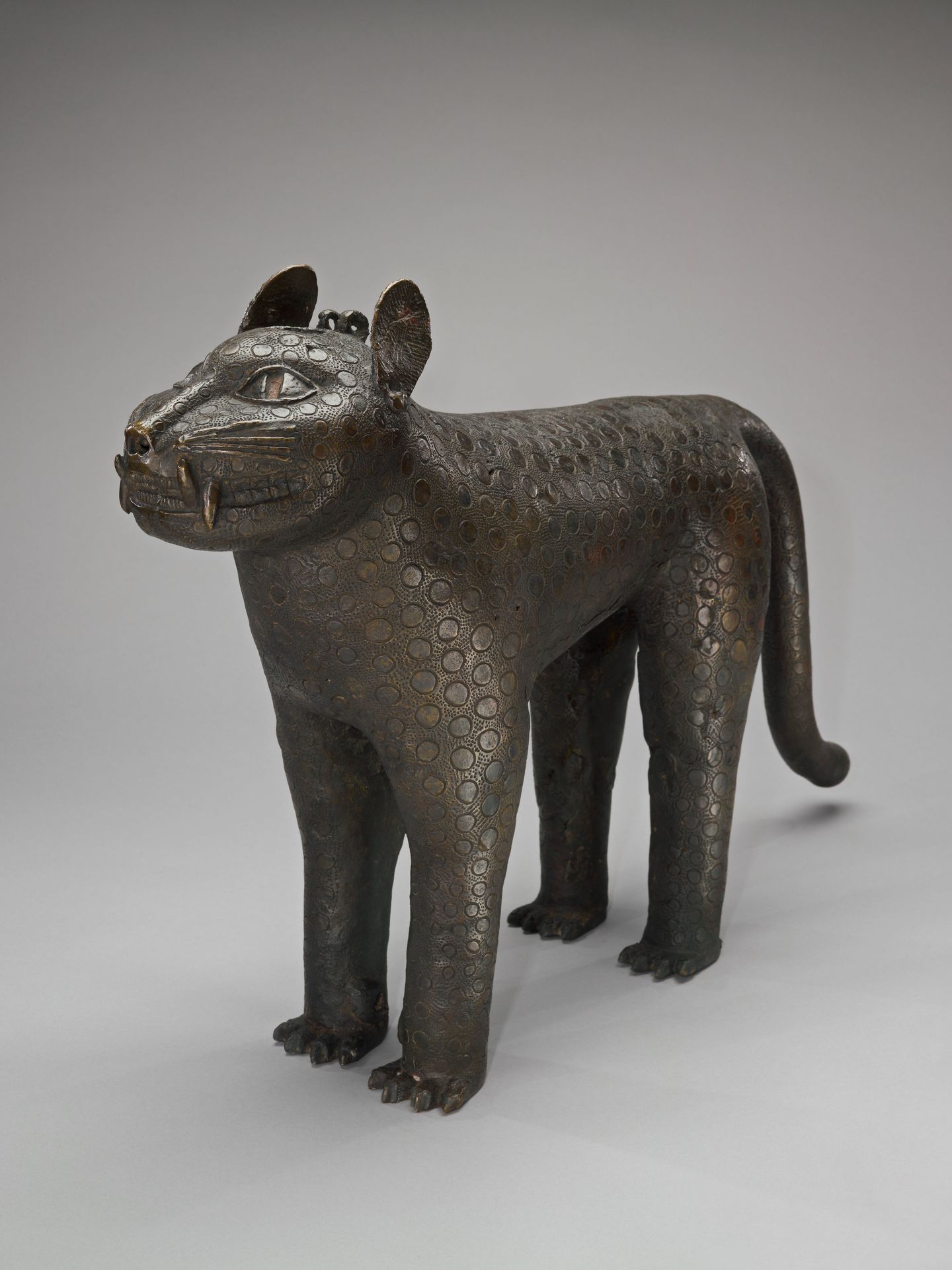
Editor: Standing before us is an 18th-century bronze sculpture from the Edo peoples, called "Water pitcher," currently housed at the Minneapolis Institute of Art. The texture is really fascinating. What stands out to you most when you examine its form? Curator: Immediately, I’m struck by the almost mathematical precision of the incised circles covering the surface, a clear deployment of visual rhythm. They provide an intricate counterpoint to the sculpture's relatively simple, quadrupedal form, thus drawing the viewer into a close inspection of the work's material surface and conceptual structuring. Notice, too, the angularity in the legs. Editor: So the artist is contrasting curved surfaces with hard angles? Curator: Precisely. And observe the tail – a smooth, pendulous curve almost comically opposing the taut uprightness of the body. The very materiality of the bronze also carries significant weight. Consider how the manipulation of this substance, through the processes of casting and incising, contributes to its overall aesthetic impact. How does the medium affect your viewing experience? Editor: It definitely emphasizes the age and craftsmanship. The darkness of the bronze makes the circular patterns more striking, more visually engaging, because they contrast more. It’s also interesting that the surface is patinated but smooth overall, drawing focus to these circular decorations, like spots, on its skin. Curator: A fascinating observation. This juxtaposition emphasizes that what truly animates this piece is how shape and form interplay. These create the essence of artistic expression here, in this artifact. Editor: Thank you! I am noticing those contrasts and repetitions far more now, helping to inform my understanding of Edo bronze work and artistry.
Water pitcher c. 18th century


Artwork details
- Medium
- bronze, sculpture
- Dimensions
- 17 x 26 in. (43.18 x 66.04 cm)
- Location
- Minneapolis Institute of Art
- Copyright
- Public Domain
Tags
bronze
sculpture
Comments

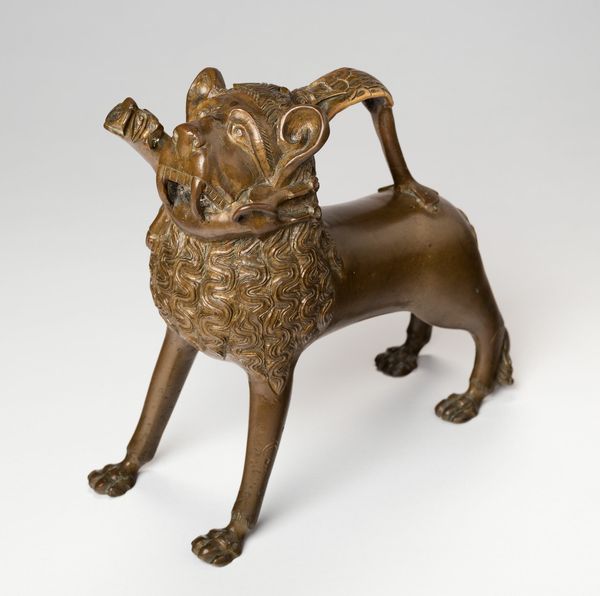
This specially shaped vessel, called an aquamanile (from the Latin for “water” and “hand”), was used by kings, or obas, of the Benin Kingdom during hand-washing ceremonies. It was filled at the top of the head, its tail acted as a handle, and water was poured from its two nostrils. The leopard was an important symbol of the oba, embodying ferocity, intelligence, agility, and speed. The balanced posture indicates strength, while the perked ears and bared fangs show awareness and aggression—traits the king was expected to have. Animal-shaped aquamaniles were introduced between 900 and 1200 from the Islamic world to Europe, and brought to the Benin peoples by Portuguese traders who came by sea. In Benin belief, the mid-fifteenth-century king Ewuare the Great is credited with gathering aquamanile vessels from the underwater palace of Olokun, the god of the sea.
About this artwork
Editor: Standing before us is an 18th-century bronze sculpture from the Edo peoples, called "Water pitcher," currently housed at the Minneapolis Institute of Art. The texture is really fascinating. What stands out to you most when you examine its form? Curator: Immediately, I’m struck by the almost mathematical precision of the incised circles covering the surface, a clear deployment of visual rhythm. They provide an intricate counterpoint to the sculpture's relatively simple, quadrupedal form, thus drawing the viewer into a close inspection of the work's material surface and conceptual structuring. Notice, too, the angularity in the legs. Editor: So the artist is contrasting curved surfaces with hard angles? Curator: Precisely. And observe the tail – a smooth, pendulous curve almost comically opposing the taut uprightness of the body. The very materiality of the bronze also carries significant weight. Consider how the manipulation of this substance, through the processes of casting and incising, contributes to its overall aesthetic impact. How does the medium affect your viewing experience? Editor: It definitely emphasizes the age and craftsmanship. The darkness of the bronze makes the circular patterns more striking, more visually engaging, because they contrast more. It’s also interesting that the surface is patinated but smooth overall, drawing focus to these circular decorations, like spots, on its skin. Curator: A fascinating observation. This juxtaposition emphasizes that what truly animates this piece is how shape and form interplay. These create the essence of artistic expression here, in this artifact. Editor: Thank you! I am noticing those contrasts and repetitions far more now, helping to inform my understanding of Edo bronze work and artistry.
Comments
This specially shaped vessel, called an aquamanile (from the Latin for “water” and “hand”), was used by kings, or obas, of the Benin Kingdom during hand-washing ceremonies. It was filled at the top of the head, its tail acted as a handle, and water was poured from its two nostrils. The leopard was an important symbol of the oba, embodying ferocity, intelligence, agility, and speed. The balanced posture indicates strength, while the perked ears and bared fangs show awareness and aggression—traits the king was expected to have. Animal-shaped aquamaniles were introduced between 900 and 1200 from the Islamic world to Europe, and brought to the Benin peoples by Portuguese traders who came by sea. In Benin belief, the mid-fifteenth-century king Ewuare the Great is credited with gathering aquamanile vessels from the underwater palace of Olokun, the god of the sea.