1808
Playing with Money

Bartolomeo Pinelli
1781 - 1835
Cooper Hewitt, Smithsonian Design Museum
Cooper Hewitt (Smithsonian Design) Museum, New York City, NY, USListen to curator's interpretation
Curatorial notes
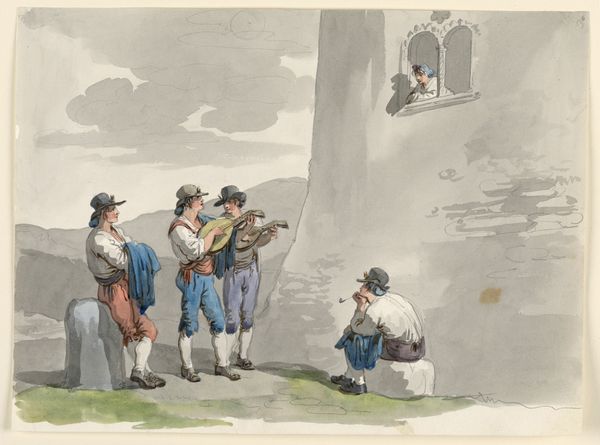
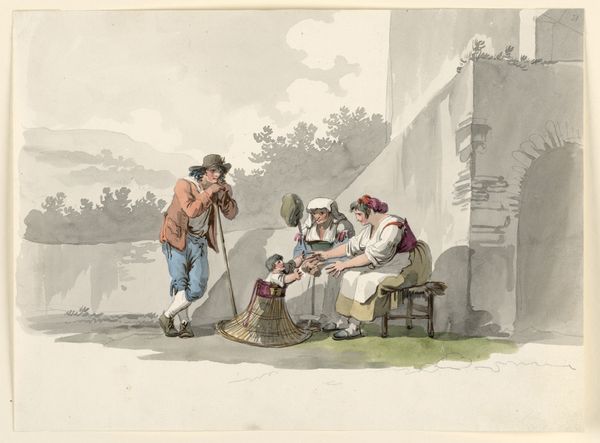
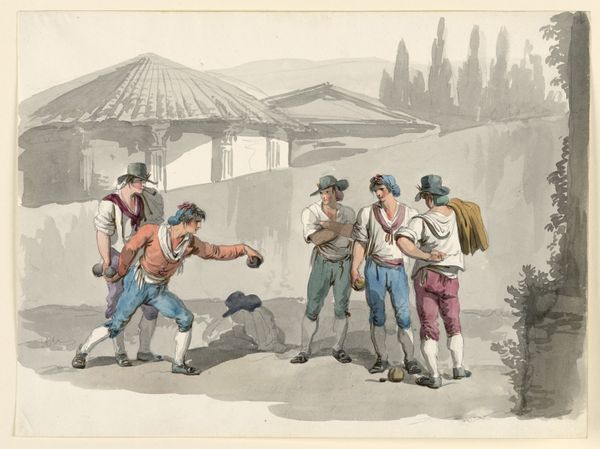
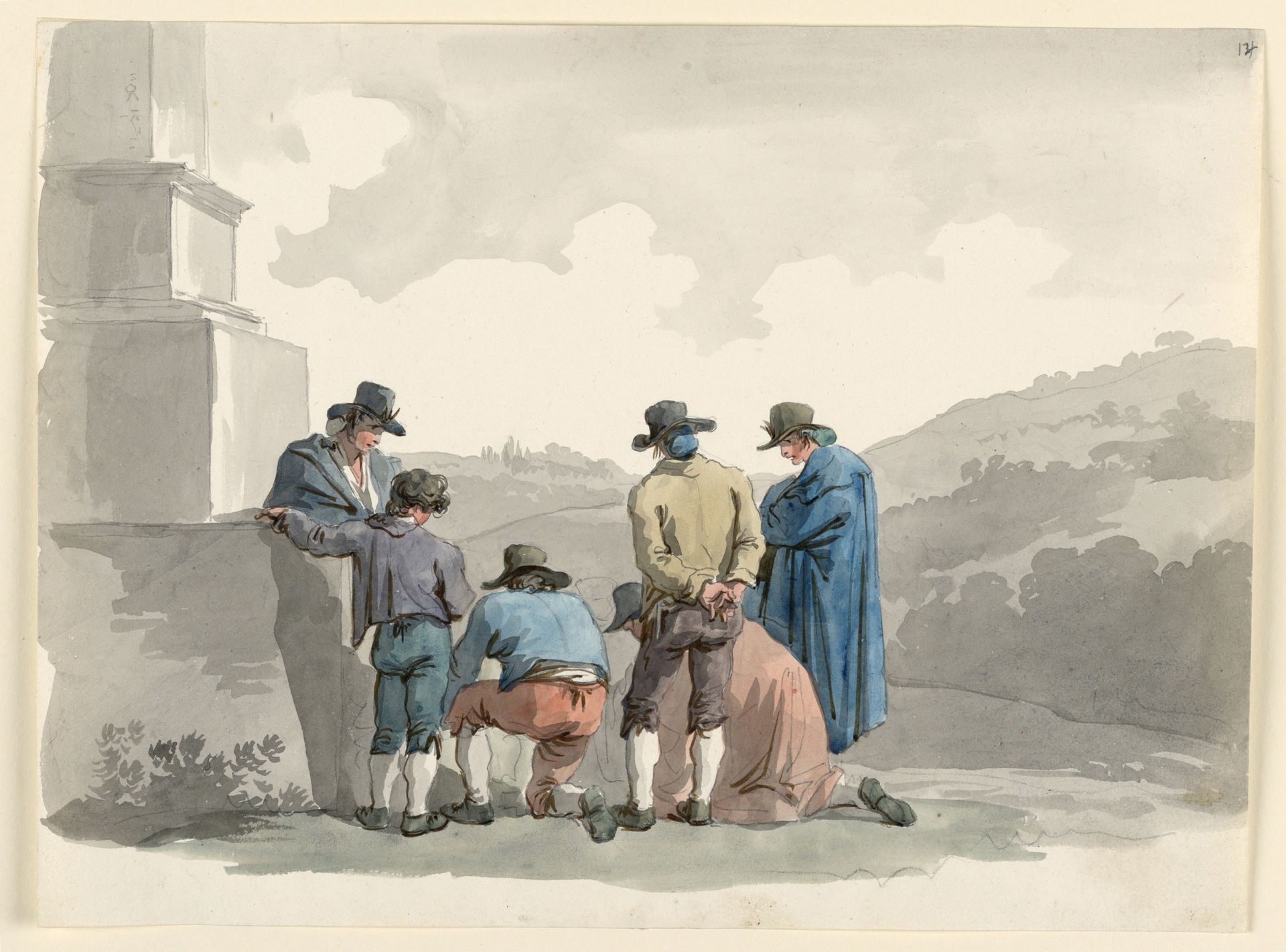
Curator: This delightful scene before us is "Playing with Money," created in 1808 by Bartolomeo Pinelli. It's a watercolor and ink drawing, full of Roman Romantic charm. What's your first impression? Editor: Bleak! Something about the pale watercolors makes it feel like these fellas are up to no good. Are they gambling near a pauper’s grave? Curator: Well, Pinelli was known for capturing everyday Roman life with a bit of caricature, so let’s not jump to conclusions of despair just yet! The subject's most immediate resource seems to be money: it's right there in the title, "Playing with Money". Perhaps the setting and atmosphere carry commentary of their own. Editor: You say ‘everyday life’—I say it depends who’s doing the ‘everyday’ bit! These are probably laborers, reduced to making sport with scraps. Curator: I see your point. Looking closer, I notice how the ink lines define their postures: bowed, hunched… and they seem fenced-in, penned in by that architectural structure. There is very little sky. Do you think he's making a social critique here? Highlighting their limited circumstances through composition and the… grimy watercolor wash? Editor: Absolutely. Romanticism wasn’t always about pretty sunsets and lovesick shepherds, was it? This reveals the nitty-gritty material conditions. Pinelli probably saw, perhaps even lived, a version of this himself. Look at their worn hats, and imagine what material determined its making – was it felt, straw, what condition were they in. Every mark is a clue! Curator: It is evocative. It makes me ponder how "play" can mean something very different depending on who is doing the playing, and with what stakes at risk. A gamble may simply be leisure, or one's only chance at survival! Editor: Right, like flipping a coin with your last few euros. Curator: Indeed. It certainly casts a different light on the phrase "playing with money". Thank you for pointing that out. I’ll never see the painting the same way again! Editor: Good! Because if we really look at what’s being shown here, who it depicts, and how these figures relate to their place and time, that transforms art!