

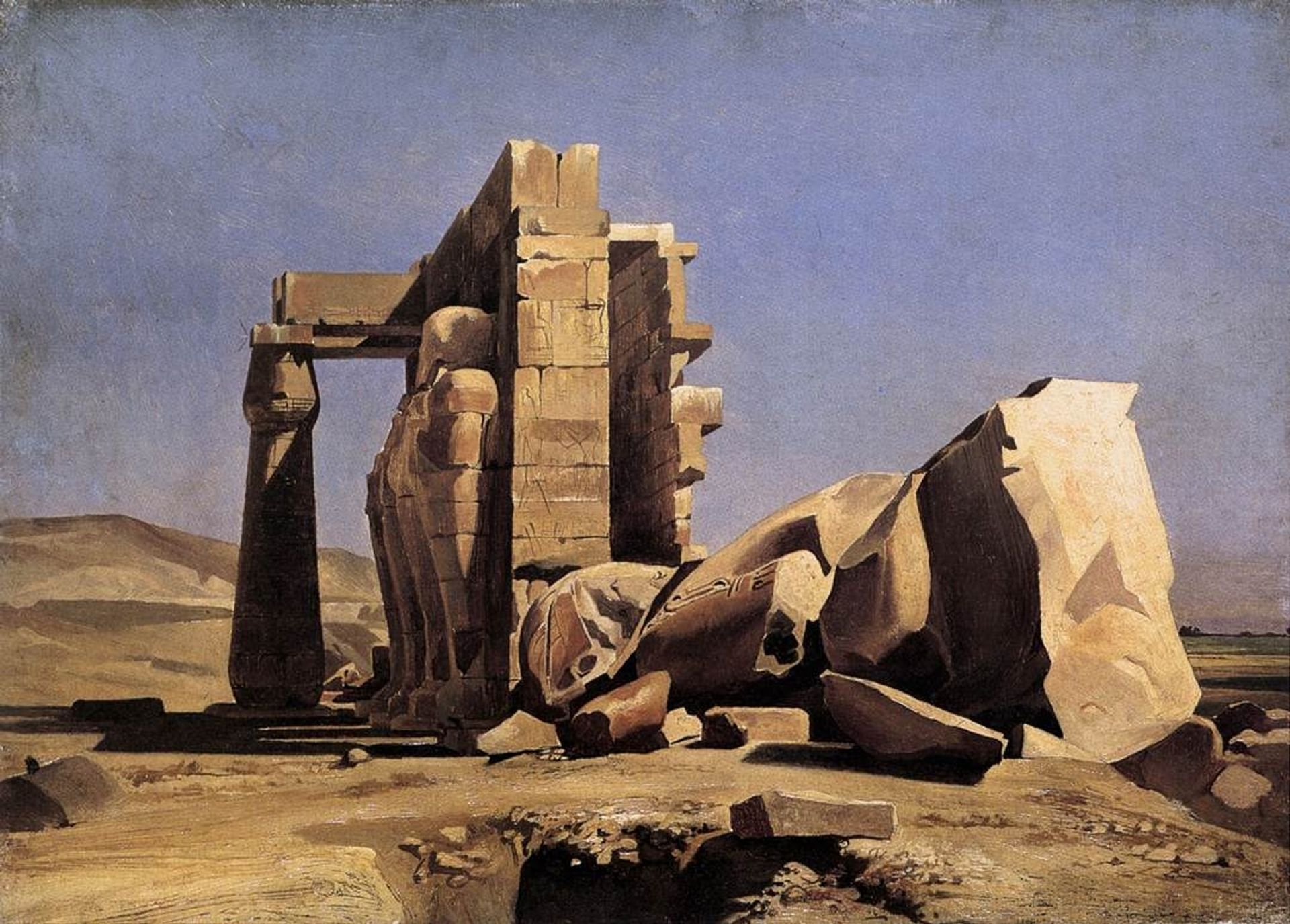
1840
Egyptian Temple

Charles Gleyre
1806 - 1874Location
Musée Cantonal des Beaux-Arts, Lausanne, SwitzerlandListen to curator's interpretation
Curatorial notes
Editor: So, here we have Charles Gleyre's "Egyptian Temple," painted around 1840. It’s an oil painting, and it really strikes me with a sense of... well, melancholy. Everything's so ruined, monumental but broken. What do you see when you look at this painting? Curator: Oh, absolutely, melancholy's a great word for it. For me, it's about time, and the sheer weight of history, you know? Gleyre wasn't just painting a ruin; he was painting an idea of a lost civilization, a culture so grand that even its remains dwarf us. Do you notice how he uses light, almost reverentially, on the fallen blocks? It’s like the sun itself is mourning. It reminds me a bit of Piranesi, in a way, this romantic obsession with crumbling empires. Editor: Yes! The light is gorgeous – it definitely elevates the ruin beyond just, well, rubble. But do you think it romanticizes too much? Does it lose some of the reality of whatever this place actually *was*? Curator: Perhaps. But isn't that the nature of memory? We never truly capture the past, only our impression of it. Gleyre wasn’t trying to give us a documentary. He’s offering a feeling, a meditation on the transient nature of power and beauty, wouldn't you say? Editor: I guess so. It makes me think about what we’re building *now* – what will people make of *our* ruins in a thousand years? Curator: Exactly! And that’s where the painting transcends just being a pretty picture of some old rocks. It forces us to confront our own mortality, and the legacy we'll leave behind, intentionally or otherwise. Powerful stuff. Editor: Definitely given me something to think about. Thanks for that perspective. Curator: My pleasure. It’s fascinating how a few brushstrokes can unlock a whole universe of thoughts, isn’t it?